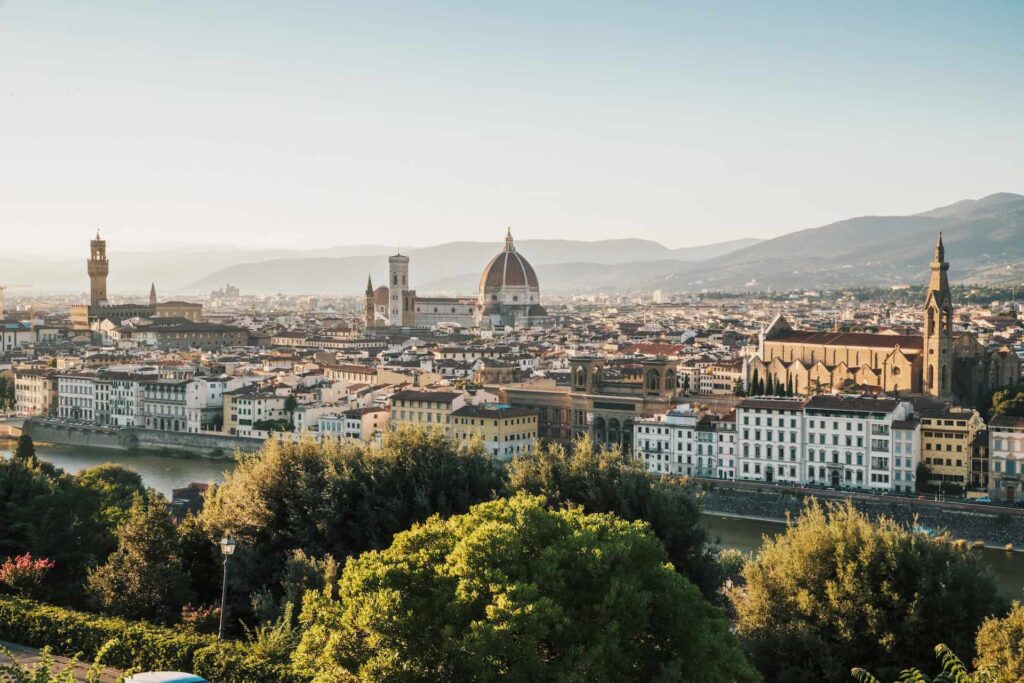


If you cross Ponte Vecchio and look up at the goldsmiths’ shops, on one side you see a row of small, regular windows, with three larger openings in the center overlooking the Arno. That row of windows is part of a long covered passageway that starts from the Uffizi, crosses the river, and reaches all the way to Pitti Palace.
It’s the Vasari Corridor, an elevated walkway of about 750 meters that the Medici family had built in the 16th century to go from their home to the government building without ever having to go down to the street. You may also find it called Galleria Vasariana or Corridoio del Vasari, from the name of the architect who designed it, Giorgio Vasari.
For centuries it was one of the most exclusive places in Florence, reserved first for the court and then for small groups of visitors. In 2016 it was closed for renovations and reopened to the public on December 21, 2024, after eight years, with a renewed route that is also accessible to those with walking difficulties.
Since it reopened, it’s one of the things I’ve been asked about the most, both by those who want to book a visit and by those who spotted it from Ponte Vecchio and wonder what’s up there. I’ll tell you why it was built, what route it takes above the city, the stories of the families and the church you pass along the way, and how to visit it today!
Cosimo I wanted it for his son’s wedding and for his safety
In 1565 Florence was preparing a huge celebration. Francis, son of Duke Cosimo I de’ Medici, was about to marry Joanna of Austria, sister of Emperor Maximilian II, and the city had to make a good impression on the guests who had come with the bride. Among triumphal arches and ephemeral decorations, Cosimo also commissioned Giorgio Vasari to create a unique work: a covered passageway that connected the family’s buildings.
Vasari was the Duke’s trusted architect. A few years earlier he had begun building the Uffizi, the building next to Palazzo Vecchio that was intended to house the offices of the Florentine magistrates, hence its name. The corridor was built in a few months, an almost incredible speed for the building sites of the time.
But behind the wedding there was a much more concrete reason. The family was moving to Pitti Palace, on the other bank of the Arno, which Cosimo’s wife, Eleonora di Toledo, had purchased in 1549. The government, however, remained in Palazzo Vecchio, and the duke had to cross the center every time he went from one to the other.
The Medici had been dukes for a short time, since 1537, when Cosimo had risen to power after the assassination of Duke Alessandro. In the city there were still those who missed the Republic. With the corridor, Cosimo could go from home to the government building without ever mingling with the crowd, safe from attacks, watching the city from above without being seen. The Medici knew well that conspiracies were a real danger, as I tell you in the post on the Pazzi conspiracy.
Vasari was inspired by a model he knew, the Passetto di Borgo in Rome, the walkway above the walls that connected the Vatican to Castel Sant’Angelo and which the popes used as an escape route. In Florence, the idea took a different form, because the corridor enters the palaces and passes over the Arno right on Ponte Vecchio. How the Medici built their power in the city is the thread I follow throughout the tour of Medici Florence, and you can also find it described in the history of the Medici family.
The route goes from the Uffizi to the Boboli Gardens
The passage starts in Palazzo Vecchio, from which a covered overpass crosses Via della Ninna and enters the Uffizi. From there, it runs to the top floor of Vasari’s building, along the corridors you walk through today during your visit to the gallery. The Vasari Corridor tour begins further ahead, on the first floor of the Uffizi, where the passageway descends toward the river.
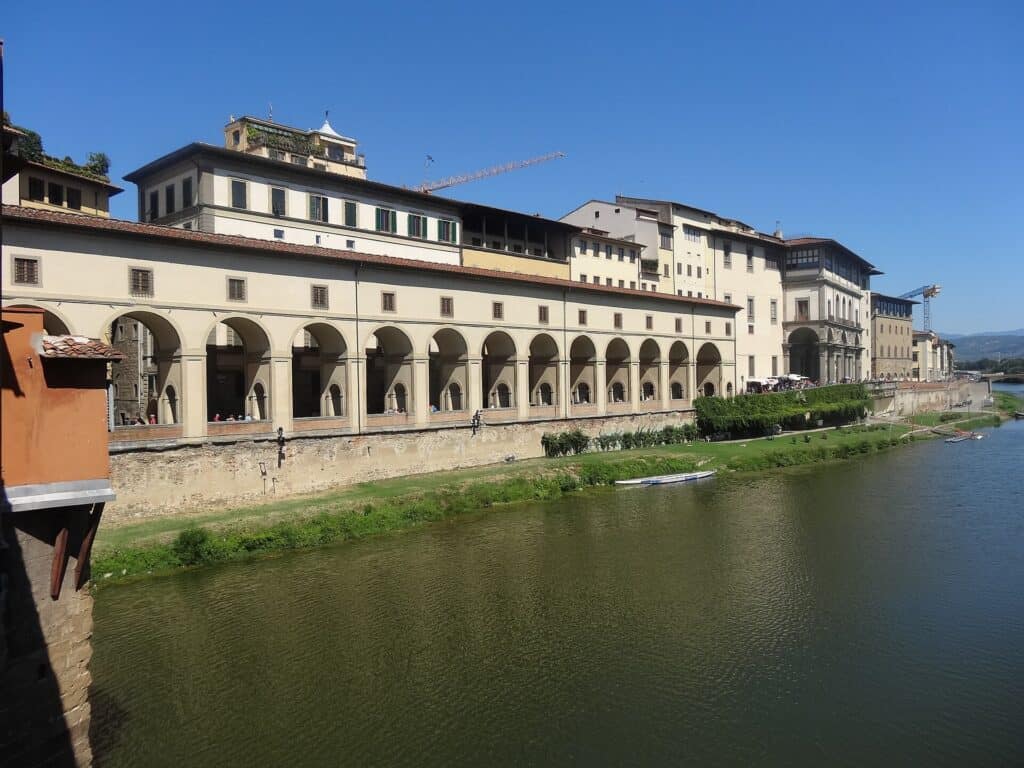
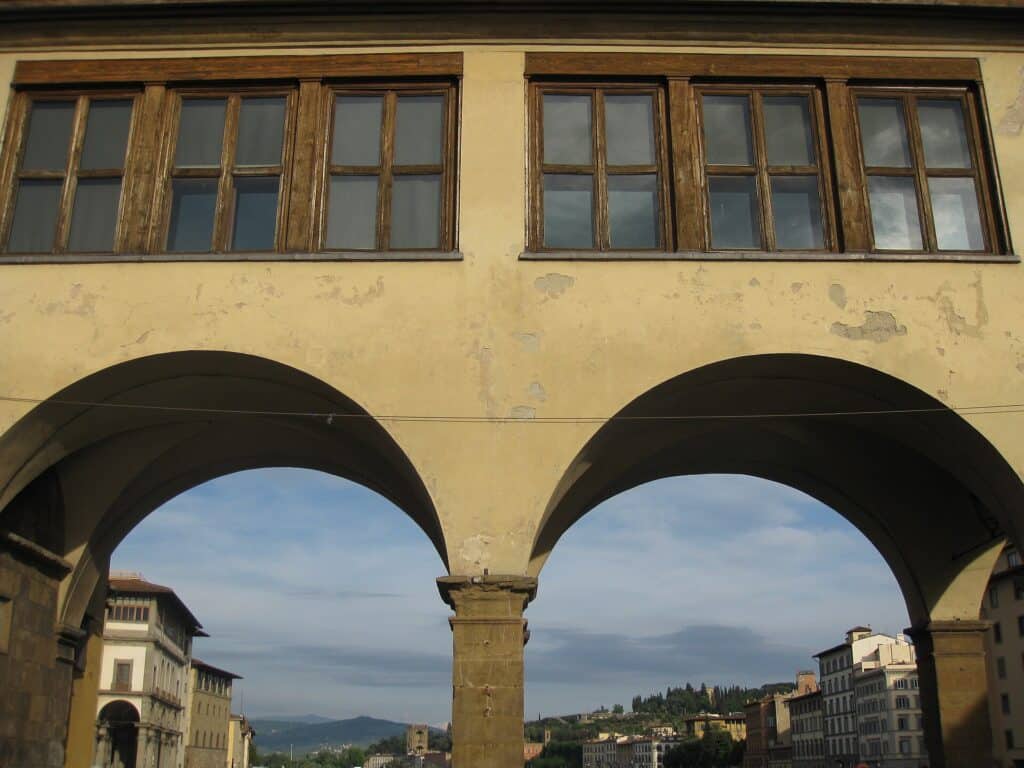
Leaving the Uffizi, the corridor rests on a row of arches along the Lungarno degli Archibusieri and follows the Arno to the bridge. If you walk along the Lungarno between the Uffizi and Ponte Vecchio, you have it above your head the entire stretch: those arches that look like a simple portico support the private road of the Grand Dukes.
Then it climbs onto Ponte Vecchio and crosses it above the shops on the upstream side, with the small windows you can see from the bridge. Arriving on the other bank, it meets its first obstacle, the Torre dei Mannelli, and goes around it. Immediately afterward, it crosses Via de’ Bardi, passes over the portico of the church of Santa Felicita, and runs behind the houses on Via Guicciardini.
The last stretch enters the Boboli Gardens and arrives near the Grotta del Buontalenti, named after the same architect to whom Florence dedicated an ice cream flavor, as I told in the post on the history of Buontalenti ice cream. From here the Grand Dukes entered Pitti Palace directly.
The lengths you find around range from about 750 meters to about a kilometer, depending on where the count begins and whether the section inside the Uffizi is included. It’s a beautiful walk, entirely indoors, with views of the Arno that cannot be seen from the street.
The Mannellis did not want to give up their tower
At the end of Ponte Vecchio, on the Oltrarno bank, there is a medieval stone tower that seems to have been placed there on purpose to block the passage. It is the Mannelli Tower, one of the towers that controlled access to the bridge in the Middle Ages and that in the sixteenth century still belonged to the family that gives it its name.
Vasari’s plan was to go through it, but the Mannellis firmly opposed it and refused to give it up or allow it to be demolished. Cosimo decided not to force their hand, and Vasari had to make the corridor go around the tower, holding it up with large stone corbels. It is the point where the path makes its strangest curve, and from where you can see Ponte Vecchio very well.
According to a Florentine tradition, the duke settled the matter with the phrase, “Everyone is master in their own house.” There are no documents to confirm this, but the tower is still there, with the corridor running around it. Unlike the Bischeri, whom I mentioned in the post on the Florentine bischero, this time the family that said no prevailed!
In Santa Felicita the Grand Dukes listened to mass from a balcony
Shortly after the tower, the corridor reaches Piazza Santa Felicita and passes above the church’s portico, partially hiding its facade. Santa Felicita is one of the oldest churches in Florence. Its origins date back to the first centuries of Christianity, when there was a Christian cemetery in this area, commemorated by the granite column you still see in the middle of the square.
Inside the church, high above the entrance, the corridor overlooks the nave with a balcony closed by a grate. From here, the grand ducal family could follow Mass without going down among the faithful and without being seen. When you enter, turn toward the door and look up: you’ll recognize it by the grate that encloses it.
While you’re there, stop at the first chapel on the right, the Capponi Chapel. It houses Pontormo’s Deposition, painted in the 1520s, with its unusual pink and blue colors. It is one of the masterpieces of Florentine Mannerism.
On Ponte Vecchio the goldsmiths took the place of the butchers
When the corridor was built, the shops on Ponte Vecchio were occupied mainly by butchers, fishmongers, and tanners, who used the Arno to dispose of their waste. For a duke passing over it, the smell was certainly not welcome.
At the end of the sixteenth century Grand Duke Ferdinand I, son of Cosimo, drove the butchers off the bridge and reserved it for goldsmiths and jewelers. Since then, Ponte Vecchio has been the golden bridge of Florence, and the shops you see today are the heirs of that decision.
I talked about the shops, the bust of Benvenuto Cellini and other curiosities of the bridge in the post Ponte Vecchio: history, curiosities, and legends. Here you just need to know that, every time you look at the shop windows, you have above your head the reason why they are there.
Hitler’s window is a legend
At the center of the bridge, the corridor opens onto the Arno with three windows much larger than the others. Among the stories you’ll hear in Florence is this one: Mussolini had them opened in May 1938, for Adolf Hitler’s visit, so that his guest could admire the view from the corridor.
The documented history is different. The central opening had existed since 1860, when it served as access to a temporary terrace, and the side ones were closed and reopened at different times. In 1938 the regime merely redid the plaster. Hitler did indeed come to Florence, but the windows were not opened for him.
Six years later, in August 1944, the retreating Germans blew up all the bridges in Florence except Ponte Vecchio and, to block access to it, destroyed the houses at both ends. The corridor was also damaged, especially the section above Via de’ Bardi, which was rebuilt after the war. During those days, the passage served the partisans as a link between the two banks, a story that Roberto Rossellini brought to the screen in the film Paisà. I tell you how the city’s bridges were destroyed and rebuilt in the post on the bridges of Florence.
From artists’ self-portraits to today’s corridor
In the seventeenth century Cardinal Leopoldo de’ Medici began collecting painters’ self-portraits, a collection that over time has become the richest in the world and today includes more than 700 works. In the twentieth century, part of it was displayed along the corridor, and for decades visitors walked among the faces of great artists looking at them from the walls.
The corridor has also gone through difficult times. The 1966 flood hit the lowest stretch, while on the night of May 27, 1993, the Mafia car bomb that exploded on Via dei Georgofili, next to the Uffizi, killed five people and damaged the Uffizi and its corridor. Some irreparably damaged works of art have been returned to their original place, as a reminder of that night.
In 2016 the corridor was closed to bring it up to safety standards, and the works lasted until its reopening in December 2024. The self-portraits were moved to the Uffizi, and the corridor came back bare as in the time of the Grand Dukes, with restored terracotta floors, new emergency exits and elevators that make it accessible.
Since 2025 the stretch above Ponte Vecchio has guests once again: about fifty Roman busts from the imperial era, including Cicero and Emperor Augustus. Until 1993 they were kept in the corridors on the second floor of the Uffizi, and after the attack they ended up in storage.
How to visit the Vasari Corridor today
The corridor can be visited by reservation only, and its ticket is a supplement to the Uffizi ticket. You enter the gallery first, then at your reserved time you go to the meeting point on the first floor, in the room in front of the Venetian Chapel. Tickets are personal, so bring an ID.
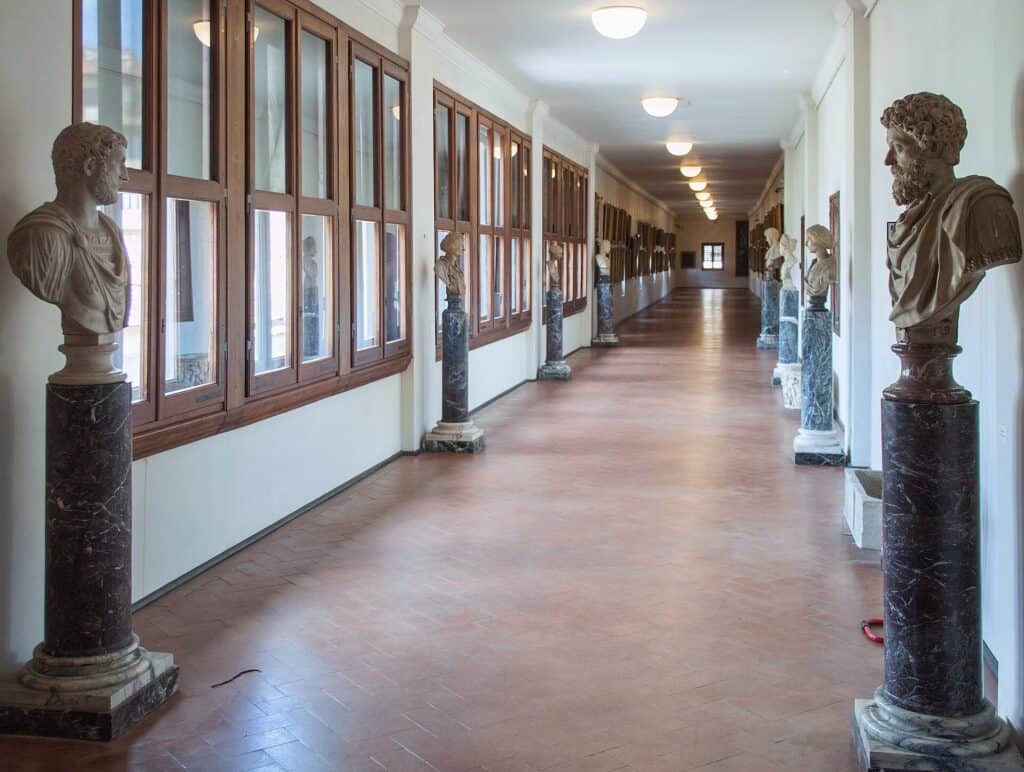
You walk in small groups, accompanied by museum staff, for about 45 minutes and in one direction only, from the Uffizi toward Boboli, with no turning back. The exit is next to the Buontalenti Grotto, from where you’ll be escorted to the courtyard of Pitti Palace. Backpacks, trolleys, and large umbrellas are not allowed.
The Uffizi asks you to enter the gallery at least two hours before your corridor time, so it’s best to plan your day accordingly: the Uffizi in the morning, then the corridor, and once you exit on the other side of the Arno you have Pitti Palace and Boboli within reach. Opening hours and prices change frequently, so check them on the official website of the Uffizi Galleries before booking.
If you want to get to the corridor already knowing the gallery, I’ll accompany you on a guided tour of the Uffizi. And if you prefer to continue the day in Oltrarno, there is the visit to Palazzo Pitti with city tour.
The Vasari Corridor can also be seen from the street
Even without a ticket, you can follow almost the entire route from outside. Start from the arches on Lungarno degli Archibusieri, cross Ponte Vecchio looking at the windows above the shops, stop at the bend around the Torre dei Mannelli, and arrive in Piazza Santa Felicita, where the corridor passes above the portico. In a few minutes on foot you have walked along the Grand Dukes’ road, just a few meters lower.
It’s one of the things I like to talk about during the walking tour of the city. If you like these stories, you can find more in the post on curiosities you can see in Florence area by area and in Legends and hidden curiosities of Florence between the Duomo and the Uffizi!