

If you look at the signs of Florentine ice cream shops, sooner or later you will come across this word: Buontalenti. Sometimes written alone, sometimes alongside “Florentine cream“. It’s not a name chosen by a marketing office. It’s the surname of a man who lived in Florence in the sixteenth century, who in theory shouldn’t have dealt with ice cream at all.
Gelato has existed long before him. Mixing snow and fruit has been found since ancient times, in cultures as diverse and far apart. But it was in Florence, at the Medici court, that something changed and took on a form closer to the one we know today.
That something bears the name of Bernardo Buontalenti.
In this article, I’ll tell you what we know for sure, where you can still see places connected to Buontalenti in the city, and where to go today if you want to taste the cream that bears his name.
Who was Bernardo Buontalenti?
Bernardo Timante Buonaccorsi, known to all as Buontalenti, was born in Florence in 1531 and died in the early 17th century. The nickname stuck to him during his lifetime, and it’s no coincidence: it roughly means “good talent.” For once, his fame isn’t exaggerated!

He was the man the Medici turned to when they needed something impossible. An architect, first and foremost: his is the Fort Belvedere, his the large grotto of the Boboli Gardens, his part of the completion of the Uffizi after Vasari’s death. But it didn’t stop there. It was also military engineer, set designer, designer of theatrical machines capable of surprising a court already accustomed to luxury.
He organized banquets, parties, and fireworks displays. If you’ve ever wondered where the tradition of fireworks that Florence still lights today for its patron saint comes from, you’ll find it right here: Buontalenti was the director of those shows, the same man behind the lights you see today exploding over the Arno on the night of San Giovanni.
In a court like the Medici, wowing guests wasn’t a whim. It was a strategy. A successful banquet, a spectacular fireworks display, a unique dessert: everything served to convey power, wealth, and cultural superiority over other Italian and European states. Buontalenti navigated this space, between art and political strategy. Hence the story we are about to tell.
History or legend?
QWhat follows is a tangle of historical documents and handed down stories; it’s not always easy to tell where one ends and the other begins. Even historians, when it comes to definitively attributing the invention of ice cream to a single person, remain very cautious.
What we can do is try to reconstruct the main facts, distinguishing where possible what is documented from what is popular tradition.
The banquet for the Spanish delegation
We are around the middle of the sixteenth century.Cosimo I de’ Medicimust receive adelegation Spanishand wants to make an impression. It’s not just any courtesy visit: behind it there’s also the intention toto obtain the support of Spain to annex Siena to the duchy. You need parties that are worthy of the occasion, ones that will leave your guests speechless.
The commission went to Buontalenti. And Buontalenti didn’t limit himself to fireworks or stage sets: he organized sumptuous banquets and, at the end of one of them, served an iced cream unlike anything seen before: milk, honey, egg yolks, a touch of wine, and citrus flavors. Ingredients that were precious at the time, some arriving from the recently discovered New World, like sugar.
The result thrilled the Spanish guests, and with them the Grand Duke. So far, the story is fairly consistent across all the historical sources that have handed it down. What remains more uncertain is the exact date and the precise details of the recipe, which over the centuries have become somewhat tangled with popular imagination.
Ruggeri, Caterina de’ Medici and the French court
There’s a second character who’s often brought up alongside Buontalenti. The story deserves to be told because it helps us understand how complex this story is: Cosimo Ruggeri.
Ruggeri was a humble Florentine poulterer, not a court artist. According to tradition, he would have participated in a competition organized by the Medici for the most original dish ever seen, presenting a frozen dessert made with sugared and flavored water. An ancestor of sorbet, rather than gelato as we know it today.
Catherine de’ Medici loved the dessert so much that, when she left Florence to marry Henry II of France, she wanted Ruggeri in her entourage. Thanks to the Florentine chefs who accompanied Catherine to the French court, gelato began to spread throughout Europe.
The two stories, that of Ruggeri and that of Buontalenti, tend to overlap in popular tales, almost as if they were the same story told twice. In reality they seem to be two different contributions, maybe even at different times: one closer to sorbet, the other more similar to a frozen cream with milk and eggs.
The recipe for Renaissance Florentine Cream
That Renaissance recipe, with honey, wine, and citrus flavors, no longer exists today. Over the centuries, it has been simplified, until it reached a much more essential version.
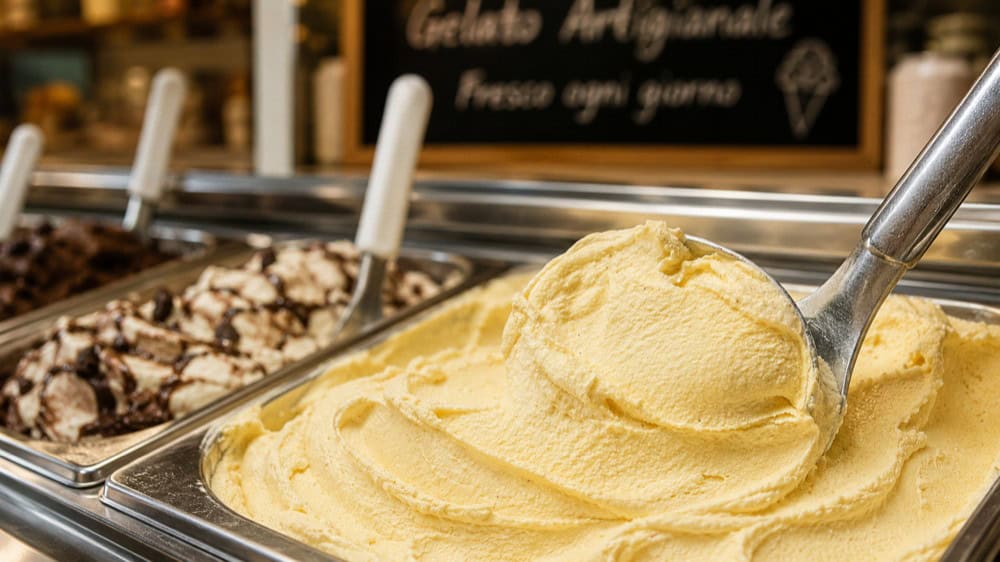
In the 1960s the The Florence Ice Cream Makers’ Committee has written down what a true Buontalenti flavor should contain.: to put, latte, sugar and egg yolks. Nothing else.
The result is a very light cream, almost ivory-colored, very different from a normal custard. The difference lies in the ratio between ingredients. More cream than milk, and the egg yolks are used sparingly, without overdoing it. The resulting flavor is rounded, clean, and almost minimal.
If you taste it expecting something intense or aromatic you will be surprised: its strength lies precisely in thesimplicity.
Buontalenti is often used asbasis for other creationsLa Dolcevita, for example, variegates it with chocolate and hazelnut sauce. In many ice cream parlors, you’ll also find it alongside slices of panettone or cake, where its clean flavor balances richer desserts.
A little curiosity: the names “crema fiorentina” and “Buontalenti” are now used synonymously in most ice cream shops, but this hasn’t always been the case everywhere. Somehistorical signs still slightly distinguish the two versions, with small variations in the recipeIf an ice cream seller talks to you about them as two different things, it’s not a mistake: it’s just anuancewhich has been lost in common language.
Where to try Buontalenti ice cream in Florence
If you search for “the real Buontalenti” in Florence, the name you hear most often is Badiani. And there’s a reason: the ice cream shop, founded in 1932 and now run by the Pomposi family, claims to have won the competition that launched this flavor in the 1960s. Over the years, it has become the best-known version, even exported abroad.
Buontalenti is now a classic found in most artisanal ice cream shops in Florence, often with small variations in the preparation.
Yes Vivoli, one of the city’s oldest ice cream shops, located in the heart of Santa Croce. The cream that bears their name uses very few ingredients: milk, sugar, and eggs, with no added flavorings. It’s a more pared-down, almost minimalist Buontalenti, in keeping with the shop’s spirit.
At the Medici Ice Cream Shop. As the name suggests, you’ll find an approach that sticks to tradition, without too much experimentation. Fior di latte is the foundation for even the most elaborate flavors, and the Buontalenti cream remains faithful to the most classic recipe.
If instead you move towards Oltrarno, towards Borgo la Croce, the Ice Cream Cellar. It offers its version of Buontalenti cream alongside more modern flavors, in an environment designed for those seeking a more informal break, even outside the main tourist centers.