

The stonework of Florentine buildings features iron rings for tethering horses, official market measures, heads carved under the cornices, walled-in windows used to sell wine, and plaques marking the height of the flood in 1966. They are almost all found in central streets, often just a few meters from a museum with a long line at the entrance.
These are details that few people point out and that remain hidden from view for practical reasons: they’re high on facades, or low, at ankle height, or they blend in with the color of the stone. If you walk past them without knowing what to look for, you won’t notice them, even if you’ve crossed the same street three times in two days.
Below, I’ve collected the ones I find most interesting, sorted by area rather than importance, so you can follow them as you wander from one point to another in the center. They’re all freely accessible, without a ticket or reservation.
How this list works
The details are grouped in four zone:
- the stretch between the Duomo and Piazza della Signoria
- the area around the New Market towards the Arno
- the Oltrarno
- a group outside the center if you have an extra half day to dedicate to Florence
Within each zone, the order follows geography. You can start from wherever you are and take whatever you find along the way, without having to fit distant stops together.
The first three zones are within a few hundred meters of each other on foot. The fourth requires a bus or a twenty-minute climb.
About directions: Where necessary, I write the side of the building and the approximate height, because with small details, the address alone isn’t enough. Some things are seven or eight meters off the ground, and to see them, you have to stop and look up, which isn’t something that comes naturally on a narrow, crowded street.
Between the Duomo and Piazza della Signoria
It’s the most traveled stretch of Florence, the one you absolutely have to do at least twice a day. It’s barely five hundred meters long, and there’s a lot of stuff inside that nobody looks at.
The face sculpted on Palazzo Vecchio
On the right side of Palazzo Vecchio, facing Via della Ninna, at a height of just over a meter and a half, there is a human profile carved in stone. Quick, barely visible lines, as large as an open hand. It can only be seen clearly from the side, in raking light.
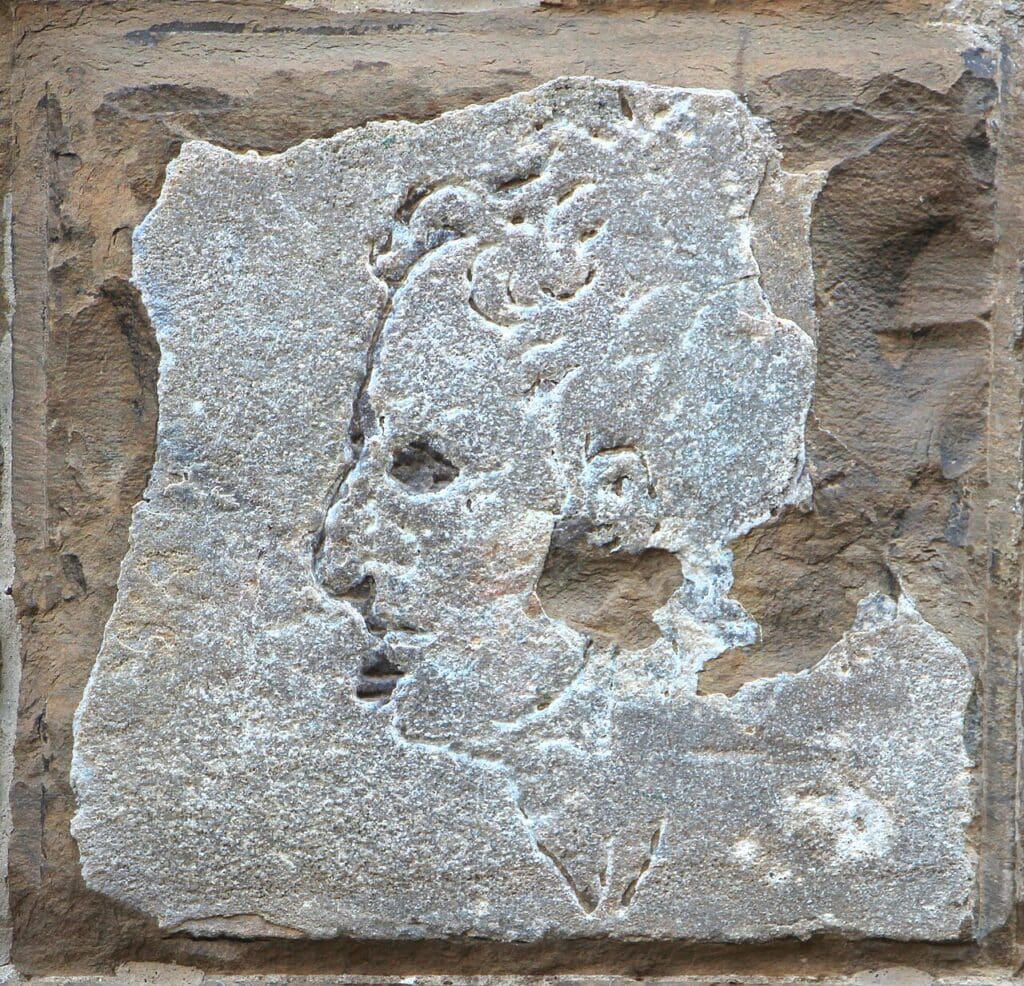
Tradition attributes it to Michelangelo, who sculpted it secretly, holding his hands behind his back while talking to someone. Versions vary depending on who tells them: a tiresome debtor, a condemned man awaiting execution, a bet with a friend. No document confirms this, the profile is undated, and its authorship remains a popular attribution. But it’s been there for centuries, and the Florentines call it “L’Importuno,” which already provides a small glimpse into how the conversation went.
Find out more at “Haunted Places in Florence“!
The measuring stones on Orsanmichele
Orsanmichele began as a grain market and for centuries was one of the city’s most important trading points. On the exterior wall, on the Via dei Calzaiuoli side, some official measurements are still engraved: the Florentine braccio, the standard dimensions for bricks and tiles.
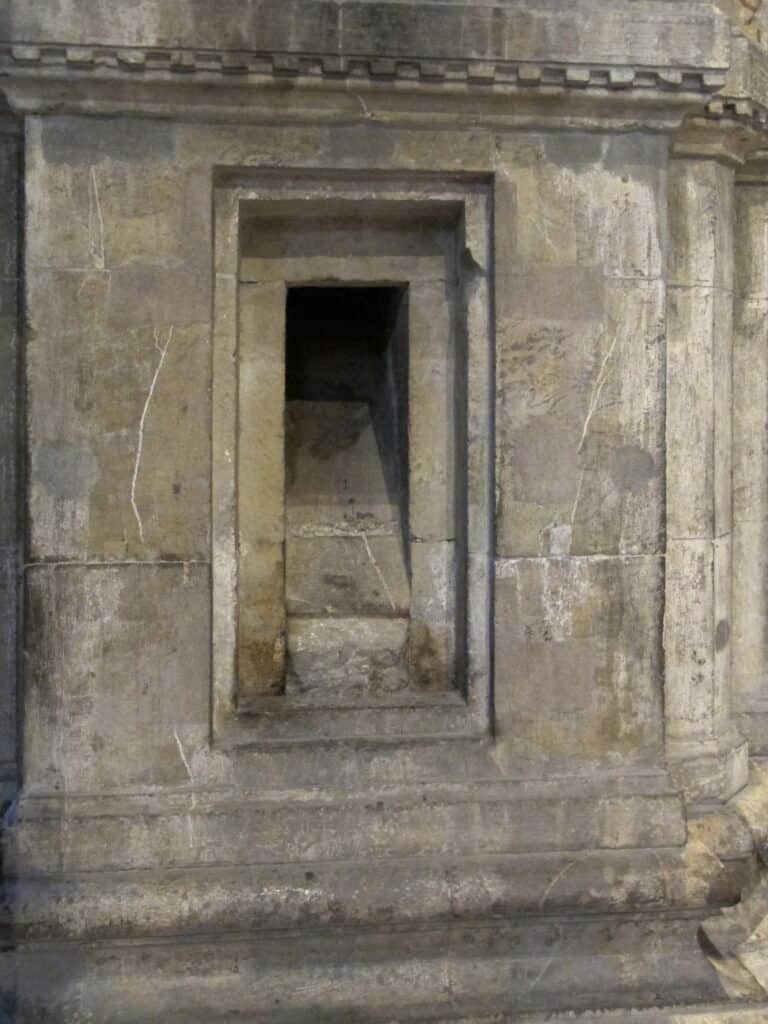
They served as a public reference. Buyers could verify on-site whether what they were paying actually corresponded to the stated size, without having to take the seller’s word for it. An anti-fraud system carved into the wall, valid for everyone and accessible at any time.
They’re at eye level, so for once you don’t have to lift your head. The problem is that they’re thin and the stone around them is dark, so you walk right past them without noticing.
Paolo Uccello’s clock in the Duomo
This is inside the Duomo, but entrance to the cathedral is free, so it falls within the perimeter.
As soon as you enter, turn toward the counterfaçade, the wall above the door you passed through. Above it is a large clock, painted by Paolo Uccello in 1443, with four prophets’ heads at the corners. It has twenty-four hours, Roman numerals, and the hand turns counterclockwise.
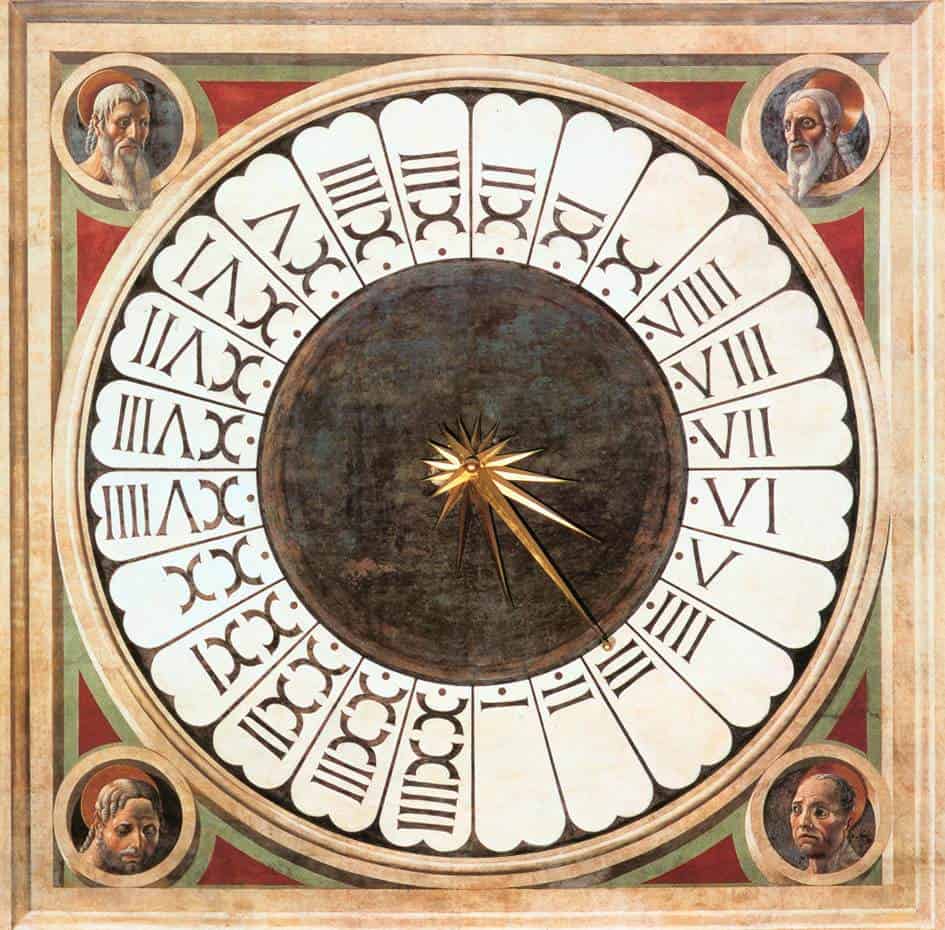
It displays Italian time, the system used in Florence until the late eighteenth century: the day began at sunset and ended at the following sunset. Ten o’clock therefore fell in the evening, not at midnight, and the position changed throughout the year as the days lengthened. The clock still works and is one of the very few remaining in the world with this mechanism.
Dante’s Stone
In Piazza delle Pallottole, a side alley a few steps from the Duomo, there’s a stone slab set into the wall with a plaque above it. It’s Dante’s Stone, the spot where, according to tradition, the poet sat to watch the cathedral’s construction.
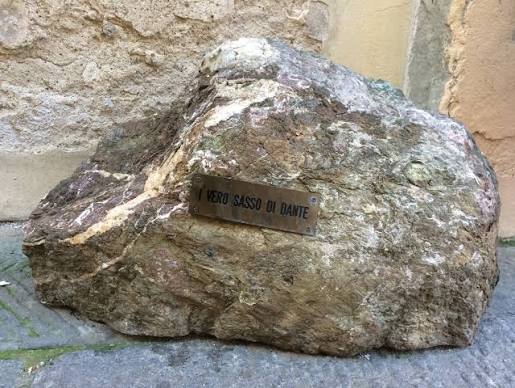
The most recounted anecdote concerns his memory. Someone asked him what his favorite food was, and he said eggs. A year later, finding him sitting in the same spot, the same person simply asked, “With what?” Dante answered, “with salt,” without hesitation.
The tale has been around since the fourteenth century and has no documentary evidence. Even the current stone is not the original: it has been replaced and moved several times over the centuries, most recently in the nineteenth century. What remains is the exact spot and the story that clung to it, which is why people stop.
Around the New Market and towards the Arno
From Piazza della Signoria, toward the river, you cross the Mercato Nuovo area. Here, the details to look for are mostly low down, between street level and the first floor.
The wine holes
They are stone-built doors, as wide as a bottle and about forty centimeters high, with a framed upper arch. Over one hundred and fifty remain in the center, many with the wooden door still in place.
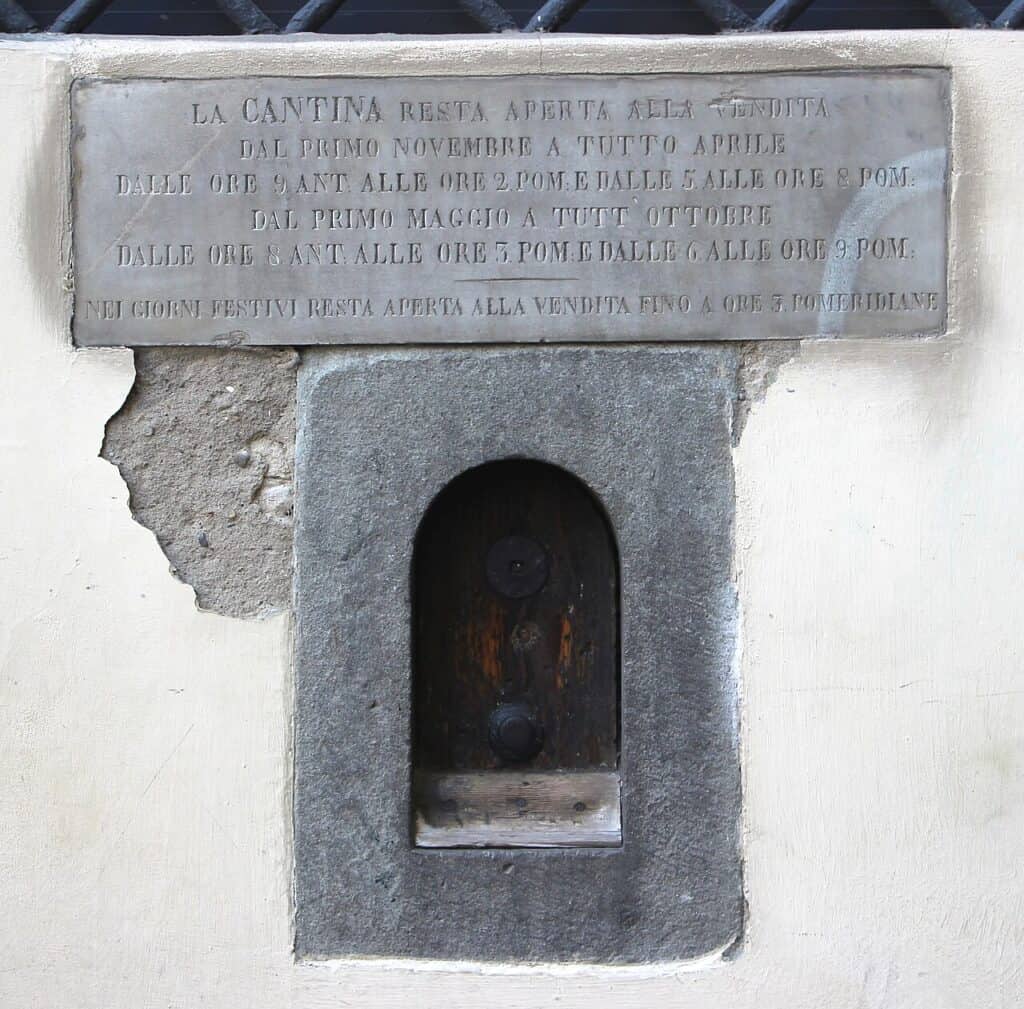
They originated in the 17th century and were used by noble families to directly sell the wine from their estates. Florentine law allowed landowners to sell wine without going through taverns, as long as the sale took place from the palace. The small door solved the practical problem: you knocked, passed the empty bottle, it came back full, and the money passed through the same opening. The buyer remained on the street, the seller inside.
You’ll find several along Via delle Belle Donne, Via del Giglio, Borgo Ognissanti, and the streets around Palazzo Strozzi. Some still have their opening hours visible. In recent years, a few establishments have reopened them, serving coffee and glasses of wine through the counter. This is more of a marketing ploy than a return to tradition, but at least they’re still open.
The stumbling block
Under the Loggia del Mercato Nuovo, on the floor, there’s a black and white marble disc set between the stone slabs. It’s just a few meters from the Fontana del Porcellino, where all the people come to nuzzle the wild boar.
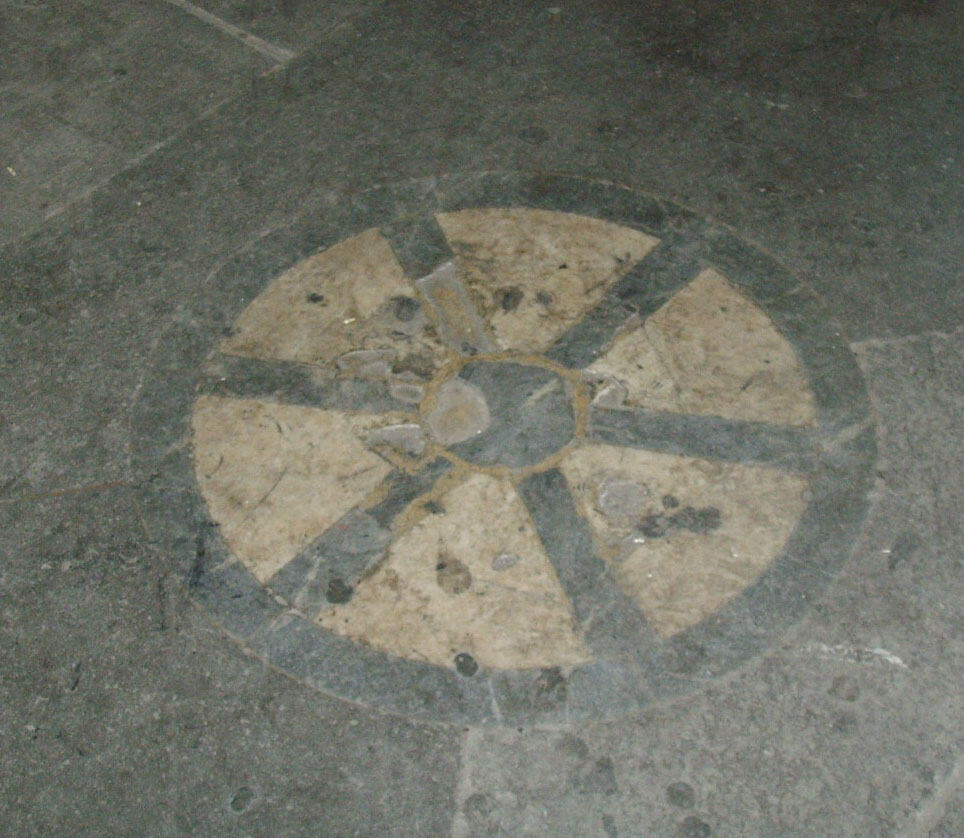
Insolvent debtors were brought here, where they were publicly punished before the assembled merchants. The location was chosen deliberately: the New Market was the center of city business, and the humiliation had to take place before those in power. I discussed this in more detail in the article on the Porcellino Fountain.
The disc is visible only when the stalls are closed or moved. During market hours, people walk over it, and the leather goods stalls almost completely obscure it.
The plaques of the 1966 flood
On November 4, 1966, the Arno River flooded, and within hours the water reached five meters in some areas of the city. In the months that followed, plaques were erected marking the maximum level reached, point by point.
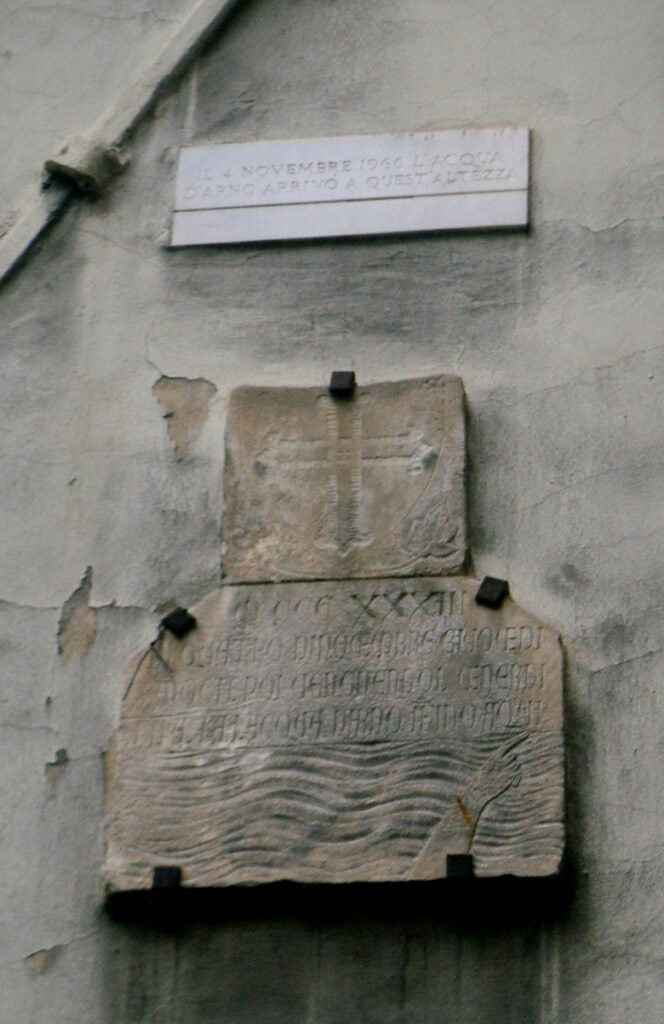
There are dozens of them throughout the city center. One of the most impressive is on Via San Remigio, at the corner of Via dei Neri: the slab stands over four meters off the ground, above the first floor. Next to it is a second, much lower one, marking the flood of 1333.
Seeing the sign with your own eyes changes your perception of the matter. The numbers remain abstract until you stop beneath a plaque level with the upstairs windows, on a narrow street where people walk easily today. The Santa Croce area was among the hardest hit, and the plaques there are all very high.
In Oltrarno
Once you cross the Arno, the pace changes: fewer organized groups, more shops, and narrower streets. The details here are spread out over a wider area, so it’s best to use Via Maggio or Borgo San Jacopo as your axis and move from there.
The always-open window of Palazzo Budini Gattai
This is technically in Piazza Santissima Annunziata, so across the Arno, but it’s too close to the route to leave it out.
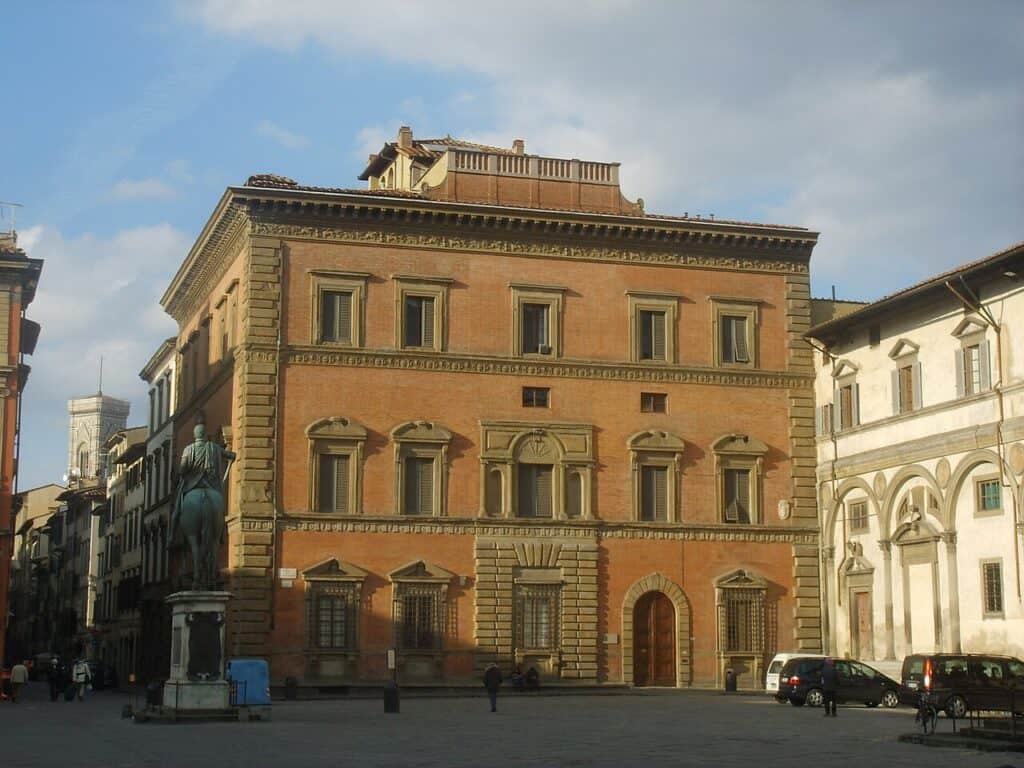
On the right corner of the building, on the first floor, there’s a window with its shutters wide open and a vase of flowers on the sill. It’s always been like this, in any season, in any weather.
The story is told about a woman from the Grifoni family who waited for years for her husband’s return, having gone to war, sitting at that window. Upon his death, her family attempted to close it, and from that moment on, paintings began to fall and objects to break throughout the building. Once the window was reopened, everything returned to normal.
The documented version is less dramatic: the building still belongs to the Budini Gattai family, who maintain the custom out of tradition and perhaps out of affection for the legend itself. In any case, the window is there, open, and you can spot it the first time you look at the corner of the building facing the square.
Find out more on “Always open windows“!
Clet’s road signs
Clet Abraham is a French artist who has lived in Florence for twenty years and modifies road signs with removable stickers. The “no entry” sign becomes a figure removing the white bar, the “no entry” sign transforms into a cross, the “stop” sign takes on a hand holding a disc.
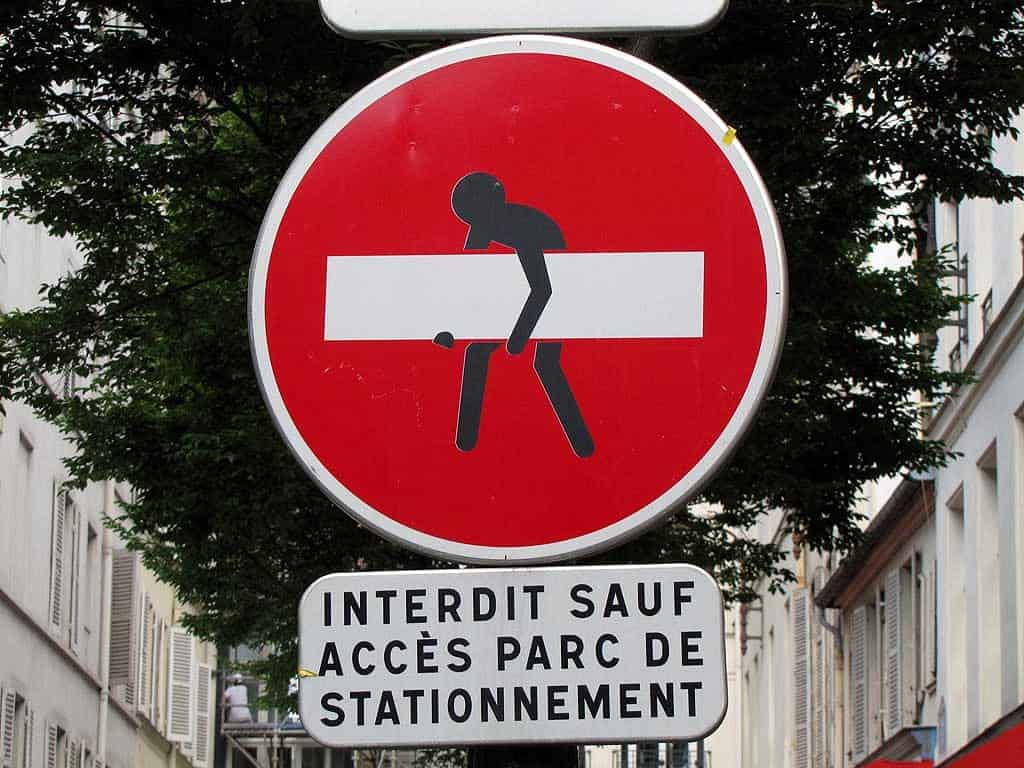
You’ll find dozens of them in Oltrarno, especially in the streets around San Niccolò and along the Lungarni. These are obviously unauthorized interventions, and the Municipality periodically removes them, so the ones you see today may not be there in six months, and new ones may appear elsewhere.
His studio is at Via dell’Olmo 8, open to the public and free to enter. Inside are original street signs, paintings, and sculptures. You might even find him working there.
The Madonna of the Stench
On Via Toscanella, at the corner of Borgo San Jacopo, inside a niche high in the wall, there is a small terracotta figure of the Madonna holding her nose.
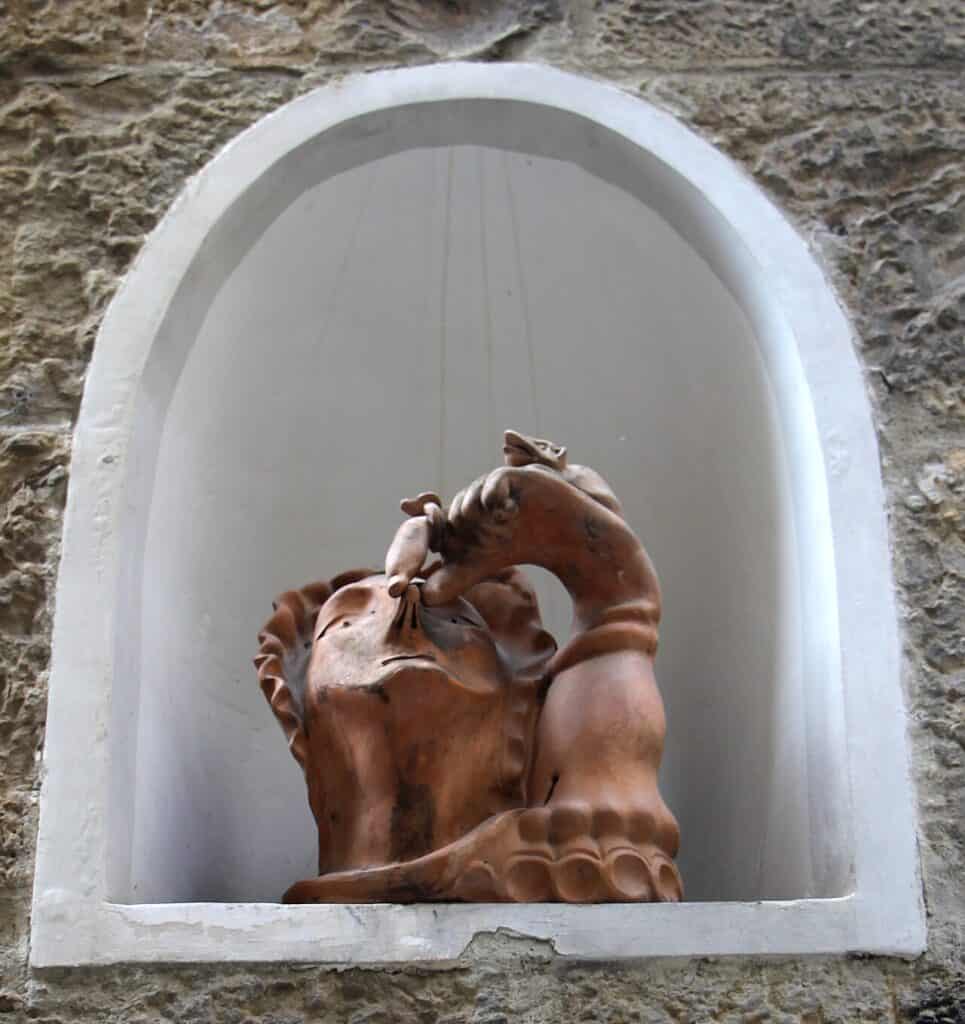
Its origins are documented and recent. In 1984, the street residents, exasperated by the garbage dumpsters and those using the alley as a public restroom, commissioned the work from artist Mario Mariotti as a form of protest. The niche had already been there, empty for some time, like so many others in the city.
It’s about three meters off the ground, in a narrow alley where your instinct is to look ahead. It’s the kind of thing you pass by a hundred times without seeing, and then you can’t ignore it anymore.
The tabernacle of Santa Rosa on the Lungarno
On the Lungarno Soderini, near the ancient Porta di Santa Rosa, a frescoed tabernacle remains, leaning against a fragment of wall. There’s nothing left around it: the walls were demolished in the 19th century, and the tabernacle is now isolated, with traffic passing by.
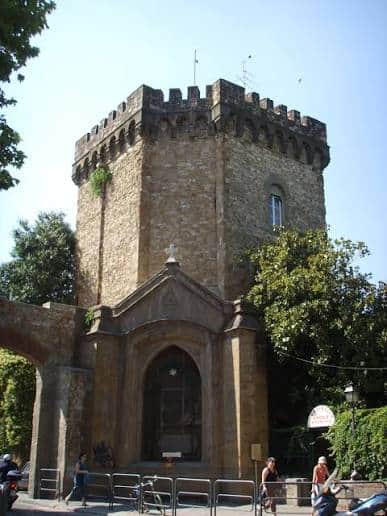
Inside, there’s a 16th-century fresco of the Madonna and several saints, protected by glass and in fair condition. The contrast between the object and its context is what makes it worth a visit: a piece of a medieval city left standing alone on a busy street.
You can see it from the opposite sidewalk, which is also the best place to see it in its entirety.
If you have more time: outside the center
These require a real journey, between twenty and forty minutes from the city center. They are all free to access and none require reservations.
The Gardens of Parnassus
Inside the Horticultural Garden, on Via Bolognese, there’s a stepped staircase topped by a long sculpture in the shape of a serpent. The body descends the entire length of the slope, its colored ceramic scales draped over it, and the head sits at the top with its jaws open.
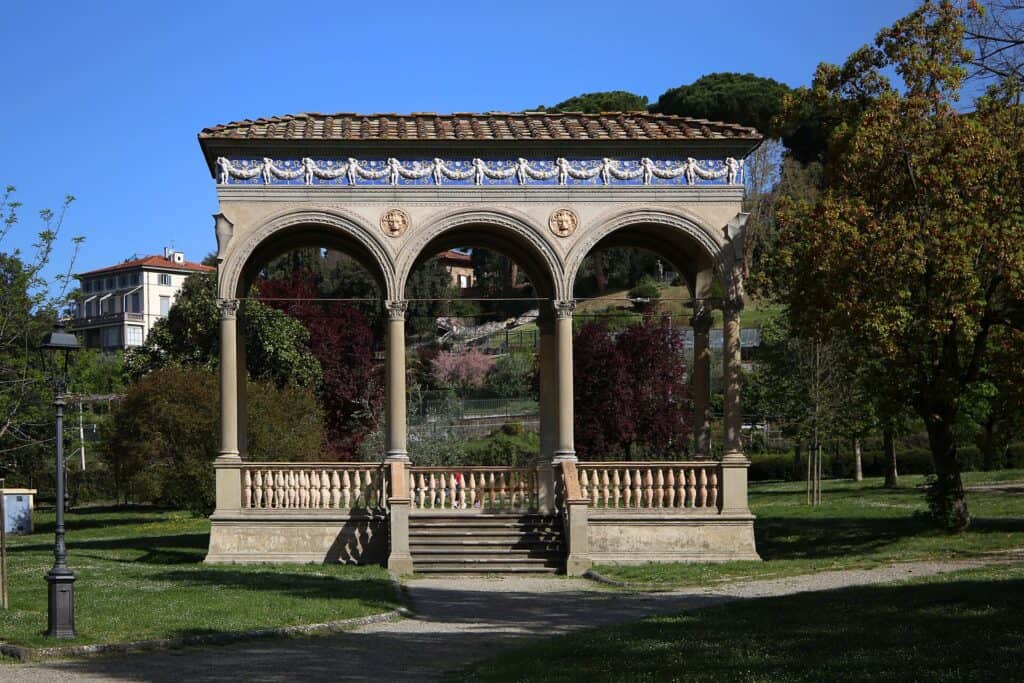
The work dates back to 1990 and recalls the myth of Python, the serpent slain by Apollo on Mount Parnassus. Climbing up, you reach a panoramic viewpoint overlooking Florence from the north, with the dome nestled among the rooftops. It’s a different perspective than the one from Piazzale Michelangelo, and it’s completely empty.
The garden is public and free. It’s a twenty-five-minute walk from Piazza San Marco, or you can take a bus up Via Bolognese.
The Third Garden
On the banks of the Arno River between Ponte San Niccolò and the Pescaia di San Niccolò, a stretch of riverbank has been transformed into an open space with paths, benches, and low vegetation. Its name comes from the fact that it is the third largest green space in the area after the Boboli Gardens and the Bardini Gardens.
You descend from the Lungarno and find yourself below street level, with the river just a few meters away. The noise of traffic almost disappears. It’s one of the few places in Florence where you can sit on the water without consuming anything.
From the center it’s a twenty-minute walk along the Lungarno, passing by Piazza Poggi.
Bellosguardo Hill
Above Porta Romana, on the southern side, a narrow street climbs up to Piazza di Bellosguardo. From there and from the stretches of road leading up, you can see the whole of Florence from a higher and more lateral vantage point than Piazzale Michelangelo.
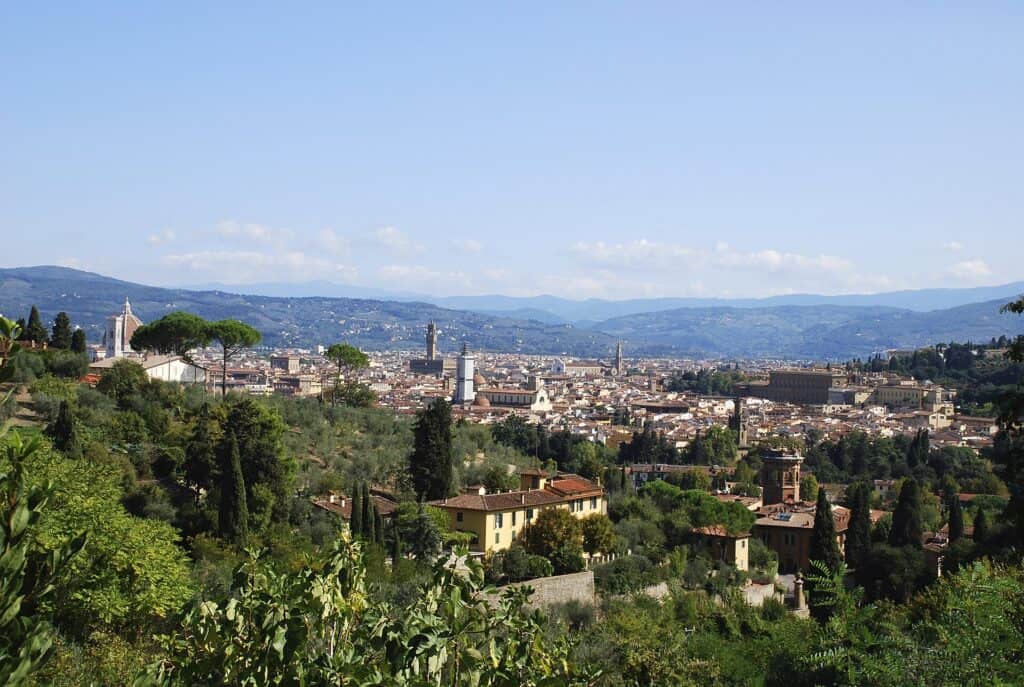
There’s no tourist infrastructure: no bars, no stalls, no bus parking. Just private villas, surrounding walls, and a few spots with open views. The climb is steep and takes about half an hour from Porta Romana.
It’s the right place if Piazzale Michelangelo seems too crowded, and around sunset the difference is noticeable.
Secret Florence: what is and what isn’t
The word “secret” is used quite liberally in articles about Florence. The Vasari Corridor is often listed as a hidden attraction, though it has a ticket office, a dedicated website, and is sold out weeks in advance.
The following are definitely worthwhile, but require a ticket and scheduling, so I’ve left them off the main list.
The Vasari Corridor. It’s the approximately 800-meter-long elevated walkway that connects Palazzo Vecchio to Palazzo Pitti, passing over the Ponte Vecchio. Built in 1565 to allow the Medici family to cross the city without having to go out onto the streets, it has reopened to the public after extensive restoration. Reservations can be made online, daily admissions are limited, and the ticket includes the Uffizi Gallery.
The secret paths of Palazzo Vecchio. These guided tours take you inside hidden staircases within the walls, Francis I’s study, and the cavity above the ceiling of the Salone dei Cinquecento. They are booked at the museum, last just over an hour, and depart only at set times with small groups.
Under Palazzo Vecchio. There are the remains of the Roman theatre of Florentia, visible with an archaeological tour that is paid in addition to the museum ticket. Under theBaptisteryand in other parts of the center there are other ancient levels, open only on special occasions.
The Anatomical Wax Museum of La Specola. It houses hundreds of eighteenth-century wax models created for the study of anatomy. It reopened after years of renovations; there’s an admission fee, and reservations are recommended on weekends.
None of these are hidden. They’re organized places, with schedules and prices, that are worth the time and expense. The difference is that they need to be planned before you leave, while everything I’ve listed above can be found by walking, without deciding anything in advance.
How to organize the tour
You don’t need a dedicated itinerary. Almost everything I’ve listed is along routes you’ll be doing anyway, so it works best as an additional layer on top of what you already have planned.
If you have a morning, the most convenient route starts from the Duomo with Paolo Uccello’s clock and Dante’s Sasso, heads down Via dei Calzaiuoli, stopping at the Orsanmichele monument, reaches Piazza della Signoria via the Via della Ninna, then cuts across to the Mercato Nuovo and ends on the Lungarno with the flood plaques. It’s a total of eight hundred meters and takes two hours to complete, walking slowly.
The Oltrarno is best left alone, perhaps in the afternoon or on a later day, because the distances are longer and the pace is different. You’ll find wine stalls everywhere along the way, so you don’t need to search for them: just know they’re there and look down when you’re walking close to the buildings.
Light matters more than it seems. The profile of Palazzo Vecchio is clearly visible only when the sun hits the wall directly, so early in the morning or late in the afternoon. The flood plaques on Via San Remigio are located on a narrow street and are in shadow in broad daylight, but they are still legible.
Those arriving from outside Florence will find it easier to leave their car in an external parking lot and enter the center by tram or bus, since the entire area is within the ZTL, a limited traffic zone (for further information you can read “Where to park in Florence“).
One thing that helps: photograph the details as you go. Many are small and high up, and they’re better seen on a screen than in person, especially the carvings on the dark stone.
Why these things deserve attention
Florence is almost always visited with a strict schedule: museums to book, timetables to respect, queues to account for. Within that schedule, the details of the street have no place, and end up being the only things you see without having anything else to do at that moment.
They’re also the only part of the city not designed for visitors. The Orsanmichele measures were a service for those buying grain, the small windows were used to sell wine without paying the innkeeper, the flood plaques were placed by those who had just had floodwaters in their homes. None of these things were designed to be viewed by tourists, and that’s why they tell Florence’s story differently than museums.
The practical effect is noticeable from the second day. You start looking at the walls as you walk, finding iron rings and coats of arms that weren’t on any list, stopping to read inscriptions that were previously just dark stone. At that point, the center ceases to be a path between one entrance and another.