

If you spend a few days in Florence, sooner or later you’ll hear it. At the bar, at the Sant’Ambrogio market, between two friends teasing each other over a schiacciata: «O bischero!». It’s one of the most used words in the city, and also one of the first that Tuscans come out with when someone tries to imitate them.
Bischero means foolish, naive, someone who gets taken in or has just done something silly. Said by a Florentine, however, it’s rarely a real insult: it all depends on the tone, and among friends it almost becomes an affectionate way of calling each other.
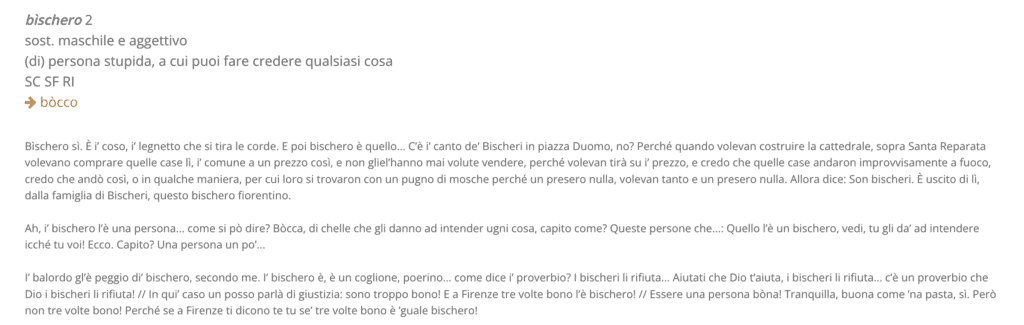
This word has a story that begins at the Duomo construction site, passes through a family of wealthy merchants and ends at a street corner in the city center that still bears their name. I’ll tell you what bischero means, where it might come from and where you can still find it today, even outside the dialect!
What bischero means when a Florentine says it
In dictionaries, a bischero is a foolish, gullible, not very clever person. The Vocabolario del fiorentino contemporaneo by the Accademia della Crusca, which collects words as Florentines actually use them, adds an important detail: bischero can be affectionate and playful, or offensive. It depends on who says it, and how.
«O bischero, che tu fai?» (“Oh bischero, what are you doing?”), said to a friend who has just spilled wine on the table, is good-natured teasing. The same «bischero» shouted out of a car window at someone who cut you off carries a very different weight. In between there are a thousand nuances, and Florentines use them all.
Other words come from the same root, and you’ll often hear them in the city. A bischerata is a silly thing, something done without thinking. But it can also mean something very easy: «l’è una bischerata» is said of a job that takes no effort at all.
A bischeraccio is an even more good-natured bischero, someone nobody is afraid of. Then there’s an old saying, farsi mangiare il bischero dalle mosche (literally, “letting the flies eat your bischero”), used for someone who lets themselves be taken advantage of without reacting.
Before it became an insult, the bischero was a piece of wood
If you play the guitar or the violin, you already know the bischero, even if you may not call it that. It’s the wooden or metal peg at the top of the neck of stringed instruments, the one you turn to tighten the string and tune it. In Italian dictionaries, this is still the first meaning of the word.
In Tuscany, however, bischero also has another, older and cruder meaning: it referred to the male member. The shift from there to “foolish person” is the same one that happened to other Italian words, such as «minchione». The De Mauro dictionary records the word from 1521.
The legend of the Bischeri family and the Duomo construction site
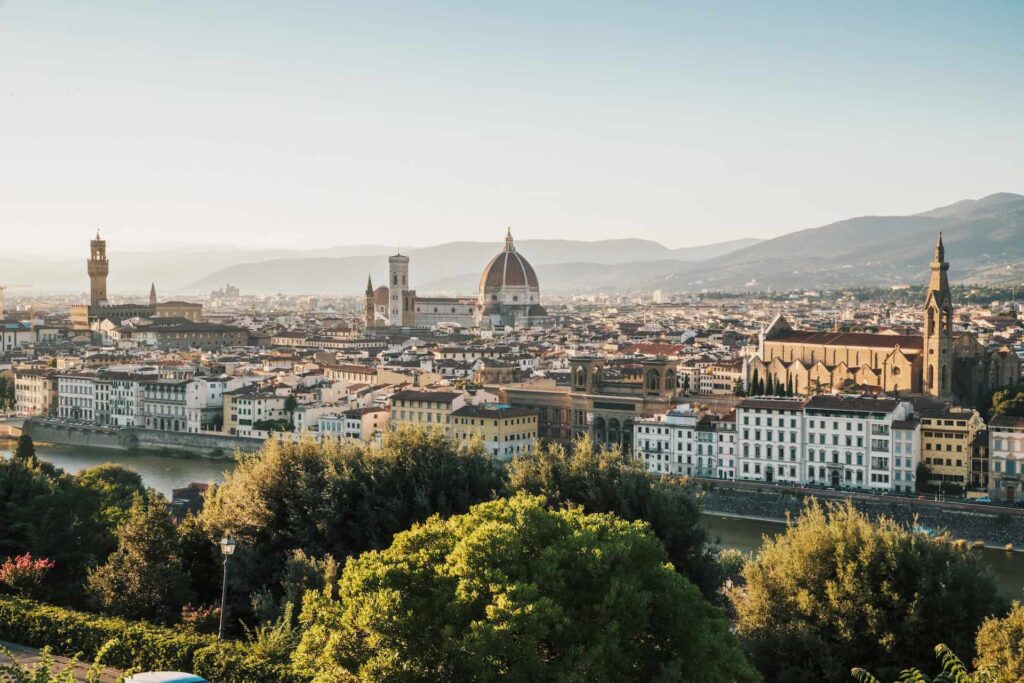
Florentines, though, tell a different story, a much more entertaining one. At the end of the 13th century, Florence was one of the richest cities in Europe and decided to build a cathedral worthy of its fame, in place of the old church of Santa Reparata. This was the construction site of Santa Maria del Fiore, the Duomo you see today.
To make room for the new building, the Florentine Republic had to buy and demolish the surrounding houses. A good part of those houses belonged to the Bischeri, a family of wealthy merchants. The government offered them a generous sum, but the Bischeri refused: with the cathedral project underway, land values had gone up, and they hoped to get even more.
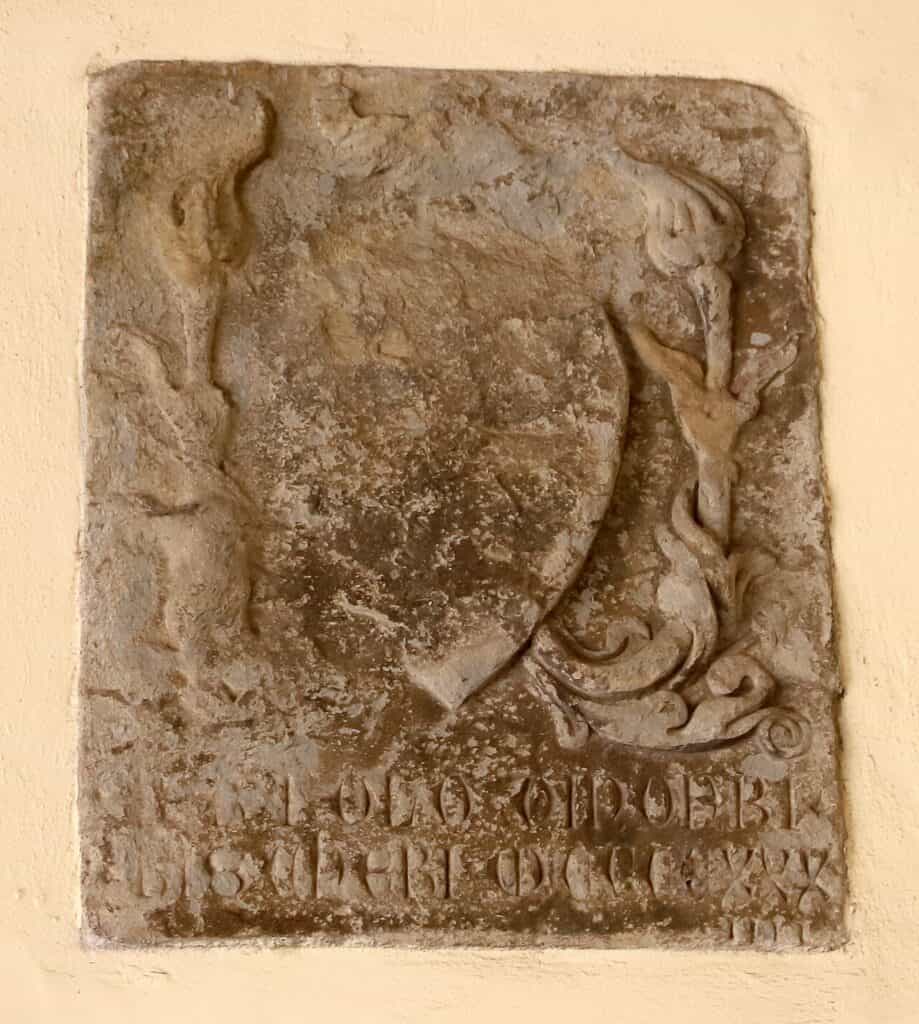
They pushed their luck too far. The government lost patience, reduced the size of the construction site and expropriated the remaining houses for just a few florins. The Bischeri had turned down an excellent offer and ended up almost empty-handed. In short, they had behaved like real bischeri!
There’s also a more dramatic version, in which a mysterious fire destroys the family’s houses one night. Historians consider it a popular invention, added over the centuries to make the story even more colorful.
If you’d like to see up close the construction site that ruined the Bischeri, with the Dome, the crypt of Santa Reparata and the terraces, I’ll take you there on my guided tour of the Florence Duomo.
At the Canto de’ Bischeri the name stayed on the street
The story of the Bischeri didn’t end with the expropriation. The family recovered well, both financially and politically: between 1309 and 1432 it gave the Republic as many as fifteen priors and a few gonfalonieri di giustizia, the highest offices of the city government. Their decline only came in 1434, when Barnaba, the last prior of the family, was exiled to Naples by Cosimo the Elder, who had just returned to power. I also talk about how the Medici got rid of their opponents during my Florence of the Medici tour.
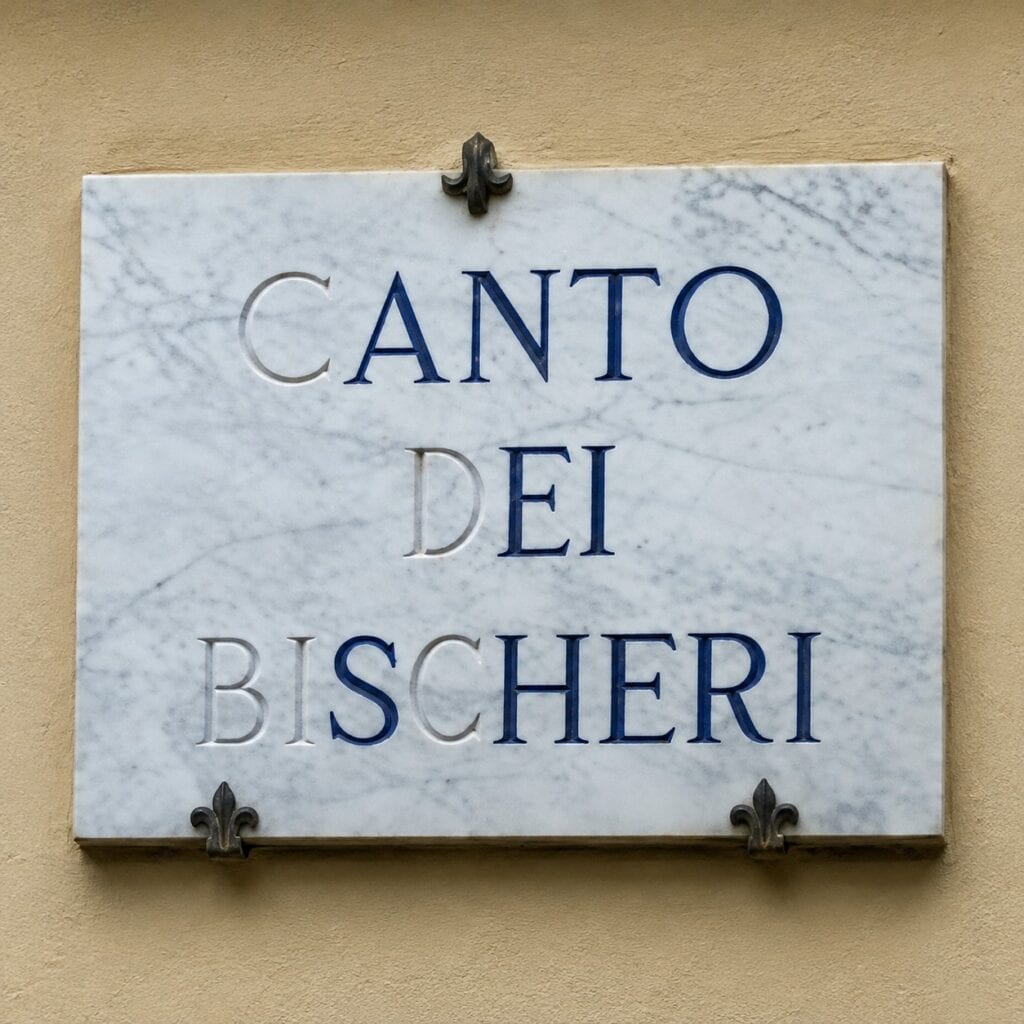
Their houses stood between Piazza del Duomo and Via dell’Oriuolo, and that corner is still called the Canto de’ Bischeri today. In Florence, the «canti» are street corners, and many of them are named after the family who lived there. I also wrote about them in the post Why are the streets of Florence called that way?.
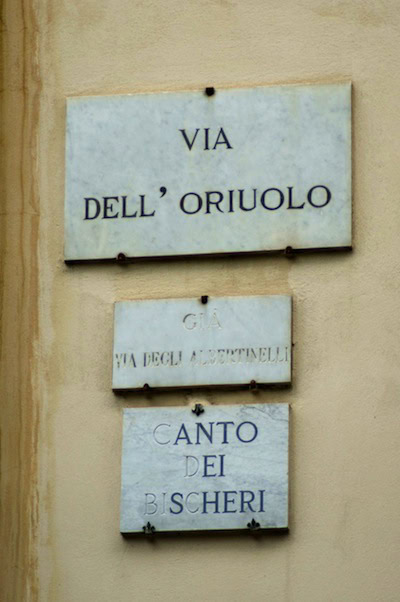
Right there today stands Palazzo Guadagni dell’Opera. After the Bischeri, the properties passed to the Buondelmonti and then to the Guadagni, and this is where another rumor comes from: according to some, the Bischeri changed their surname to Guadagni so they could return to the city without being mocked. It’s a story Florentines love, even though no documents confirm it.
For linguists, the origin is still a mystery
As nice as it is, the story of the Bischeri family doesn’t convince linguists much. Dictionaries give an uncertain etymology, and the scholar Alberto Nocentini devoted an article to the word with a telling title: «Bischero: un caso apparentemente risolto» (“Bischero: an apparently solved case”).
There are several hypotheses. Some link the word to the Latin «discus», others to a Germanic root meaning wood, connected precisely to the peg of stringed instruments. More than explaining where the word comes from, the story of the Bischeri explains very well what Florentines mean when they use it: someone who tries to be too clever and ends up losing out.
In Pisa, bischeri are something you eat
If you head towards Pisa, you’ll find the word in pastry shops too. The torta co’ bischeri is a typical cake from Pontasserchio, near San Giuliano Terme. It has a filling of rice, dark chocolate, pine nuts, candied fruit, raisins and spices, baked in a shortcrust pastry shell.
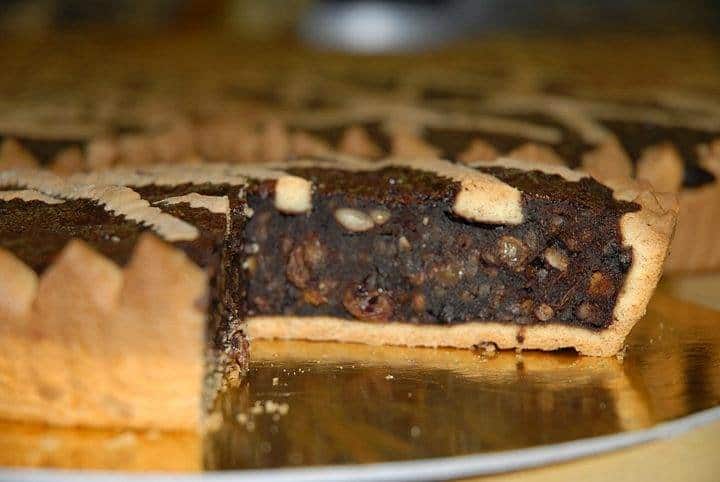
The name comes from the edge: the pastry is cut into small points that look just like the pegs of a guitar. Tradition dates it back to the early 16th century, when it was made for the pilgrims who came to the town for the feast of the Santissimo Crocifisso dei Miracoli. Since 2007 it has also had a quality label, with rules that require pine nuts from the Migliarino Park.
Today bischero is everywhere, even on social media
Bischero hasn’t stayed a word for grandparents. The City of Florence itself, in its #BuongiornoFirenze series on social media, has dedicated a post to the Canto dei Bischeri and its story. Videos explaining why people say bischero, like the one by Mollica’s, have collected thousands of reactions and comments from Florentines who discovered the legend after a lifetime of using the word.
Lorenzo Baglioni, the Florentine singer-songwriter who became famous at the Sanremo Festival with «Il congiuntivo», has also made several videos about words from the Florentine dialect. And the word has even made it to Milan: Bischeri is a restaurant with sing-along dinners, born, as they put it themselves, from the meeting of a Tuscan soul and a Milanese one.
Curzio Malaparte, in his book «Maledetti toscani», wrote that Tuscans have «heaven in their eyes and hell in their mouths». Bischero is perhaps the gentlest example of that hell!
If a Florentine calls you bischero, don’t take offense
Now that you know the story, next time you walk through Piazza del Duomo, look at the corner with Via dell’Oriuolo: that’s where a family of wealthy merchants gave the city its most famous word. And if a Florentine calls you bischero with a smile, take it as a sign of friendship.
The Canto de’ Bischeri is one of the stops I love talking about during my Florence on Foot walking tour. If you enjoy these stories, you’ll find more in Legends and hidden curiosities of Florence between the Duomo and the Uffizi and in Curiosities you can see in Florence, area by area!