

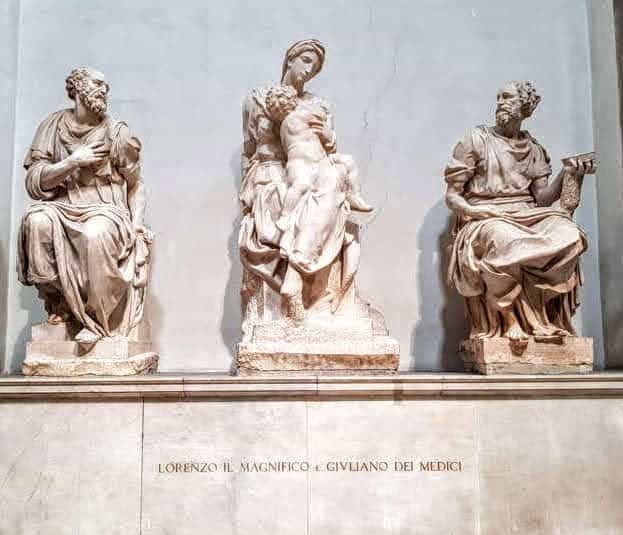
That is the first thing you notice when you walk into the New Sacristy of San Lorenzo: the two large tombs sculpted by Michelangelo, with the statues of Day and Night, Dawn and Dusk. They are so beautiful that almost no one notices the wall opposite, where, beneath a Madonna and Child, there is a simple marble chest. That is where Lorenzo the Magnificent rests, together with his brother Giuliano.
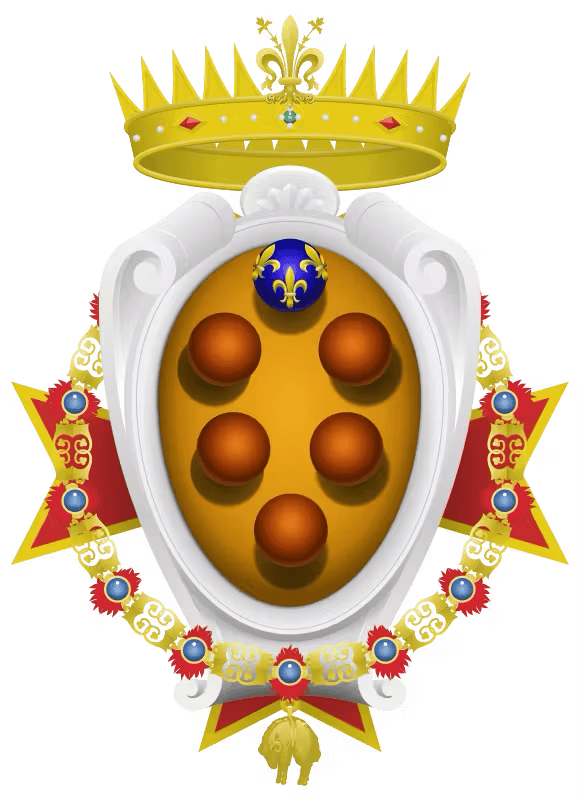
For more than twenty years, from 1469 to 1492, Lorenzo de’ Medici was the most powerful man in Florence without ever holding the title of lord of the city. He governed through the family bank and a network of alliances that reached as far as Rome and Naples, while his trusted men sat in the city’s magistracies. Meanwhile, he wrote poetry and supported the artists who shaped Renaissance Florence.
When I talk about the Medici during my tours, one of the questions I hear most often is precisely where Lorenzo the Magnificent is buried. Many people think of the tomb with the statue known as “Il Pensieroso”, which actually belongs to his grandson, another Lorenzo.
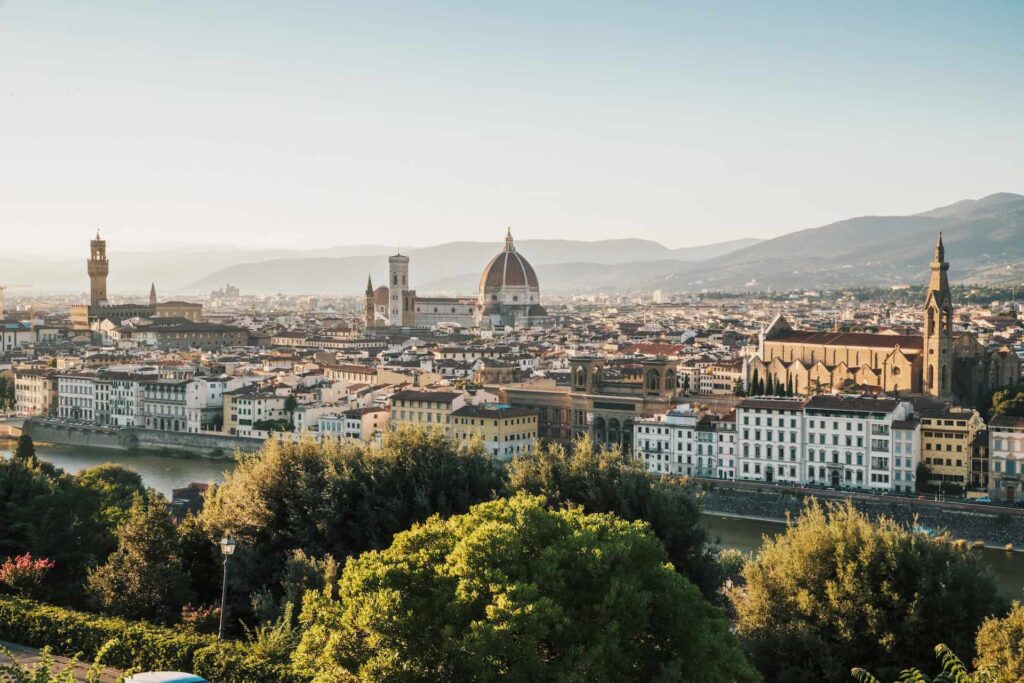
In this post, I’ll take you to the places of his life, in the order in which he lived them. We’ll start with Via Larga, where he was born, and the chapel where Benozzo Gozzoli painted him as a boy. Then come the Duomo of the Pazzi Conspiracy, the garden where he discovered Michelangelo, the Villa di Careggi and, finally, his tomb. But first, let me explain why we call him “the Magnificent”!
In Florence, “Magnificent” was a title many men were entitled to!
If you had asked a fifteenth-century Florentine about Lorenzo the Magnificent, he would have looked at you a little puzzled. “Magnificent” was a courtesy title for addressing men of rank, and other prominent figures of the Republic received it too, starting with the Gonfaloniere di Giustizia. In letters of the time you read “the Magnificent Lorenzo”, with the title before the name, just as we say “Doctor” or “the Honorable” today.
Over time, the order was reversed. Historians and writers began to write “Lorenzo the Magnificent”, and the courtesy title became a nickname, read as a judgment on his qualities. It suits him perfectly, after all!
Lorenzo took the reins of Florence in December 1469, on the death of his father, Piero the Gouty, when he was twenty. Formally, he was never lord of the city: the Republic stayed in place with its councils and magistracies, but every important decision went through Palazzo Medici. In Italian politics, historians have called him “the needle of the scales”, because he kept Milan, Venice, Naples and the Papacy in balance.
He was also a poet, and a good one. He wrote love sonnets and Carnival songs, which were sung in the streets from the parade floats. The most famous is the Song of Bacchus, which Italian children still learn at school: “How beautiful is youth, / which always slips away! / Whoever wants to be happy, let him be: / there is no certainty about tomorrow.”
His court was frequented by philosophers such as Marsilio Ficino and Pico della Mirandola, and by poets such as Agnolo Poliziano, who was also his children’s tutor. If you want to know the whole story of the family, from its origins to its decline, you’ll find it in my post on the history of the Medici family. Here we follow only Lorenzo, place by place.
Lorenzo grew up in Palazzo Medici, on Via Larga
Lorenzo was born on January 1, 1449, in the old Medici house on Via Larga, the street now called Via Cavour. For the Florentines of the time, however, it was still 1448: in Florence the year began on March 25, the feast of the Annunciation, and it did so until the eighteenth century.
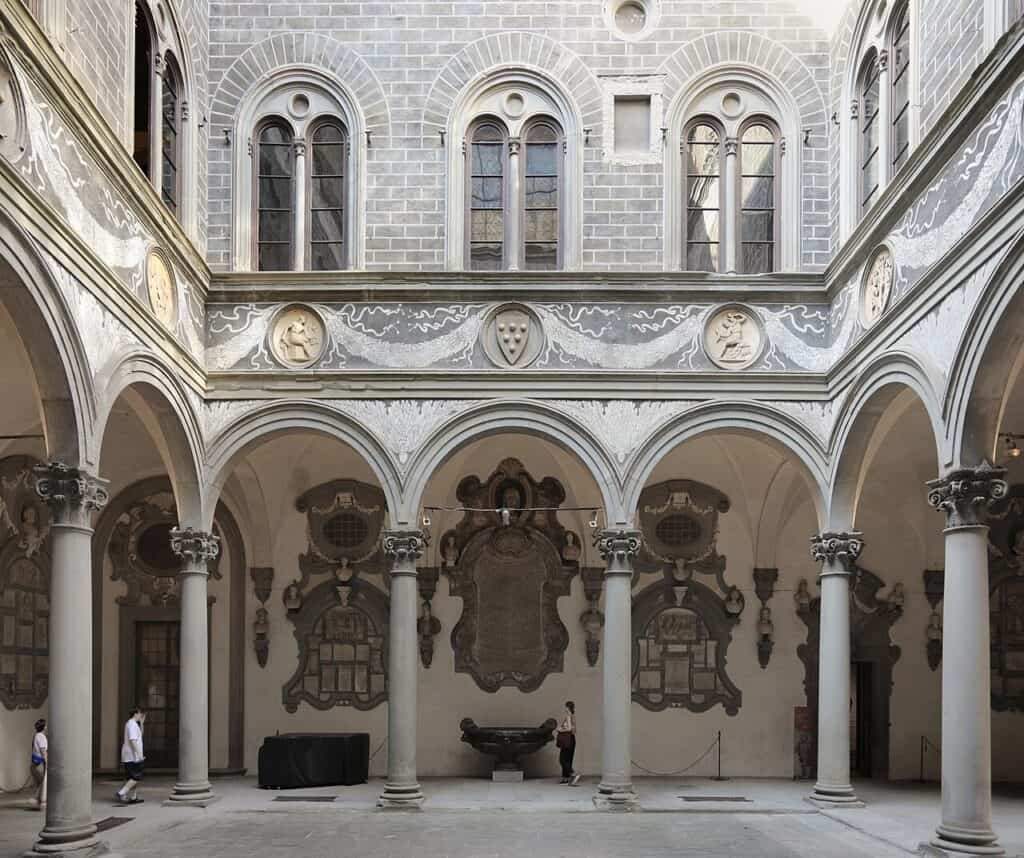
In those years, the great palace you see today was still a building site. His grandfather, Cosimo the Elder, was having it built right there to a design by Michelozzo, on the site of some houses bought for the purpose. Like every Florentine child, Lorenzo was baptized in the Baptistery of San Giovanni, which is also the first stop on my Florence of the Medici tour.
The family moved into the new palace towards the end of the 1450s, and Lorenzo spent his childhood and his whole adult life there. It was the Medici home, but also the place where politics was made: ambassadors were received here, and decisions were taken here that the Republic then approved in Palazzo Vecchio. In the courtyard stood Donatello’s bronze David, which is now in the Bargello and which I write about in my post on Donatello in Florence.
When you walk past the palace, look at the ground-floor windows. They are called kneeling windows because they rest on two brackets that look like bent knees. Michelangelo designed them in 1517, when the corner loggia was walled in on the orders of Lorenzo, Duke of Urbino, the Magnificent’s grandson: the one whose tomb has the Pensieroso.
In 1659 the Medici sold the palace to Marquis Gabbriello Riccardi, and his family enlarged it. That is why today it is called Palazzo Medici Riccardi: it houses public offices and a museum you can visit.
In the Chapel of the Magi you’ll find him as a boy
On the first floor of the palace is its most precious room, the Chapel of the Magi. It was the family’s private chapel, also designed by Michelozzo. In 1459 Benozzo Gozzoli frescoed it with the journey of the Magi to Bethlehem.
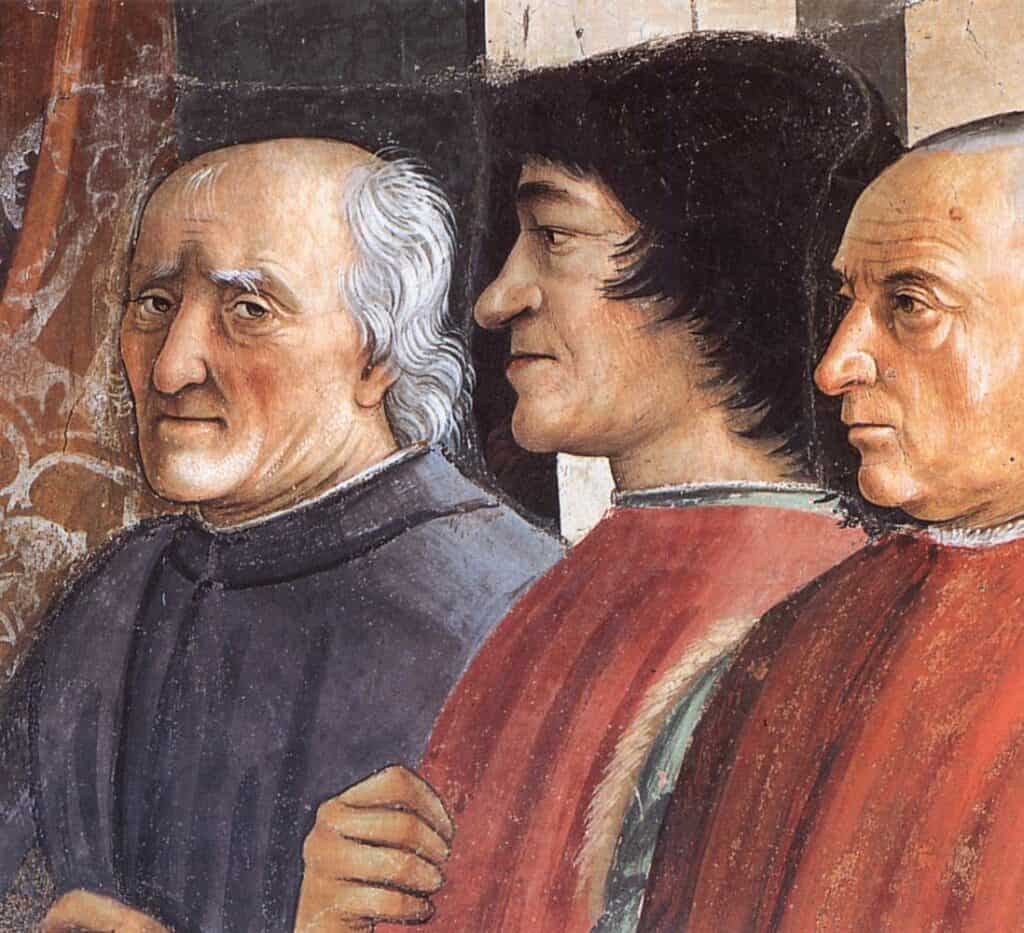
The procession winds through a landscape of Tuscan hills full of horses and exotic animals. Among the figures, Gozzoli included the Medici and their most illustrious guests. You can recognize Cosimo the Elder and Piero the Gouty, Lorenzo’s father, riding two mules, and among the dignitaries are Galeazzo Maria Sforza and Sigismondo Pandolfo Malatesta. Benozzo even painted himself in, with his name written on his red cap.
In 1459 Lorenzo was ten years old. Tradition identifies him as the young man in golden clothes on a white horse leading the procession, but for scholars this is at most an idealized portrait. According to the Byzantinist Silvia Ronchey, the real boy Lorenzo is instead among the figures in the procession, shown in three-quarter view.
Look for Giuliano, his younger brother, too: he is the boy with a leopard on his horse’s back. Nineteen years later he would be killed in the Duomo during the Pazzi Conspiracy. The chapel is small and can be visited with the Palazzo Medici Riccardi museum ticket, at Via Cavour 3.
In the Duomo Lorenzo survived the Pazzi Conspiracy
On the morning of April 26, 1478, Lorenzo and Giuliano left Palazzo Medici to attend Mass in Santa Maria del Fiore. During the service, the conspirators, linked to the Pazzi family and to Pope Sixtus IV, attacked them. Giuliano died under their blows, while Lorenzo, wounded in the neck, managed to lock himself in the Sacristy of the Masses, behind Luca della Robbia’s bronze doors.

Lorenzo’s revenge was ruthless, and after that day his hold on Florence grew even stronger. I’ve told the whole story, with the conspirators and the places you can still see today, in my post on the Pazzi Conspiracy. Inside the Duomo, I also tell you about that morning during my guided tour of the Florence Duomo.
At the Garden of San Marco Lorenzo discovered Michelangelo
A short walk from Palazzo Medici, towards Piazza San Marco, the Medici owned a large garden. Lorenzo gathered ancient statues and marble fragments there, and opened it to young artists so they could study and copy them. They were guided by the sculptor Bertoldo di Giovanni, a former pupil of Donatello, which is why many consider the garden the first art school in Florence.
Around 1489, a fourteen-year-old from Ghirlandaio’s workshop joined those young men: Michelangelo Buonarroti. His biographer Ascanio Condivi tells us that the boy carved the head of an old faun, copying it from an ancient piece, but with its mouth open and all its teeth. Lorenzo, passing by, remarked that old men always lose a few teeth. As soon as the Magnificent had gone, Michelangelo knocked out one of the faun’s teeth and hollowed out the gum. The anecdote sounds a little like legend, but it paints the picture well!
Lorenzo took him into Palazzo Medici, where Michelangelo lived until the Magnificent’s death and ate at the family table with Poliziano and the other guests. In those years he carved the Madonna of the Stairs and the Battle of the Centaurs, which are now in Casa Buonarroti. I write about Michelangelo’s relationship with the Medici, which was never an easy one, in my post on Michelangelo in Florence.
Nothing remains of the garden today. In its place, at Via Cavour 57, stands the Casino Mediceo di San Marco, which Francesco I de’ Medici had built about eighty years later by Bernardo Buontalenti, the same Buontalenti as the famous Buontalenti ice cream. Today it houses a school of the European University Institute. A stone’s throw away is the Convent of San Marco, which Cosimo the Elder had Michelozzo rebuild.
At the Villa di Careggi Lorenzo lived among philosophers, and there he died
Outside the center, on the hills north of Florence, stands the Medici Villa of Careggi. The Medici bought it in 1417, and Cosimo the Elder had Michelozzo turn it into the family’s favorite country residence. Cosimo died there in 1464, and Lorenzo spent long periods there, far from the business of Via Larga.
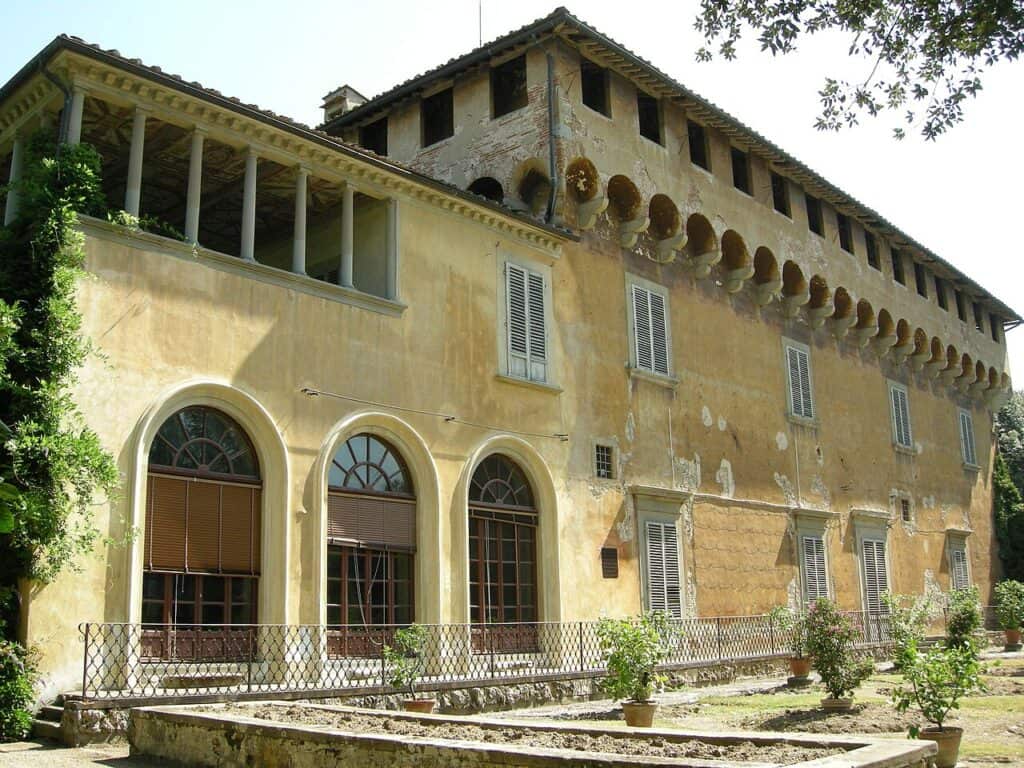
Careggi is linked above all to the philosophers. Cosimo entrusted Marsilio Ficino with translating Plato from Greek and gave him a house near the villa. Around Ficino gathered the group we call the Platonic Academy, which Lorenzo and Poliziano also attended. They met to discuss philosophy, and every year they celebrated Plato’s birthday, November 7, with a banquet.
Lorenzo suffered from gout, the family illness that had also tormented his father, Piero the Gouty. In the spring of 1492 his condition worsened, with a leg ulcer that turned into gangrene, and he had himself taken to Careggi, hoping to recover. He died during the night between April 8 and 9, 1492, at just 43 years old.
Several stories grew up around that night. According to chronicles of the time, a few days earlier lightning struck the lantern of the Dome and some marble fell towards the Medici houses, and the Florentines took it as an omen. The most famous story, however, involves Girolamo Savonarola. It is said that the friar, called to Lorenzo’s bedside, asked him to give Florence back its freedom, and that Lorenzo turned his back on him, dying without absolution.
This version comes from Savonarola’s biographers, written years after the events. Agnolo Poliziano, who was there that night, wrote in a letter that the friar comforted and blessed him, and most historians consider his account more reliable. The next day his body was carried into the city, to the Convent of San Marco, and from there to San Lorenzo for a simple funeral.
Today the villa belongs to the Region of Tuscany and is one of the Medici villas and gardens listed by UNESCO. It is under restoration and opens to the public only on certain occasions, so check the Medici Villas and Gardens website before you go. If you want to see a villa Lorenzo commissioned himself, head to Poggio a Caiano: he had it designed by Giuliano da Sangallo and celebrated it in his short poem Ambra. His son Giovanni, who became Pope Leo X, completed it, and today it is a state museum.
Lorenzo the Magnificent is buried in the New Sacristy, but not in the tomb you think
Lorenzo was first buried in the Old Sacristy of San Lorenzo, Brunelleschi’s sacristy, where his ancestors lay. The bronze and porphyry monument that he and Giuliano commissioned from Verrocchio for their father Piero and their uncle Giovanni is still there. For himself, though, Lorenzo never had a tomb worthy of his rank.
Within a few decades the family had two popes: Lorenzo’s son Giovanni, who became Leo X, and his nephew Giulio, Giuliano’s son, who became Clement VII. It was they who commissioned Michelangelo to build the New Sacristy, on the other side of the basilica, as a funeral chapel for the family. The project also included a monument to “the Magnifici”, Lorenzo and Giuliano, but it was never built.
The two monumental tombs that everyone photographs belong to two other Medici. One is that of Giuliano, Duke of Nemours, the Magnificent’s son, with the statues of Day and Night. The other belongs to Lorenzo, Duke of Urbino, his grandson, seated with his hand on his chin above Dawn and Dusk: because of that pose, the statue is known as the Pensieroso, “the thinker”. It was to this Lorenzo, incidentally, that Machiavelli dedicated The Prince, with the words “to the Magnificent Lorenzo de’ Medici”. You can see why so many people get confused!
The Magnificent lies on the wall opposite the altar, in a simple marble chest together with his brother Giuliano. Their remains were moved here from the Old Sacristy around the middle of the sixteenth century. Above the chest is Michelangelo’s Medici Madonna, left unfinished when the artist left for Rome in 1534, flanked by Saints Cosmas and Damian, the family’s patron saints, carved by Montorsoli and Raffaello da Montelupo.
The Medici Chapels require a separate ticket from the Basilica, with the entrance on Piazza Madonna degli Aldobrandini. I take you inside on my Medici Chapels and city tour, and if you also want to see the Old Sacristy, there is my guided tour of the Basilica of San Lorenzo.
A walk in the footsteps of the Magnificent
Almost all of Lorenzo’s places lie within a few hundred meters of each other. You can start from Palazzo Medici Riccardi on Via Cavour, walk up the street to Piazza San Marco, where Michelangelo’s garden once stood, and then head back to San Lorenzo for the two sacristies. The Duomo is a five-minute walk away, while Careggi needs a short trip out of the center.
If you’d rather have a guide tell you the whole story, the Medici are the common thread of my Florence of the Medici tour. And if you enjoyed this story, I also recommend The Pazzi Conspiracy and the history of the Medici family!