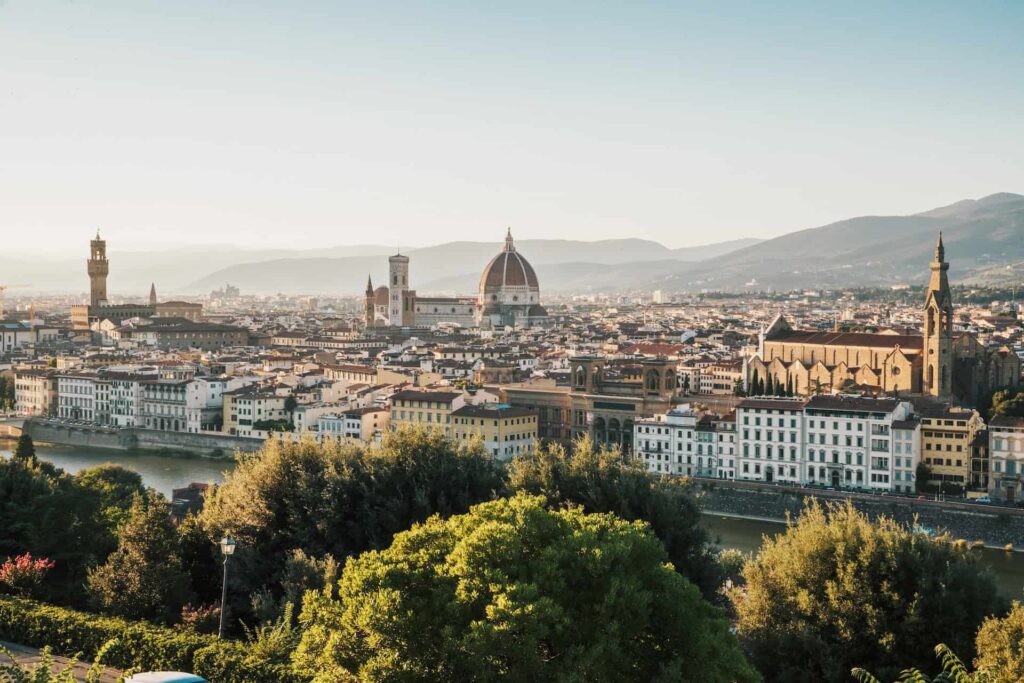


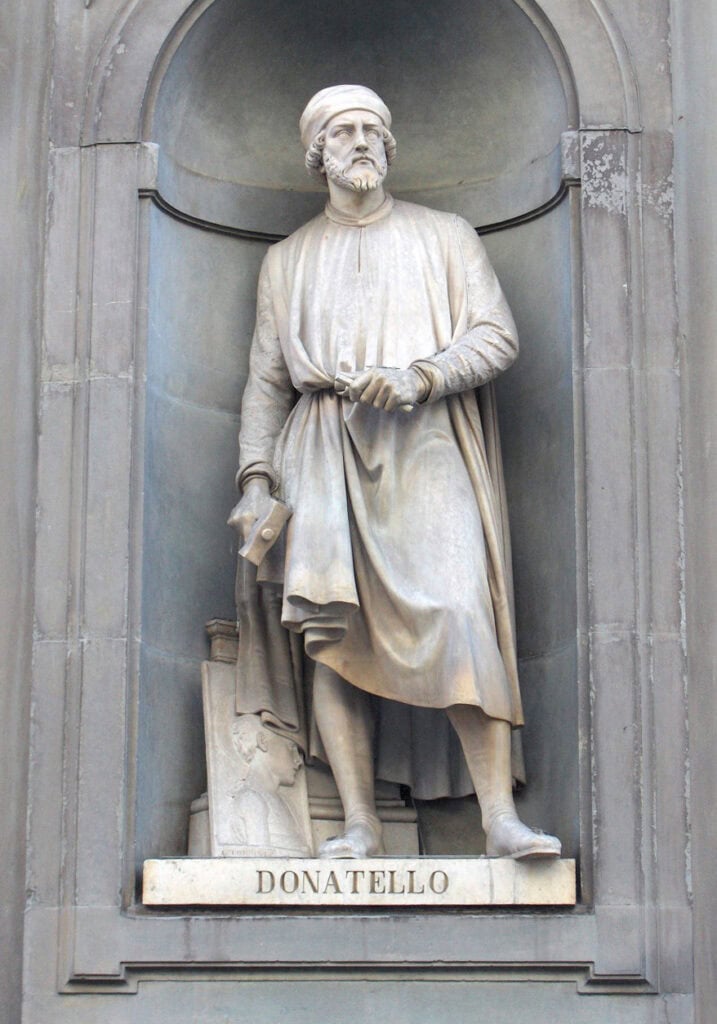
Donatello is everywhere in Florence.
His works aren’t hidden in the back of a museum. They’re at eye level, along the streets you walk: a niche on a wall in Orsanmichele, a stone lion on a pedestal, a tabernacle that looks like decoration but is actually one of the most important works of fifteenth-century Florence. You walk past it, maybe take a photo, and move on.
The reason is simple. Michelangelo has David, a point of arrival that everyone knows. Donatello does not. His works are distributed in at least six different places: some in museums with tickets, others in open churches, others still on the street.
Yet Florence is his city more than anyone else’s. He was born here in 1386, died here in 1466, and, aside from a decade spent in Padua, he never truly left.
In this article, I’ll take you through his works, following the order of his life. Donatello at twenty and Donatello at seventy are two different sculptors, and if you look at them in this order, you’ll immediately notice it. I’ll also tell you which are the originals and which are the copies, the most frequently missing piece of information that will save you from wasting time.
Who was Donatello and why his character matters?
Donato di Niccolò di Betto Bardi was the son of a wool carder. He came from no family of artists, and he inherited no workshop. He learned the trade by working, first as an apprentice to a goldsmith, then in Lorenzo Ghiberti’s workshop, where around 1404 he collaborated on the wax models for the north doors of the Baptistery.
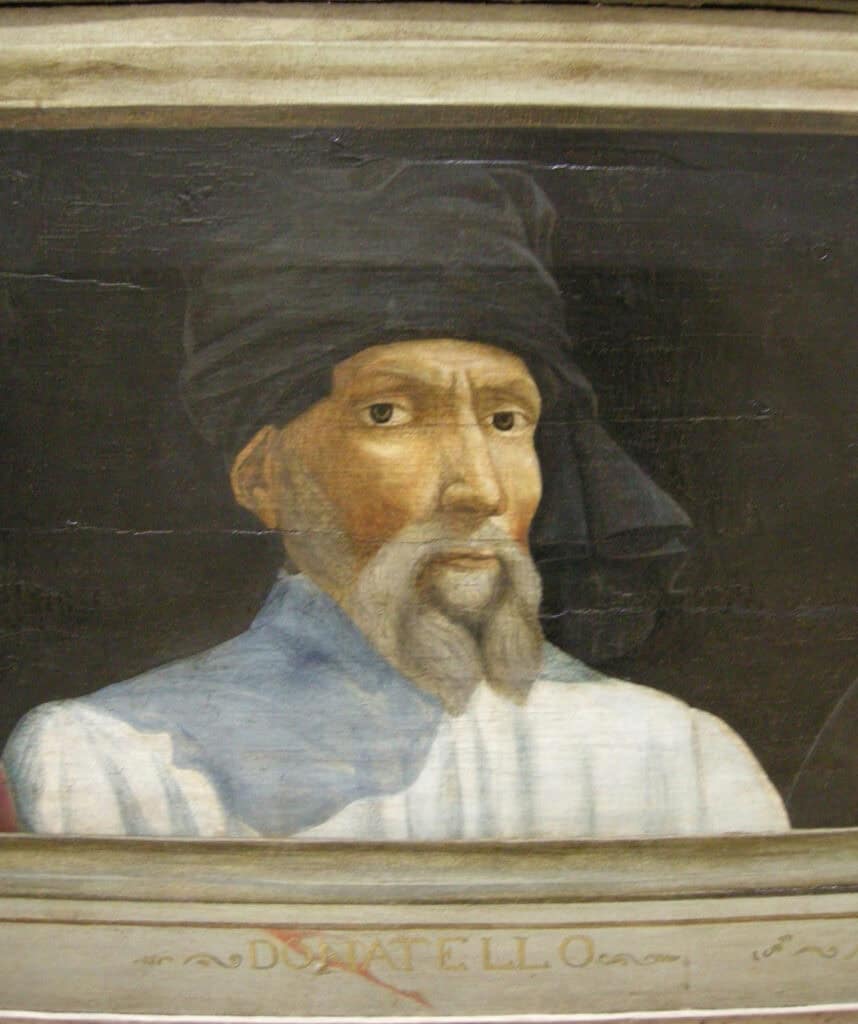
Shortly before it had beenin Rome with Filippo Brunelleschi, studying ancient ruins. The two were friends, ten years apart in age, and spent their time measuring columns and capitals amid the rubble. They returned to Florence with a new idea of what a statue could be.
The friendship with Brunelleschi also tells another story. There is an episode, reported by Vasari in the Quickly, which says more about the two than any stylistic analysis.
Donatello sculpts a wooden crucifix and shows it to his friend, convinced he’s created a masterpiece. Brunelleschi looks at it and tells him it looks like a peasant on a cross, not Christ. Donatello is offended and replies that criticizing is easier than doing: take a piece of wood and try it yourself. Brunelleschi actually tries, secretly, for months. Then he invites Donatello to lunch. Donatello arrives with eggs and cheese in his apron, enters, sees the finished crucifix, and remains motionless. He opens his hands and lets everything fall to the floor. His next line has gone down in history: “You are allowed to make the Christs, I am allowed to make the peasants.”
It must be said that today art historians tend to deny the anecdote: the two works are dated about ten years apart, so the competition as Vasari describes it cannot have gone exactly that way.
That crucifix exists, it’s in Santa Croce, and Christ there is truly an ordinary man: a thin, awkward, worn body. There’s nothing divine about the proportions. Donatello looked at real people and cast them in stone and wood, even when he was depicting saints, prophets, and biblical heroes.
His figures have real faces, aging bodies, and awkward and unusual expressions. From this perspective, a tour of the city ceases to be a list of museums and becomes a way to follow a man who for eighty years continued to observe people.
The Bargello: the heart of the journey
If you’re short on time and only have one place to choose, choose this one.
The Bargello National Museum has an entire room dedicated to Donatello. In that room, you can see the entire span of his career. You can see in twenty minutes what would take you a day’s travel elsewhere.
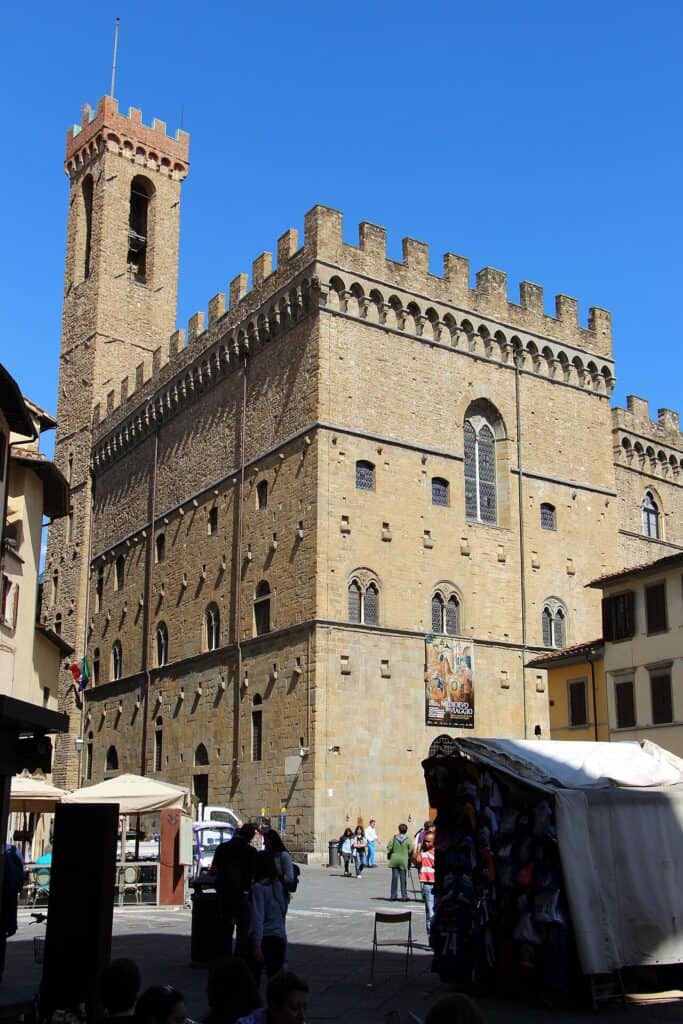
We start from David in marble, sculpted between 1408 and 1409 for the Duomo. Donatello is just over twenty years old, and it shows: the pose is still based on Gothic models, the body is a bit stiff, and some proportions are off. It’s the work of a talented young man who hadn’t yet found his voice.
A few meters away there is the David in bronze. Thirty years pass between the two, and it shows. It’s the first full-length male nude since antiquity, a naked boy wearing a straw hat, his foot resting on Goliath’s severed head, an expression difficult to decipher. It’s exactly the kind of choice you’d expect from someone who sculpted a peasant Christ.
Then there is the San Giorgio, the original. The statue you see in the niche of Orsanmichele, on the street, is a copy. Here, the saint stands with his shield in front of him, looking straight ahead, and has a tension in his body that seems ready to spring. Below the statue, in the museum, there is also the relief of Saint George freeing the princess: just a few millimeters deep, yet within it there is a landscape, arches, distance. It is theschiacciato techniqueand Donatello himself invented it.
In the same room you will find the Marzocco, the lion symbol of Florence. AIn this case too, the original is here while the copy is outside, in Piazza della Signoria.
The Bargello is also a building worth a visit in and of itself. It was the palace of the Captain of the People and later the headquarters of the city police chief, complete with prisons and gallows in the courtyard. You can find us here.works by Michelangelo, Of Celliniand of theVerrocchio.
For further information: Bargello Museum Tour
The Opera del Duomo Museum: the construction years
For much of his life Donatelloh e worked for the construction site of the Duomo, as belonging to a huge organization, the Opera of Santa Maria del Fiore, which for more than a century brought together stonemasons, bricklayers, foundries and sculptors.
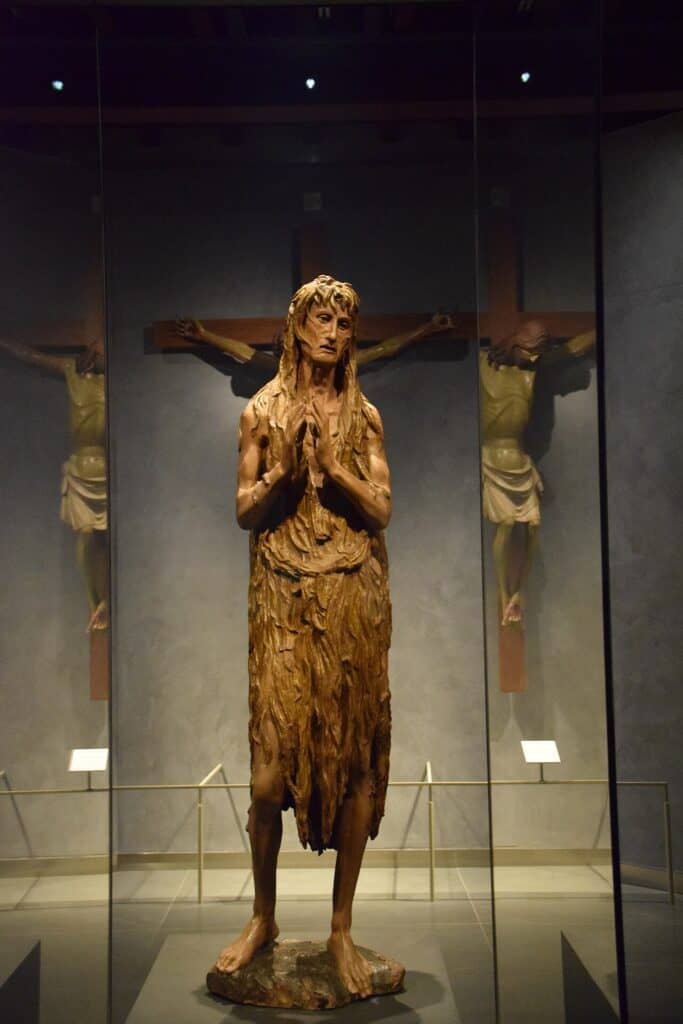
Almost everything he did up there today it’s in the museum behind the Cathedral. The statues were removed from the outside to protect them.
I Prophets of Giotto’s Bell TowerThey are the clearest example. They were in the niches of the tower, seen from below and against the light. Now you can see them from a meter away and see things no one should ever have seen: the marked skin, the veins in the hands, the open mouths. The most famous is the Habakkuk, which the Florentines have always called the Pumpkin because of his bald head. He’s a real man, very thin, with the look of someone who’s had a bad night. Vasari says that Donatello spoke to him as he sculpted him, telling him to hurry up and talk.
Then there is the Singing, the choir stall that was inside the Cathedral. A row of children dancing and playing, crowded together, out of focus, almost overlapping. It’s the happiest work I’ve ever done. In the same room you’ll find Luca della Robbia’s choir. The comparison is immediate: on one side, composed and orderly children, on the other, the chaos of Donatello.
The last one is the Wooden Magdalene, perhaps the main reason to come here. He sculpted it as an old man, in the 1450s. Mary Magdalene is an elderly woman, worn out by fasting, covered only by her hair. Teeth are missing, legs are dry, and her hands are clasped together but don’t really touch. Those who see her for the first time usually stop and say nothing.
Put these three things together and you have the complete journey: from Donatello working on commission inside the construction site, to the one who at the end of his life sculpts a broken woman and calls her a saint.
For further information: Tour of the Cathedral
Orsanmichele and Santa Croce: Donatello on the street
So far, we’ve talked about museums. But two of his most important works can be seen while walking, without paying any admission.
Orsanmichele
Orsanmichele it’s a strange building: it began as a grain market, became a church, and has fourteen niches on its four outer sides. Each Florentine guild, that is, each trade guild, had to fill its own with a statue of its patron saint. It was a competition among the rich.
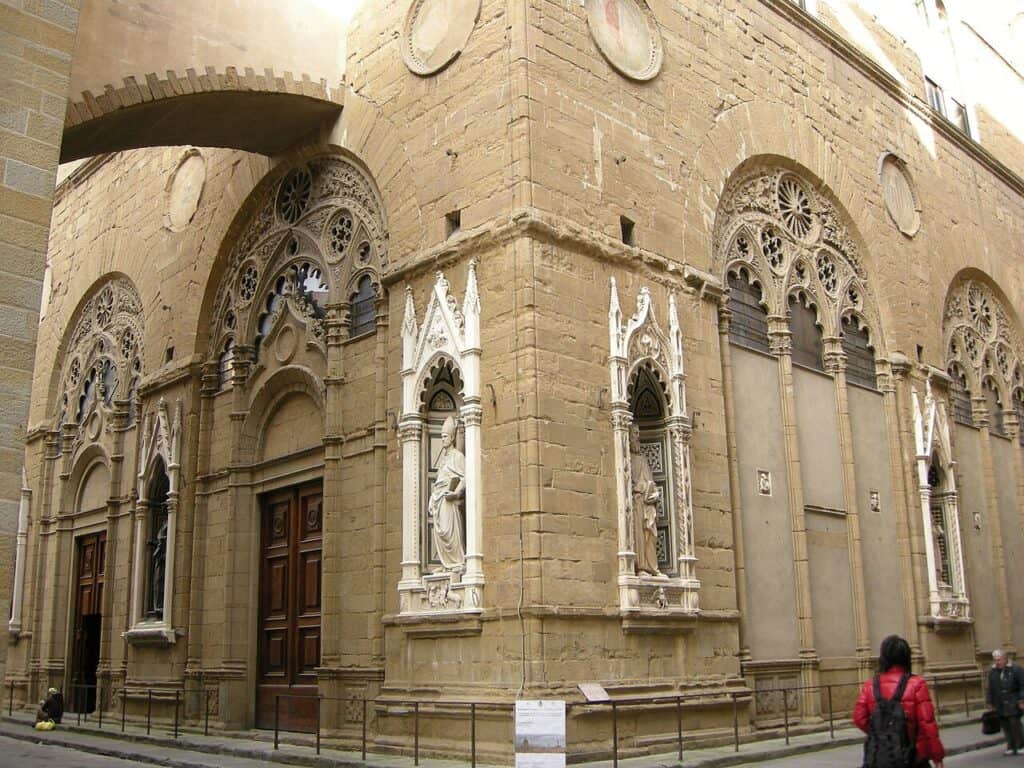
Donatello sculpted two of them:
- The Saint Mark, for the Guild of Linen Workers, is still in place: a man standing with a book in his hand, a long beard, his weight resting on one leg. Look at him from below: he’s built to be seen from there, not from the front.
- The Saint GeorgeIt was in the niche of the Armorers’ Guild. What you see on the street today is a copy; the original is at the Bargello. It’s still worth stopping by, because the niche and the tabernacle are the real ones, and you understand the effect the work must have had in that precise spot on the street.
A practical tip: the statues at Orsanmichele are free to view from the street, at any time. The internal museum, which houses some originals, has limited opening hours, so it’s best to check in advance.
Holy Cross
In Santa Croce there are two works by Donatello and they are at opposite ends of the spectrum.
- The first is the Annunciation Cavalcanti, on the right wall of the nave. A tabernacle in pietra serena with gilding, a kneeling angel, and a Mary who turns halfway, surprised, almost retreating. It is elegant, rich, built for an important family who wanted to be seen.
- The second is the Crucifix of the Bardi Chapel, the one from the anecdote with Brunelleschi. Now that you’ve come this far, go look at it calmly. There’s no beauty in that body: the ribs stick out, the head slumps to one side, the mouth is open. If you have time, cross the city center and go see Brunelleschi’s crucifix in Santa Maria Novella. It’s a twenty-minute walk, and you can compare it with your own eyes.
San Lorenzo: the Medici, the Old Sacristy and the end
The relationship between Donatello and the Medici is long and unusual. Cosimo the Elder commissioned works from him, protected him, and paid him an annuity when he was too old to work. Vasari recounts that Cosimo, shortly before dying, urged his son Piero to continue supporting him. And finally, he had him buried beside him.
To understand this bond, just go to San Lorenzo, the family church.
- In the Old Sacristy, the space constructed by Brunelleschi, Donatello worked on the stucco and bronze doors. The tondi with the Stories of St. John the Evangelist, the Four Evangelists, the cherubs in the entablature. It looks like decorative work, and in part it was, but those figures move haphazardly within rounded spaces that seem to imply order. Apparently, Brunelleschi didn’t like them at all, and the two argued precisely over this.
- Then there are the two bronze pulpits, along the nave. They are the last thing he created. He died in 1466, leaving them incomplete; his students finished them. Look closely: the Passion scenes are crowded, disorderly, with figures overlapping and breaking through the edges. There is no longer any concern for balance.
The tomb is in the crypt, beneath the basilica, a few steps from that of Cosimo de’ Medici. A simple plaque, in a place that almost no one visits. You only get there if you know it’s there.
If you’re following the route in the order I suggested, this is where it ends. You started with a twenty-year-old sculptor of a somewhat stiff David for the Duomo, and you end up here: two half-finished pulpits and a stone under the floor.
Originals and copies
This is the part that is usually missing from itineraries, but which is actually needed before leaving home.
In Florence, many sculptures displayed outdoors are copies. This isn’t a deception: the originals were brought indoors to protect them from rain, smog, and vibrations. But if you don’t know this, you risk walking around thinking you’ve seen the actual work, when in reality you’ve seen a cast.
For Donatello the situation is this.
Originals that you only see by paying for the ticket
- Saint George, marble David, bronze David, and the Marzocco at the Bargello National Museum
- Prophets of the Bell Tower, Choir, and Magdalene at the Museo dell’Opera del Duomo
Copies you see on the street for free
- Saint George in the niche of Orsanmichele
- Marzocco in Piazza della Signoria
- Prophets in the niches of Giotto’s Bell Tower
- Judith and Holofernes in front of Palazzo Vecchio, under the Loggia dei Lanzi. The original is inside the palace, in the Hall of Lilies, and requires a museum ticket.
Originals that you can watch for free or almost for free
- St. Mark in the niche of Orsanmichele, from the street
- Crucifix from the Bardi Chapel and the Cavalcanti Annunciation — Basilica of Santa Croce, entrance fee
- Old Sacristy and pulpits — Basilica of San Lorenzo, entrance fee
- Funeral monument of Baldassarre Cossa — Baptistery of San Giovanni, included in the cumulative ticket for the Duomo
Useful information
Two useful notes. The Duomo complex ticket is a single ticket, including the Museo dell’Opera, Baptistery, Bell Tower, and Dome: if you’re interested in Donatello, the museum alone is worth the expense. And the two main museums, the Bargello and the Opera del Duomo, are less than a ten-minute walk from each other.
One last thing about opening hours. The Bargello and several Florentine museums have closing days that vary throughout the year, and the basilicas have different opening hours during services. Always check the official websites the day before, especially if you only have one morning available.
It depends on how much time you have and how much you really care.
- If you have an hour or so, just go to the Bargello. The Donatello room offers you the two Davids, the San Giorgio, and the Marzocco in the same space, and alone speaks volumes about forty years of work. It’s the best ratio of time spent to things seen in the city.
- If you have half day, add the Museo dell’Opera del Duomo. It’s a ten-minute walk from the Bargello and will complete the tour: after the two Davids, the Magdalene comes as a surprise. These two museums together cover the most important part of the tour.
- If you have a whole day, put Orsanmichele and Santa Croce in the middle. You can pass through Orsanmichele anyway on your way from one side of the city center to the other, and the crucifix in the Bardi Chapel is worth the detour, especially now that you know the history behind it.
If you return to Florence or stay for several days, save San Lorenzo for last. The unfinished pulpits and the tomb in the crypt make sense once you’ve seen everything else.
A word of advice that applies to all profiles: don’t try to see all of Donatello in one day. There are six locations, four different tickets, and a fair bit of walking, and by the end you’ll be left with a jumble of statues. Better to take two leisurely stops than six marathons.
If you’re interested in this way of touring the city, it also works with other artists.In Michelangelo in Florence I took the same route and it partly passes through the same places: at the Bargello and the Opera del Duomo, there are works by both, just a few meters apart. Looking at them one after the other is the most direct way to understand how much Michelangelo owes to Donatello.
Ultimately, Donatello is the artist who forces you to look at faces. Not the perfect bodies, not the elegant poses: the faces of people you might encounter on the street, sculpted five hundred years ago by a man who walked those streets every day.