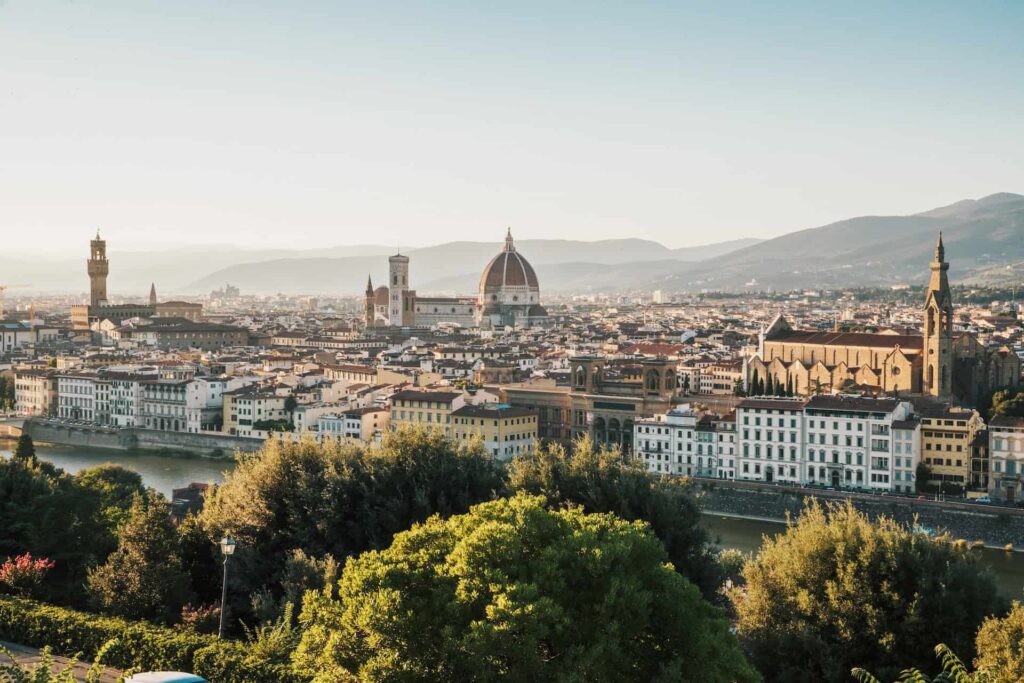


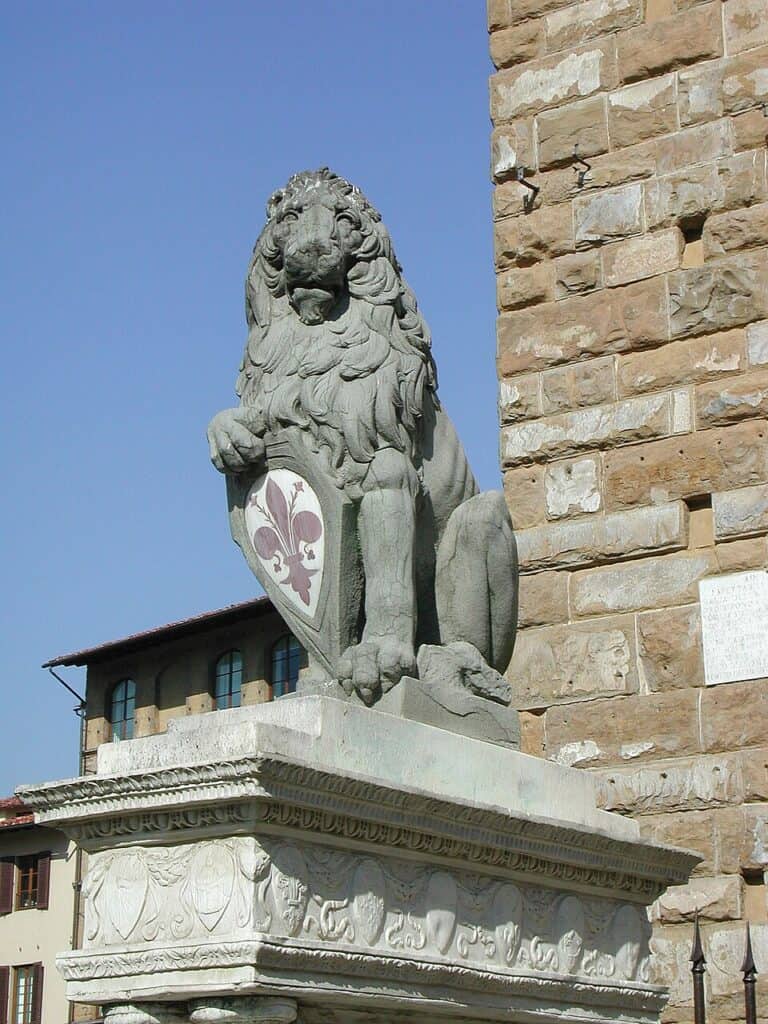
Whoever arrives in Piazza della Signoria, sooner or later, stops in front of him. He stands to the left of the entrance to Palazzo Vecchio, sitting on his hind legs, with one front paw resting on a shield bearing the red lily of Florence. He is theMarzocco, The lion that has been watching over the city for centuries.
For Florentines, it’s the symbol of a republic, of an identity, of a bond with the lion that spans nearly a thousand years of history. For the visitor encountering it for the first time, it’s a small enigma: a curious name, a proud expression, a paw resting on a coat of arms.
It’s worth stopping to understand who he really is, where he comes from, and why he continues to appear everywhere in Florence, even where you least expect him.
What is Marzocco?
The Marzocco is a heraldic lion. Depicted seated, with one paw resting on the coat of arms of Florence: the white shield with the red lily. This is the classic pose, the one that has prevailed over the centuries and is still instantly recognizable today.
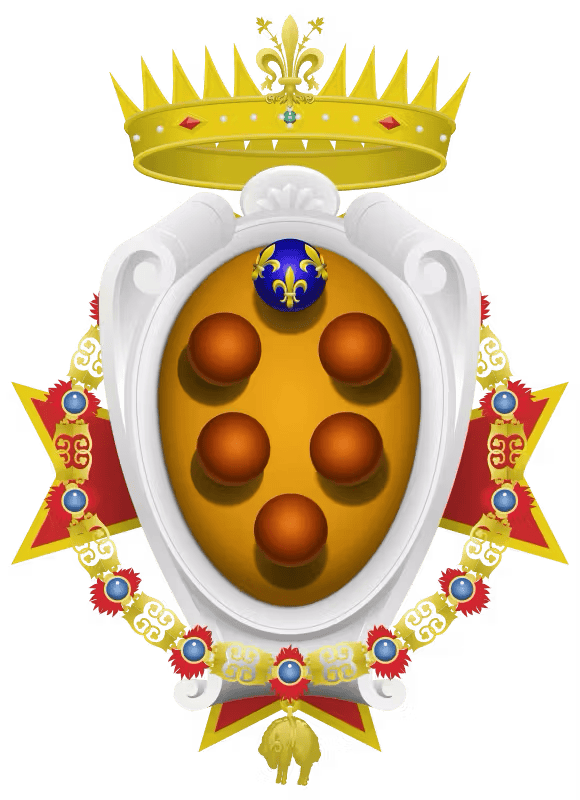
It’s not just any lion: it’s the lion of the Florentine Republic, the totem animal that the city chose as its guardian as early as the Middle Ages. It can be found carved in stone, painted on walls, cast in bronze, and carved as a weather vane on towers. It appears on buildings, bridges, gates, and even at the base of lampposts along the Arno.
In its many versions the pose changes little, and the message remains the same: this is Florentine land, and the lion protects it.
The meaning: why a lion is the symbol of Florence
In the Middle Ages many Italian cities had chosen a spirit animal, a creature that embodied the character and marked its territory. Siena had the she-wolf, Pisa the eagle, Perugia the griffin, Venice the lion of St. Mark.
Florence chose the lion and named it Marzocco. This choice reveals something specific about the city’s self-image. The lion was considered the king of beasts, the only one proud enough to bow to no one, and in Christian tradition it also evoked powerful figures such as the tribe of Judah and the lineage of King David. For a republic that championed independence, it was the right animal to rely on.
The Marzocco, in particular, represented the people’s power: not the lord, not the prince, but the Municipality and the free citizens who governed it. For this reason it was seen placed on the arengario of Palazzo Vecchio, where the people gathered for important decisions.
When Florence conquered a neighboring city, it sent a stone Marzocco to be placed in the main square, as if to indicate who was now in charge. The lion thus guarded not only Florence, but the entire territory under the Republic’s control.
The etymology of the name: from Mars to Leo
Scholars have been debating the name “Marzocco” for a long time, and there is no certain answer. The most accredited hypothesis, and also the most suggestive, connects the word to the god Mars. Originally, Roman Florence (theFlorencefounded in the Caesarian era) had Mars as its protective deity, and an ancient statue of him, according to the chronicles, watched over the city near the Ponte Vecchio. Dante also recalls this in Canto XIII of theInferno, where he has a suicidal Florentine say that the city changed its patron saint from Mars to John the Baptist, and that the old statue of the god of war continued to watch over the Arno. That sculpture, sources say, was swept away in the flood of 1333 and has since been lost.
When the medieval Florentines, now Christians, abandoned Mars for St. John the Baptist, something of the old pagan protector seems to have migrated into the figure of the lion. Hence the idea that “Marzocco” derives from the Latin Martocus, a kind of affectionate diminutive, translatable as “little Mars”.
The lion, in this interpretation, would be the heir of the ancient god of war, his domesticated version adopted by the Christian city. There is also an alternative hypothesis, of Lombard origin, which traces the word back toMarh(horse) and a verb meaning to tighten, to support. This remains a minority theory, but it demonstrates how ancient the name is and how its roots are lost in time.
Donatello’s Marzocco: the most famous statue
Among the many Marzocchis that Florence has produced over the centuries, one has eclipsed them all. Donatello made it between 1418 and 1420, in full creative youth, when he had already demonstrated his talent with the statues for Orsanmichele but was not yet the undisputed master of the Renaissance.
The commission came from the Florentine Republic in preparation for an important occasion: the visit of Pope Martin V, who in 1419 was a guest in Florence for nearly two years at the convent of Santa Maria Novella. To welcome the pontiff, the Operai del Duomo renovated the papal apartments and commissioned Donatello to create a sculpture that would dominate the entrance staircase. It was an elegant way to remind the pope, in his own home, who was the master of the house.
Donatello chose the serena stone, the ‘gray-blue sandstone from the Florentine quarries, and from that block he carved a lion unlike any other.
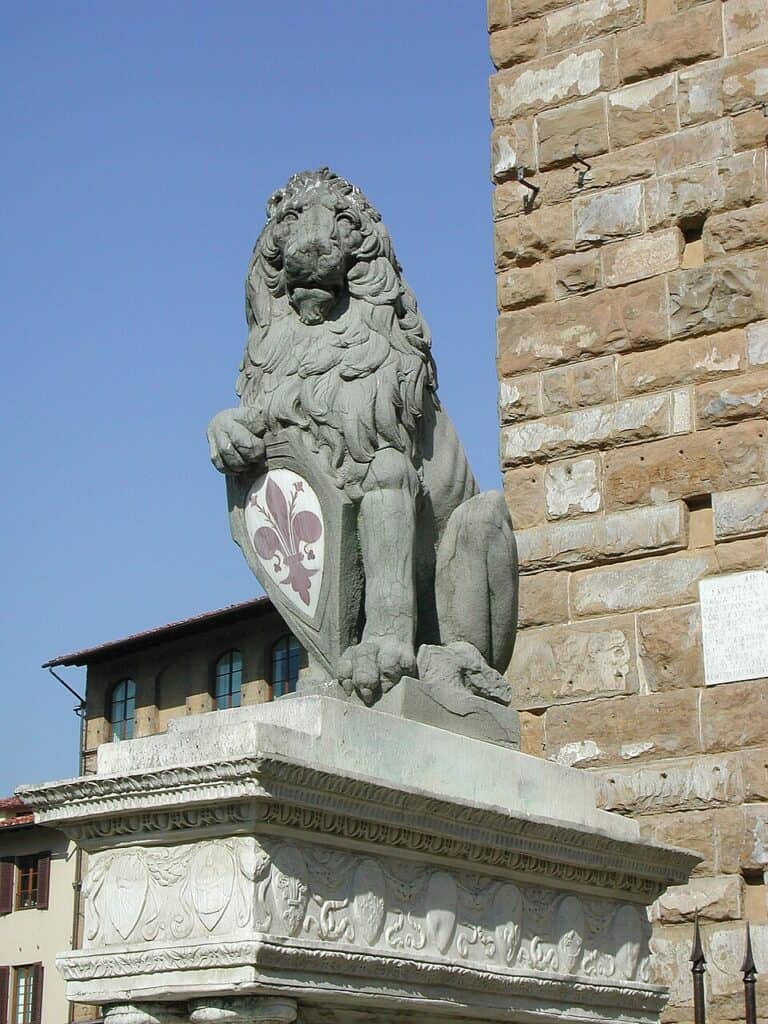
The pose is solemn, half-seated on his hind legs, with his right forepaw resting on the lily shield in an almost ceremonial gesture.
The gaze is fixed, looking into the distance, and the expression has a concentration that has struck anyone who has observed it up close. It is said that Michelangelo, speaking of Donatello, said he had never seen a more honest face than that lion. The mane is thick, crafted in deep locks that catch the light, and the body has an almost human posture, as if the animal were thinking.
The subsequent history of the statue is a little novel. After the pope’s departure, the staircase of Santa Maria Novella was demolished, and all trace of the Marzocco was lost for nearly three centuries. It resurfaced in the early 19th century, when architect Giuseppe Del Rosso, during the restoration of Palazzo Vecchio, decided to replace the old, weather-worn 14th-century lion with Donatello’s work, and in 1812 he placed it in front of the palace’s façade.
It remained there for several decades, exposed to rain and frost, until it was decided to shelter it in 1865. Since then, it has resided in the Bargello Museum, while in its place in the square, a faithful replica continues to serve its purpose.
Where is the Marzocco located today in Florence?
In Florence, the Marzocchi are not one, but many, scattered throughout the city like pieces of a mosaic that the attentive tourist ends up recognizing everywhere.
- Signoria Square, in front of Palazzo Vecchio, houses a copy of Donatello’s Marzocco. It is located to the left of the entrance, on a tall marble base decorated with the coats of arms of the Florentine districts. It is the copy that replaced the original in 1865, and for the casual visitor, it remains in every way “the” Marzocco of Florence. Next to it, on the same railing, is a copy of theJudith and Holofernes, also by Donatello, and not far away Michelangelo’s David: three symbols of the Republic placed in a row in front of the seat of power.
- The National Museum of Bargello, instead, it houses Donatello’s original, in the Sala di Donatello on the first floor. Seeing it up close, sheltered from the elements, is a different experience than encountering it in the square: the pietra serena reveals all the workmanship of the mane, the details of the muzzle, the calibrated posture. For those who want to understand why this sculpture has survived centuries without losing its power, it’s an almost obligatory stop.
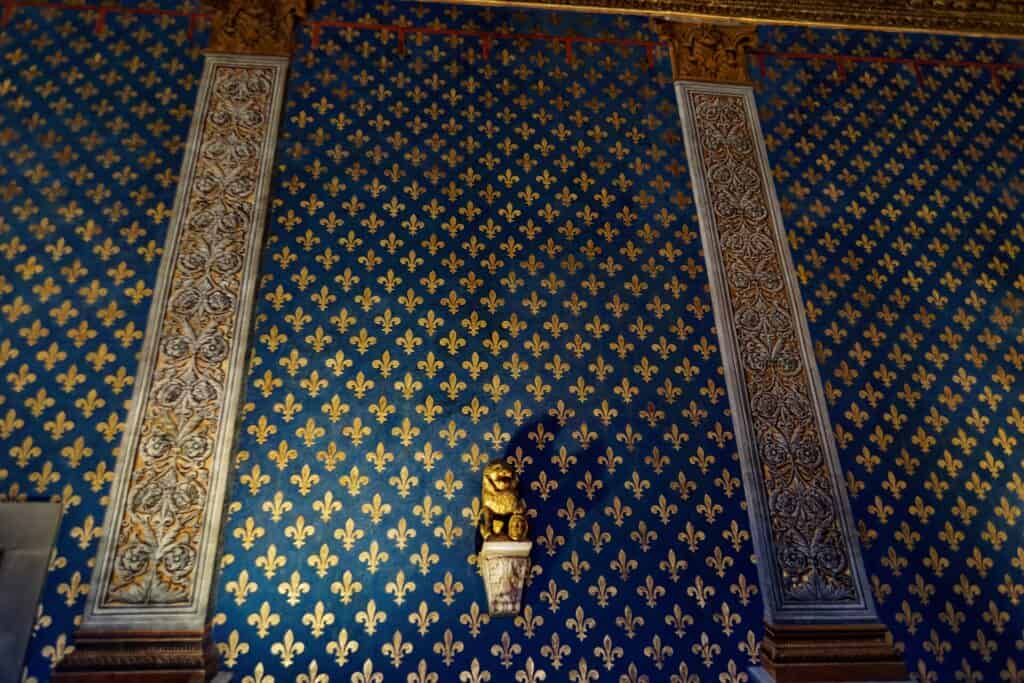
- The Old Palace. It is also dotted with Marzocchi. At the top of Arnolfo’s tower, a weather vane features the profile of a rampant lion with a lily between its paws—the oldest version of the symbol, predating Donatello’s seated iconography. Above the entrance portal stand two gilded lions guarding the entrance to the palace. Inside, in the Hall of Lilies, a large fresco by Domenico Ghirlandaio depicts a Marzocco clutching the ensign of the Florentine people, set within a cycle of Illustrious Men.
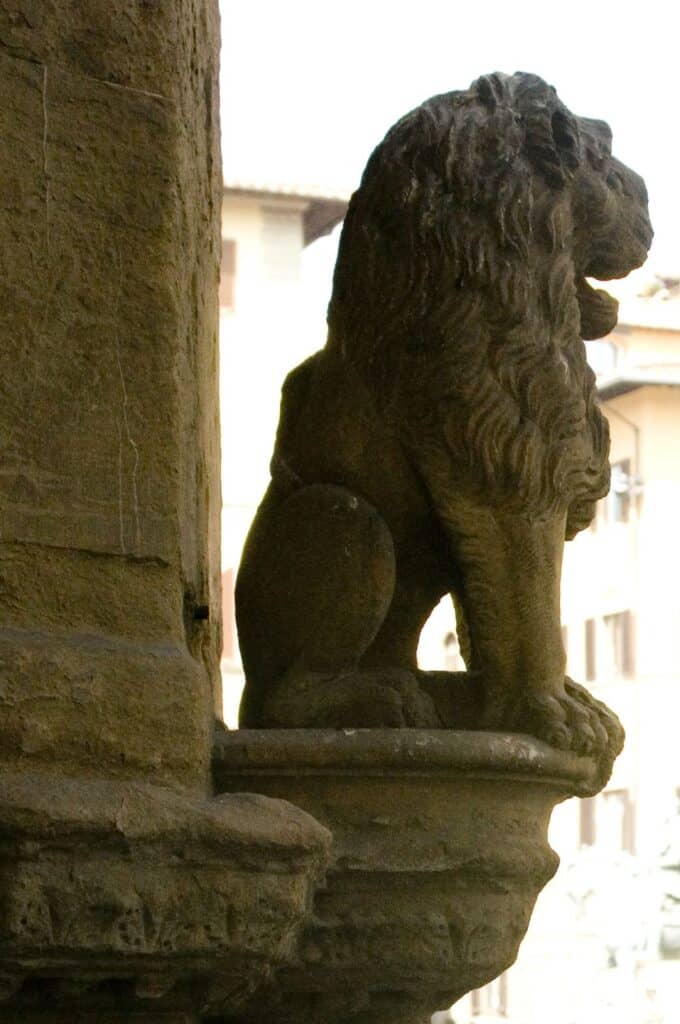
- The Loggia dei Lanzi, on the south side of Piazza della Signoria, is guarded by two stone lions at the foot of the steps. The one on the right dates back to the Roman era, while the one on the left was sculpted in the late 16th century by Flaminio Vacca to match the ancient one. They are not Marzocchi in the strict sense, but they are part of the same tradition of guardian lions that protects the civic heart of the city.
- Along the Lungarni. Finally, it’s worth looking up every now and then. The streetlamps that illuminate the banks have bases shaped like lion’s paws, a discreet echo of the Marzocco that continues to watch over the river.
- At Cascine Park, at the two monumental entrances, other pairs of stone lions guard the largest green area in Florence, as if they were the last outposts of the Florentine lion.
Legends: The Lion Who Saved the Child and the Living Lions of Via dei Leoni
One of the most beloved stories among Florentines dates back to the late thirteenth century and has the flavour of legends told around the fire.
It is said that, to assert their independence, the Guelph Party had a cage containing a real lion placed in Piazza San Giovanni, in front of the Baptistery, a tangible sign of the city’s power.
One day, the animal managed to force the bars and free itself. As panic spread through the streets, the lion grabbed a child in its jaws. The crowd stopped, mothers screamed, and the scene seemed headed for tragedy.
But the lion, instead of tearing him to pieces, placed the cub on the ground unscathed in front of his mother and calmly allowed himself to be returned to his cage. From that day on, tradition says, the lion was recognized as a lucky animal and protector of Florence, and the Florentines began to cherish it as a living talisman.
The extraordinary thing is that, legend aside, there really were live lions in Florence! For centuries the Republic maintained a real menagerie at public expense, first next to the Baptistery, then in a courtyard behind Palazzo Vecchio, in the area between the current Via dei Gondi and a street that for this very reason took the name of Lions Street.
In the fourteenth century, there were about thirty animals, cared for by a keeper who had to meet specific requirements: be of noble birth, have paid taxes for at least thirty years, and wear a long beard, contrary to the custom of the time. The well-being of the lions was considered an indicator of the city’s well-being: if the animals were healthy, Florence would prosper; if they fell ill or died, it was interpreted as a dire omen.
The Coronation of the Marzocco: A Tradition That Lives Again Every Year
Every year, in the days leading up to June 24 (the feast of St. John the Baptist, the patron saint of Florence), the copy of the Marzocco in Piazza della Signoria receives a special honor.
A delegation of the Guelph Order, dressed in Renaissance costume, joins the lion in the procession and places a golden crown on its head, leaving it there for the duration of the patron saint’s celebrations. The ceremony takes place in two parts: the Sunday before the feast and again on the morning of the 24th, and each time attracts a small crowd of Florentines and visitors who stop to watch.
The gesture has ancient roots. Already in the Middle Ages, on solemn occasions, the Marzocco of Palazzo Vecchio was crowned by the Municipality, and the band of the crown bore a noteworthy inscription:“I wear a crown for the worthy fatherland, so that everyone may maintain their freedom.”.
Crowning the lion meant publicly reaffirming that power belonged to the people and that civic freedom had to be defended, year after year. The modern ceremony takes up this legacy and reenacts it with the philological care of historical reenactors, accompanied by the Uffizi Flag Bearers and the Procession of the Florentine Republic.
For those who happen to be in Florence at the end of June, the coronation is one of the most evocative occasions to see the city display its civic traditions. It is linked toFiresSan Giovanni and the final of the Calcio Storico Fiorentino in Piazza Santa Croce. Three events that, taken together, convey a sense of a city capable of celebrating itself with its most ancient symbols, with the Marzocco in the forefront.
The Marzocchi family outside Florence: the lion as a symbol of power
Anyone traveling through Tuscany, sooner or later, will encounter a Marzocco even outside the walls of Florence. For centuries, the Florentine Republic used the lion and lily as a territorial emblem, planted in the squares of conquered or allied cities.
Outside Florence you can find Marzocchi:
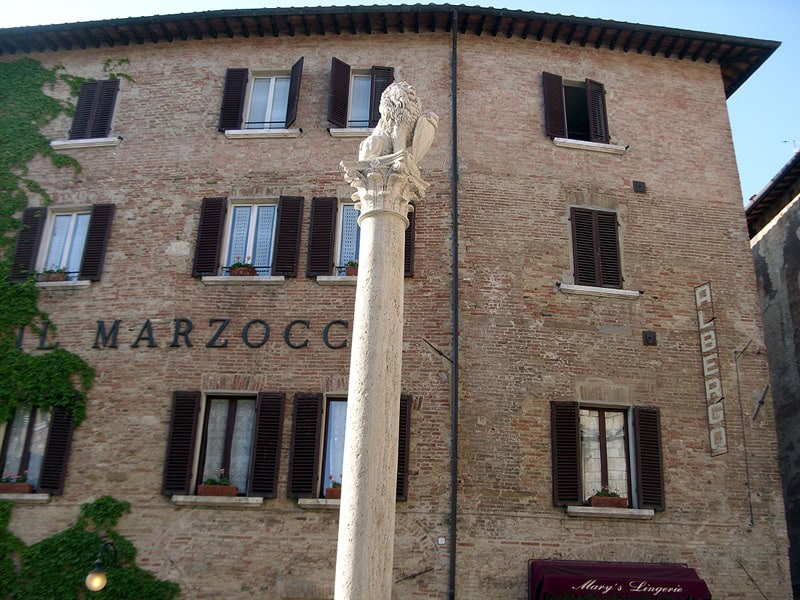
- in Montepulciano, in Piazza Grande, the Marzocco Column, erected in 1511 when the city came under Florentine control. At the top of the column stands a lion holding the coat of arms of Montepulciano, a sign that the new ruler protected the town but also recognized its identity. It is the prototype of a formula repeated throughout Tuscany: the Marzocco does not obliterate, but dominates;
- In Anghiari, in the province of Arezzo, the Marzocco PalaceToday it houses a museum dedicated to the famous battle that saw Florentine troops defeat Milanese troops on the plain below in 1440. This same battle was intended to be immortalized by Leonardo da Vinci in the hall of Palazzo Vecchio, in an unfinished fresco that was later lost. The palace takes its name from the Florentine lion that adorns its façade, a reminder of Florence’s control of that portion of the Tiber Valley.
- in Livorno, at the mouth of the port, stands since the fifteenth century the Marzocco Tower, built by the Florentines as a signal beacon and later converted into an artillery plaza. At the top, a copper weathervane in the shape of a rampant lion originally rotated, clearly visible to incoming ships—both a welcome and a warning. The tower still stands, and its name has stuck.
One could go on and on: Castrocaro in Romagna, Pietrasanta in Versilia, Pisa itself after the conquest of 1406. Wherever Florence laid hands, the Marzocco arrived punctually, carved on a door, hoisted on a column, painted on a wall. Seeing it today in these cities, far from its birthplace, tells better than any history book the geography of Florentine rule and the patience with which a small stone lion held together an idea of state for nearly four centuries.
The Marzocco continues to do what it has always done: sit in Piazza della Signoria, one paw on the lily shield, staring straight ahead. Thousands of tourists pass by every day, photographing it, believing it to be just another sculpture, and almost no one realizes that the lion has arrived there after six hundred years of relocations, legends, coronations, and battles.
But Florence knows this. It knows it in the names of its streets, in the streetlamps along its banks, in the weathervanes that swirl on its towers. And every June 24th, when the crown is placed on its stone head, the city reaffirms one simple fact: that its symbol is not just a lily, but the lion that holds it.