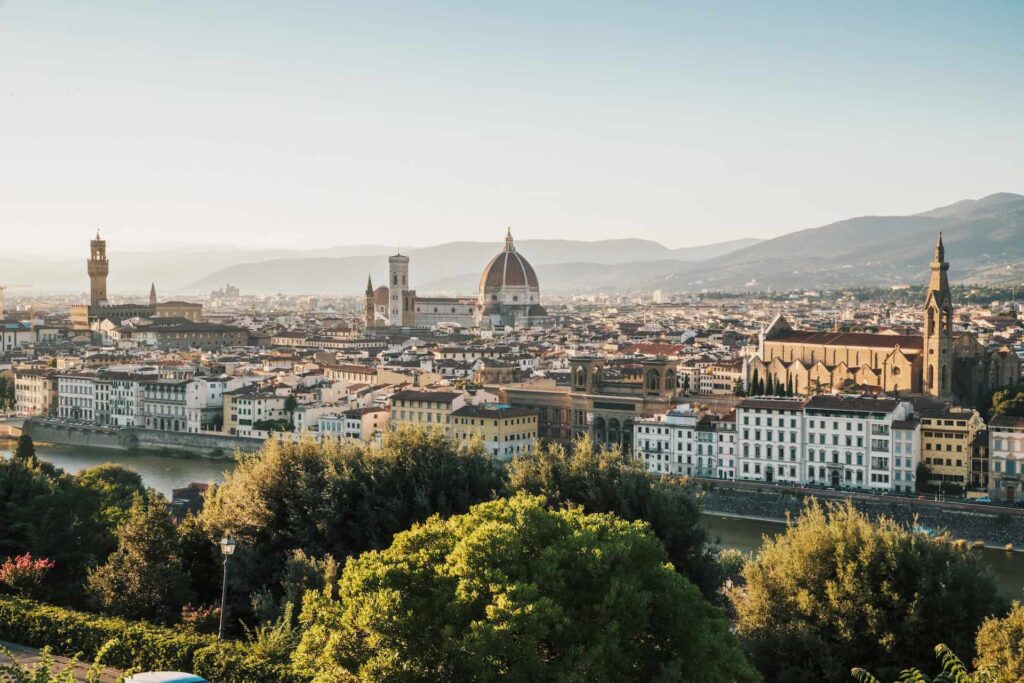


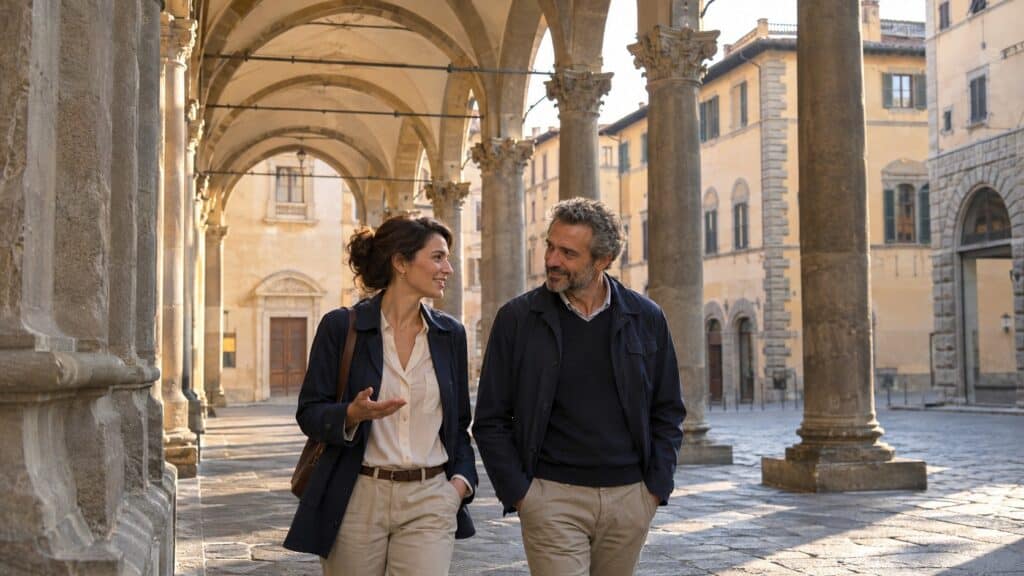
You only need to stop for a few minutes at a lampredotto stall to hear Florentine at work. The tripe seller asks you “icché tu vuoi?” (“what’ll you have?”), the customer behind you comments that with these prices “senza lilleri un si lallera,” and anyone coming from outside has a hard time keeping up.
And yet many sayings that Italians use every day, even those who have never lived in Tuscany, were born right here. Ridursi al lumicino (to be down to your last little light) and diventare la pietra dello scandalo (to become the stone of scandal) are expressions that come from the markets and streets of Florence a few centuries ago.
A few weeks ago I told you the story of the bischero, the most Florentine word there is. This post picks up from there and looks at the city’s other sayings: those born here that passed into Italian, and those that are still ours alone.
During my walks, sayings are one of the things that make the people walking with me smile the most, because almost everyone discovers they speak a little Florentine without realizing it. I’ll tell you why so many Italian sayings were born in Florence, where to find the places they come from, and which words you still hear today on the streets of the city center!
Why so many Italian sayings were born in Florence
The Italian spoken today has a Florentine foundation. In the 14th century, Dante, Petrarch and Boccaccio wrote their most famous works in the vernacular of their city, and in the following centuries that literary Florentine became the model for anyone who wanted to write in Italian. In the 16th century, Pietro Bembo pointed to it as the language to imitate, and in 1612 the Accademia della Crusca published the first Vocabolario, built on the words of Florentine writers.
Along with the words came the sayings. Many expressions born among the merchants’ stalls, the artisans’ workshops and the offices of the Republic ended up in books, and from books in the spoken language of the whole of Italy. Along the way, however, the memory of the place they came from was almost always lost.
Some of them come directly from Dante. When Italians say that something is “senza infamia e senza lode” (neither good nor bad, literally “without infamy and without praise”), they are quoting the third canto of the Inferno, where the poet describes the cowards who lived “sanza ‘nfamia e sanza lodo”. Even “stai fresco” (“you’ll be waiting a long time”) comes from the Divine Comedy, from the ice in which the traitors are immersed in the thirty-second canto. If you want to follow the poet’s footsteps in the city, I recommend the route in Itineraries in Florence among Dante’s places.
The most famous saying about the Florentine language, however, we owe to a man from Milan. In the summer of 1827, Alessandro Manzoni arrived in Florence with his whole family to revise The Betrothed, whose first edition was still full of Lombard forms. He wanted to hear how educated Florentines spoke, and on that work he built the definitive edition of 1840. He himself described it as rinsing his “cenci” (rags) in the Arno, and from this came “sciacquare i panni in Arno” (to rinse your clothes in the Arno), which today is said of anyone who goes to polish their Italian.
During that stay the Manzoni family lodged at the Quattro Nazioni hotel, in Palazzo Gianfigliazzi on Lungarno Corsini, on the corner of Via Tornabuoni and a few steps from Ponte Santa Trinita. On the facade there is still the plaque placed by the City in 1919, with the writer’s words about the waters of the Arno in which he rinsed his rags. You’ll pass it if you walk along the river from Ponte Vecchio towards the Cascine, and if you’re also curious about the bridge next to it, I wrote about it in The bridges of Florence.
At the Mercato Nuovo, debts became sayings
Under the Loggia del Mercato Nuovo, the one with the Porcellino, leather bags and souvenirs are sold today. For centuries this covered square was one of the hubs of Florentine business, frequented by silk merchants and money changers, and for this very reason it was the right place to show everyone what happened to those who didn’t pay their debts.
In the center of the floor there is a black and white marble disc reproducing a life-size wheel of the Carroccio, the cart bearing the insignia of the Republic that accompanied the Florentines into battle. It is the pietra dello scandalo (stone of scandal), also called the pietra dell’acculata. According to tradition, insolvent debtors were brought here with their trousers down and bumped several times, bottom first, on the stone, in front of the assembled merchants.
From this punishment come two expressions that we still use in Florence. Essere col culo per terra (to be left with your backside on the ground) means being left penniless, and sculo is rotten luck, the kind that leaves you flat on the ground. The expression “pietra dello scandalo,” on the other hand, is older than Florence: already in ancient Rome, those who went bankrupt had to sit on a stone and publicly declare they were giving up their assets, and today we use it for anyone who causes a stir with their behavior.
A word you still read in the newspapers comes from the same area. The Florentine banker worked sitting at a banco, the table where he counted coins and recorded exchanges, and according to the most common explanation, when he failed his banco was broken. Hence bancarotta (bankruptcy), the broken bench.
The disc can be seen properly only when the stalls are closed, early in the morning or in the evening. I also talked about it in Curiosities you can see in Florence, area by area and in the post on the Porcellino Fountain, which stands under the same loggia.
Ridotto al lumicino and essere al verde
Staying on the subject of money, walk a few minutes toward the Duomo to Piazza San Martino, a stone’s throw from Dante’s House. Here there is a small oratory with a portrait of Saint Antoninus above the door: he is the archbishop who in 1441 founded the confraternity of the Buonomini di San Martino (the Good Men of Saint Martin). They were twelve citizens charged with helping the “poveri vergognosi,” the shamefaced poor: once well-off families who had fallen into poverty and were ashamed to beg for alms.
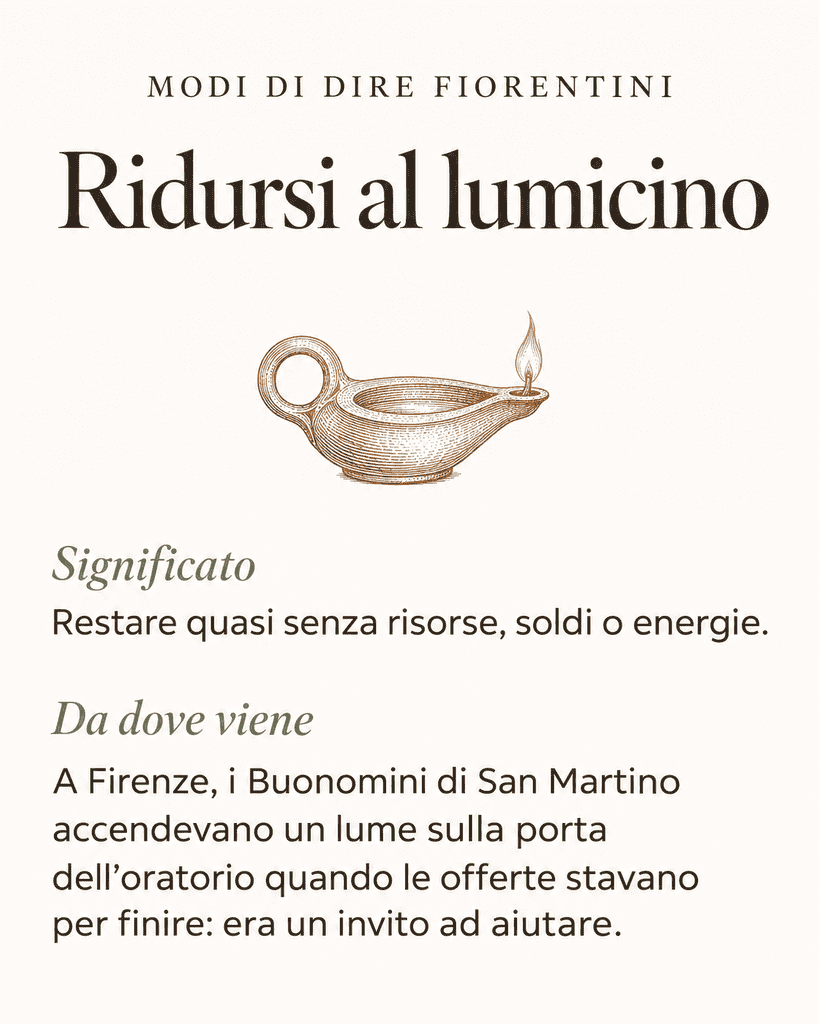
The Buonomini lived solely on donations. When the coffer was almost empty, they lit a small candle (lumino) at the oratory door, and Florentines passing by understood it was time to leave something. This is how essere ridotti al lumicino was born, which today we say of anyone left almost without resources, whether money or energy.
The confraternity still exists, and the oratory can be visited at certain hours of the day. Inside are the lunettes frescoed in the late 15th century by Ghirlandaio’s workshop, with the stories of Saint Martin and the charitable works of the Buonomini, and next to the entrance there is still the slot for leaving a donation.
Essere al verde (to be broke, literally “to be at the green”) also has a Florentine explanation, although in this case there is more than one hypothesis. The oldest is given by Paolo Minucci in his notes to the Malmantile racquistato, a 17th-century poem full of Florentine sayings. He recounts that during public auctions a candle with its lower part dyed green was lit: when the flame reached the green, the auction closed and no more bids could be made.
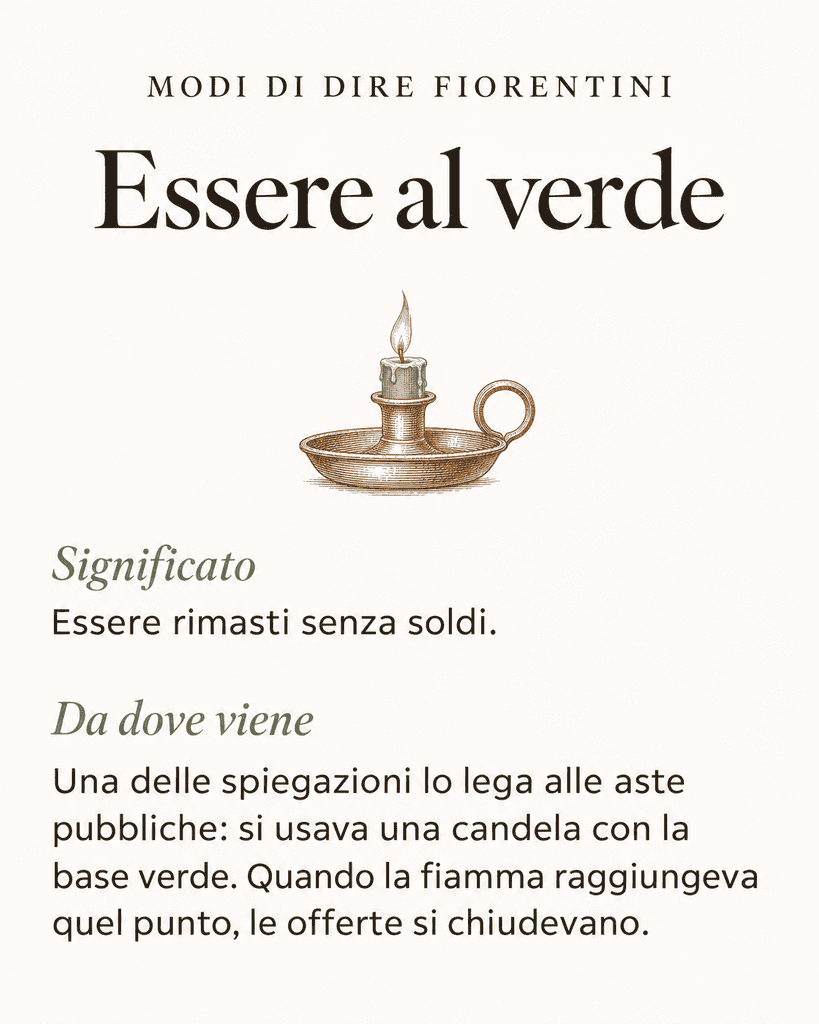
Other explanations link it to the green base of candles in general or to the cloth of gaming tables, so here it’s better to speak of tradition than of certain history.
Stare alle porte coi sassi and the city gates
Until the 19th century, Florence was enclosed by a ring of walls, the last one built between the late 13th century and 1333, with a series of gates that were closed in the evening. Those returning from the countryside after hours stayed outside until morning. According to tradition, anyone who saw the gate close by and feared they wouldn’t make it in time threw stones at the doors to warn the guards to wait.
Hence stare alle porte coi sassi (to be at the gates with the stones), which in Florence is said when a deadline is very close and you’ve left everything to the last minute. You hear it for Christmas presents as well as for a university exam. There are no documents confirming the episode of the stones, but the image of the gates closed at sunset gives a good idea of what the city was like.
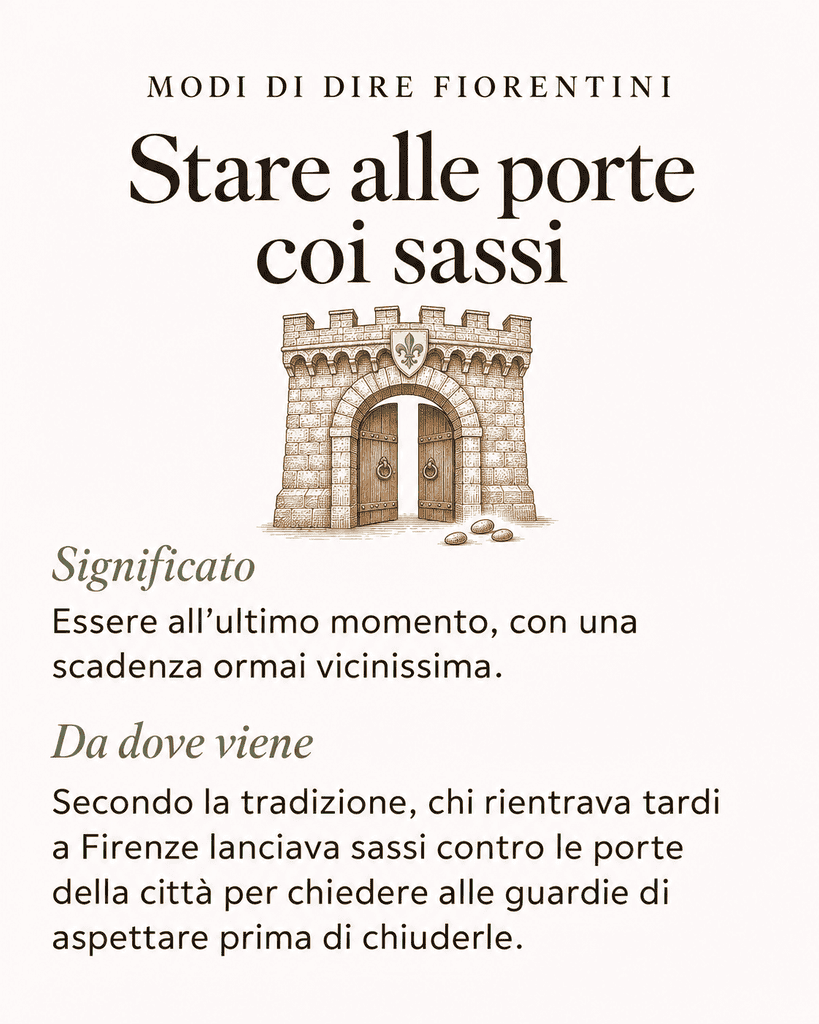
Many of those gates are still standing. Porta San Frediano, in the Oltrarno, still has its great wooden doors, and Porta Romana, opening towards Siena and Rome, is the second largest. Porta San Niccolò stands at the foot of the climb to Piazzale Michelangelo. On the right bank of the Arno, the walls were demolished in the 19th century to make way for the avenues, and the remaining gates, such as Porta al Prato and Porta alla Croce, now stand like islands amid the traffic.
A ufo and the Duomo construction site
In Florence, “mangiare a ufo” or “entrare a ufo” means eating or getting in for free, at someone else’s expense. The explanation that has been told for centuries leads straight to the construction site of Santa Maria del Fiore. The materials destined for the new cathedral, it is said, entered the city duty-free because they were marked with the initials A.U.F.O., ad usum Florentinae Operae, “for the use of the Florentine Opera,” the body that has overseen the works on the Duomo since the end of the 13th century.
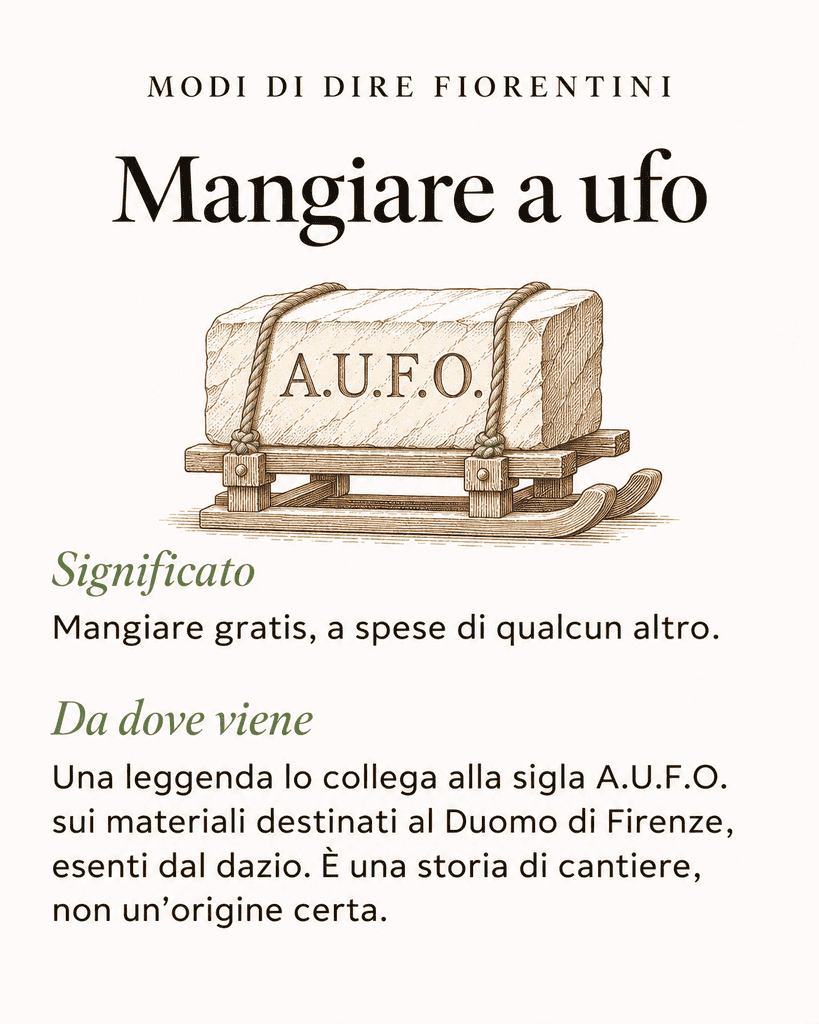
The story adds that some crafty people marked their own carts with the same letters, to get their goods through without paying. It is a version that the Opera di Santa Maria del Fiore itself is happy to tell, but linguists are much more cautious: Daniele Baglioni, in a 2025 study on false etymologies, cites it among the explanations constructed after the fact. As with the Bischeri, therefore, it’s best to tell it as a construction-site legend and not as the certain origin of the word.
From the same construction site comes another saying, lungo come la fabbrica del Duomo (as long as the building of the Duomo), for a job that never ends (they say it in Milan too, thinking of their own). The works in Florence began in 1296, the cathedral was consecrated in 1436, and the facade you see today was completed only in 1887. If you want to see the result of all those centuries up close, I’ll take you there myself on the guided tour of the Florence Duomo, and I told the story of the Dome in Brunelleschi’s Dome.
Fiorentini ciechi and other sayings about the neighbors
Tuscans have a saying ready for every nearby city, and Florentines are no exception. One of the oldest, however, is about us: fiorentini ciechi, blind Florentines. Dante already mentions it in the fifteenth canto of the Inferno, when Brunetto Latini recalls that an old reputation in the world calls the Florentines “orbi” (blind).
The early commentators on the Comedy explain the nickname with a story involving the Pisans. In the early 12th century, Pisa set out to conquer the Balearic Islands and asked Florence to guard the city during the expedition. On their return, to say thank you, the Pisans offered the Florentines a choice between two bronze doors and two porphyry columns covered with a scarlet cloth. The Florentines took the columns without looking at them closely, and only later discovered that they had been damaged by fire.
The columns really exist: they are the two red porphyry columns next to the Baptistery’s Gates of Paradise, on the side facing the Duomo. The Opera di Santa Maria del Fiore links them to the Pisan gift of 1117, while the story of the cloth and the hidden cracks remains a tradition of the commentators. Next time you stop to photograph Ghiberti’s doors, look to the sides too, and if you like these details, you’ll find more in Legends and hidden curiosities of Florence between the Duomo and the Uffizi.
Then there are the sayings that Florentines aim at others. The towns on the plain northwest of the city get “Brozzi, Peretola e Campi, Dio li fece e buttò via gli stampi” (God made them and threw away the molds), while “meglio un morto in casa che un pisano all’uscio” (better a dead man in the house than a Pisan at the door) comes from the coast, between Livorno and Lucca, and has become the most famous parochial proverb in all of Tuscany. Said by a Florentine, like “bischero,” it’s almost always a joke.
The Florentine words you still hear on the street
In addition to the sayings that passed into Italian, there are the words that remain ours, and they are the ones anyone visiting Florence hears straight away at the bar or the market. Since 1994, the Accademia della Crusca has been collecting them in the Vocabolario del fiorentino contemporaneo (Vocabulary of Contemporary Florentine), a project promoted by the linguist Giovanni Nencioni to document how people really speak in the city.
“Icché” stands for “what,” and you hear it in “icché tu fai?” (what are you doing?) or “icché c’è c’è” (whatever there is, there is). Something you like ti garba, a smart person is ganzo (or ganza), and “gnamo” means “let’s go, hurry up.” To indicate something close to the listener, people still use codesto, which at school was presented to us as a literary form and which in Florence is perfectly normal.
Then there’s the way of building sentences. A Florentine says “noi si va” instead of “noi andiamo” (we go), often puts an “o” before a name to call someone (“o Gino!”), and lunch, for many, is still il desinare.
The first thing you notice, however, is the gorgia, the aspiration of the “c” between two vowels that turns “la casa” into something like “la hasa.” The test Florentines set for anyone who wants to imitate them is to ask for “una Coca-Cola con la cannuccia corta” (a Coca-Cola with a short straw), which, pronounced as it should be, becomes “una hoha hola hon la hannuccia horta.”
And sooner or later you will also hear “senza lilleri un si lallera,” that is, without money there’s no party. Lilleri are coins, and the word seems to come from the tallero (thaler), an old silver coin. If all this talk of tripe sellers and lampredotto is making you hungry, you’ll find my recommendations in Where to eat traditional food in Florence.
A walk among the sayings in the center of Florence
Now that you know these stories, you can string them together in a walk of just over a kilometer. Start at the Baptistery and the Pisan columns, walk down Via dei Calzaiuoli and turn toward Piazza San Martino for the Buonomini’s little light, then head to the Mercato Nuovo to look for the stone of scandal. If you still feel like walking, continue along the Arno to Palazzo Gianfigliazzi, where Manzoni rinsed his rags.
I tell many of these stories during the walking tour of the city. If you liked this post, read also The Florentine bischero and Why are the streets of Florence called that way?, where you’ll find the stories behind the names of the streets and corners in the center!