

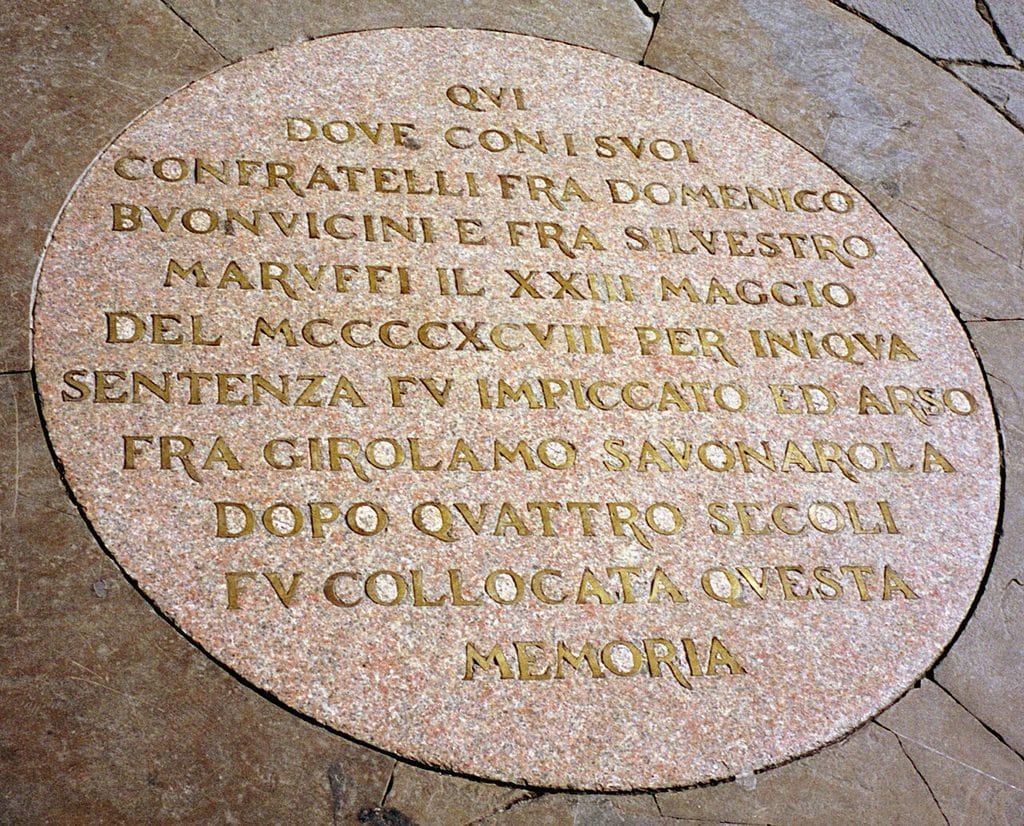
If you stop in Piazza della Signoria and look at the pavement in front of Palazzo Vecchio, a few steps from the Fountain of Neptune, there’s a circular plaque that almost everyone ignores, rushing toward the Uffizi. It marks the exact spot where, on May 23, 1498, a Dominican friar was hanged and burned in front of a crowd that, a few years earlier, had followed him as a spiritual guide.
That friar was Girolamo Savonarola. For four years, from 1494 to 1498, he was probably the most powerful man in Florence, without ever having held political office.
Who he really was, what he did in the city, and why his story ends in that very square: I’ll tell you all about it here, along with the places where you can still find traces of him today.
The friar and Florence
Savonarola was not Florentine. He was born in Ferrara in 1452, entered the Dominican order in Bologna, and arrived in Florence for the first time in 1482, without making much of an impression: his sermons, at first, emptied more churches than they filled.
He returned to the city in 1490 and was called to the convent of San Marco, the same community where you can still visit his cell today. This time, something has changed: his harsh, apocalyptic sermons announce imminent punishment for a Church and a society he considers corrupt. Florence, gripped by economic and political tensions, is truly beginning to listen to him.
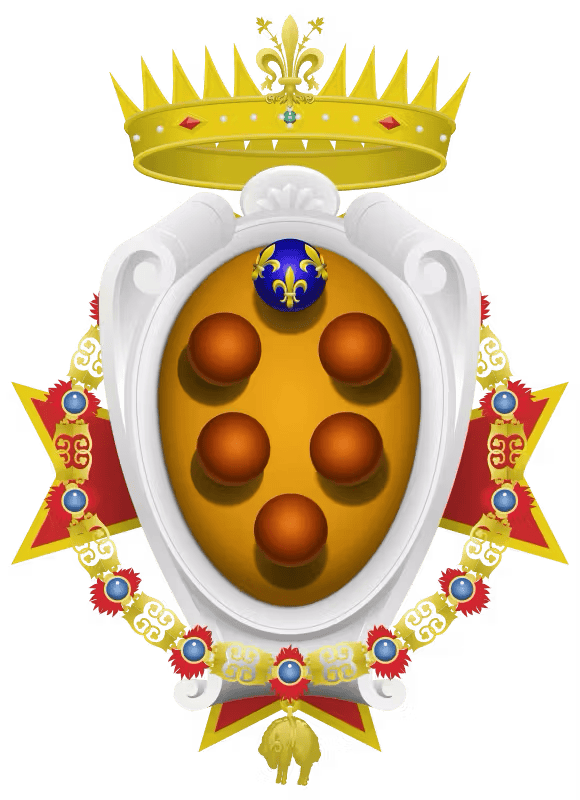
In 1494, Charles VIII of France descends into Italy. The Medici Family, who had effectively governed the city for decades, were expelled and Florence suddenly found itself without a leader. Savonarola, who had predicted a “scourge” coming from abroad, found himself in the position of being listened to as a prophetic voice. He did not hold an official position, but he was the key figure behind the new republican constitution: a Grand Council inspired by the Venetian model, designed to broaden political participation beyond the narrow circle that had governed under the Medici.
A much-told anecdote about Lorenzo de’ Medici has been circulating for centuries: that Savonarola, called to his bedside in 1492, refused him absolution because Lorenzo did not want to restore freedom to Florence. Sources on this matter are scarce, it is more of a legend passed down than a documented episode with certainty, but it’s still an anecdote that describes Savonarola well..
With Machiavelli, however, the connection is direct and verifiable: he was an official of the Florentine chancellery during Savonarola’s years, he closely observed his rise and fall, and years later he would use him in The Prince as an example of an “unarmed prophet”. Whoever tries to change things without the strength of his own to sustain him, sooner or later falls.
The Bonfires of the Vanities
During the carnivals of 1497 and 1498, right in Piazza della Signoria, Savonarola’s followers organized what would go down in history as the Bonfires of the Vanities: public bonfires in which objects considered symbols of luxury and sin were burned.
The material is collected mainly by groups of children, organised by the friar’s most faithful followers. The crybabies, as their political opponents scornfully called them, for their public weeping during sermons. They go from house to house, piling up in the center of the square mirrors, cosmetics, playing cards, dice, false wigs, sumptuous clothes, books, and paintings considered profane.
On one detail in particular, popular tradition and historical research disagree entirely: it is often said that Sandro Botticelli, impressed by Savonarola’s preaching, threw some of his own mythological paintings into the flames. This story has a grain of truth in the real connection between the painter and the Savonarolian circle of the last years of his life. However no contemporary source documents with certainty which works, if any, ended up among the burned vanities.
The Fall and Death
Savonarola’s power did not last long. In 1497, Pope Alexander VI excommunicated him for refusing to stop preaching despite Rome’s demands and openly accused him of heresy and schism.
The decisive moment came in April 1498 with what has gone down in history as the “trial by fire”: a Franciscan friar challenges a follower of Savonarola, Fra Domenico da Pescia, to walk through a corridor of fire to prove the veracity of his master’s prophecies. The ordeal never actually takes place, but the crowd, expecting a miracle, feels mocked.
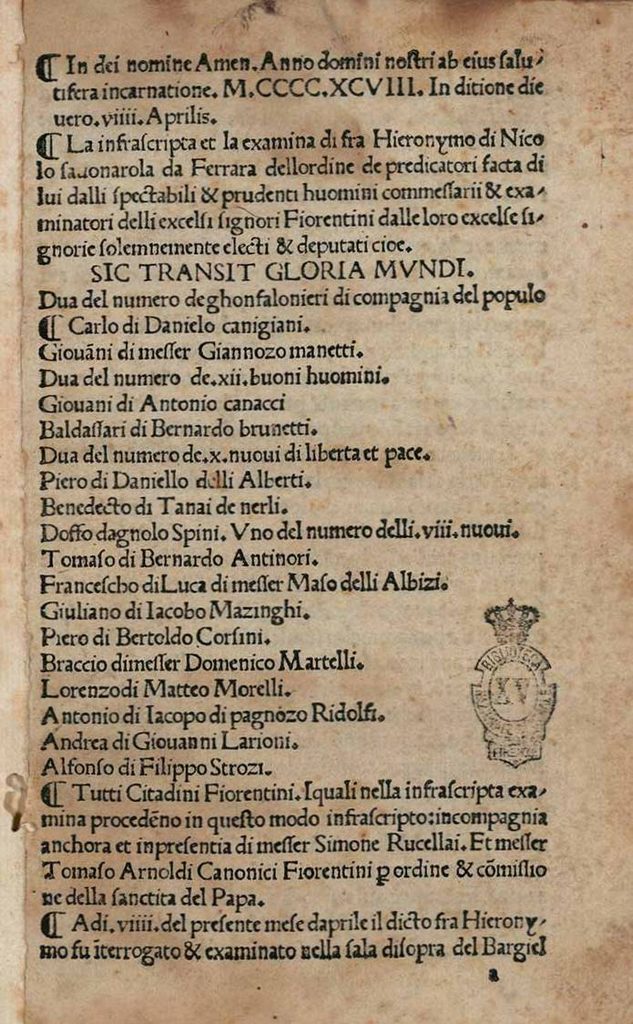
The next day, an enraged mob attacked the convent of San Marco. Savonarola was arrested along with two of his closest collaborators, Fra Domenico da Pescia and Fra Silvestro Maruffi. A trial for heresy and schism followed, conducted by both a civil and an ecclesiastical court, during which Savonarola was tortured and forced to make confessions, some of which he later retracted.
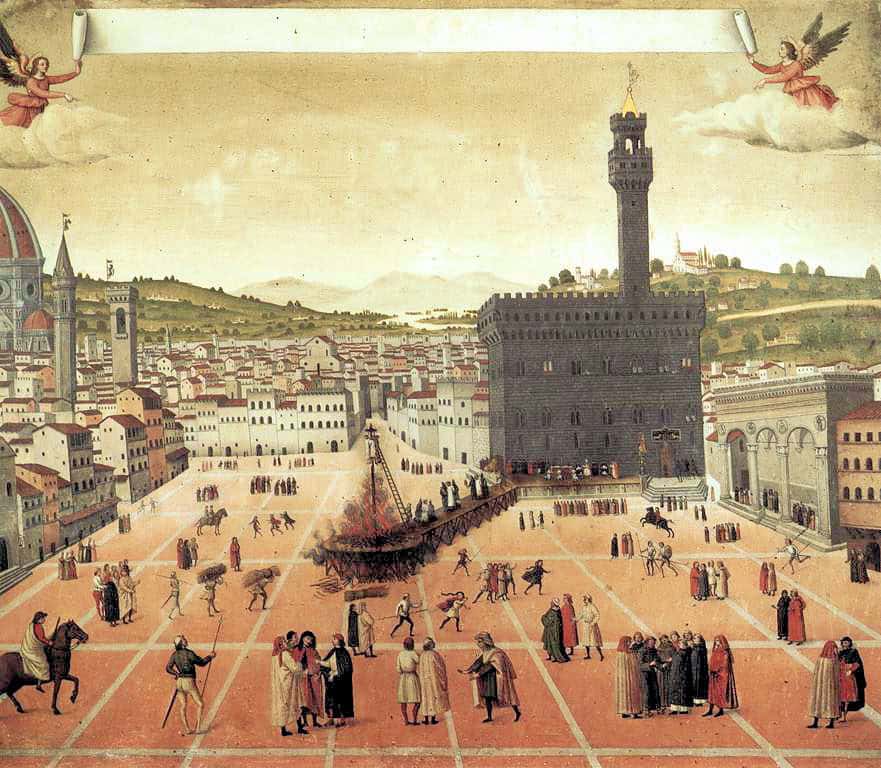
On May 23, 1498, the three were hanged and then burned on a gallows set up in Piazza della Signoria, the same site of the Bonfire of the Vanities a few years earlier. The ashes were collected and thrown into the Arno River, to prevent his followers from turning them into relics.
Where to find it today in Florence
If after this story you want to see the places with your own eyes, in Florence there remain concrete traces of it, not just a name in books.
Signoria Square. In the center of the square, between the Fountain of Neptune and the entrance to Palazzo Vecchio, a circular plaque on the ground marks the exact spot of the execution. It’s easy to walk over it without noticing: look for it by looking at the pavement, not up.
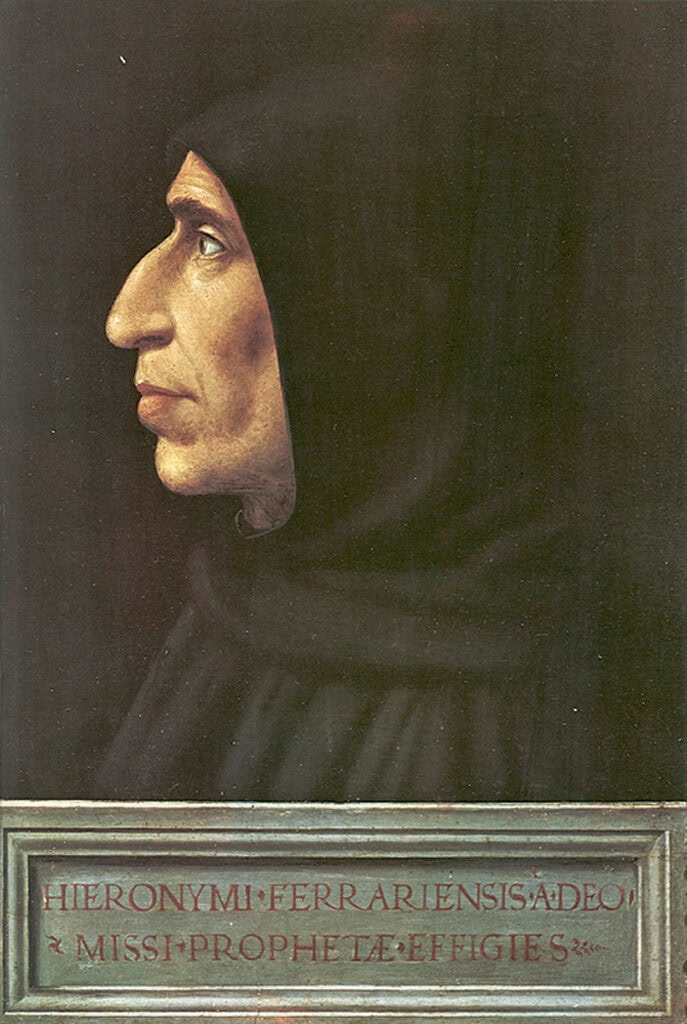
Convent and Museum of San Marco. Savonarola lived here as a prior and was arrested here on the night of the attack. Today, the complex is a museum, and among the rooms open to visitors are his cell and some of his belongings, as well as a portrait painted by Fra Bartolomeo, one of his closest followers. Check the updated opening hours before visiting, as they may change throughout the year.
Two places, just a few minutes’ walk from each other, that tell the beginning and end of the same story: from the cell where Savonarola prayed and wrote to the square where he died.