

When we think of Michelangelo Buonarroti, we immediately imagine David, the Pietà, or the extraordinary frescoes of the Sistine Chapel. It’s easy to see him as an almost superhuman artist, one of the greatest geniuses of the Renaissance. Yet even Michelangelo had to deal with daily needs: eating, organizing the house, and shopping.
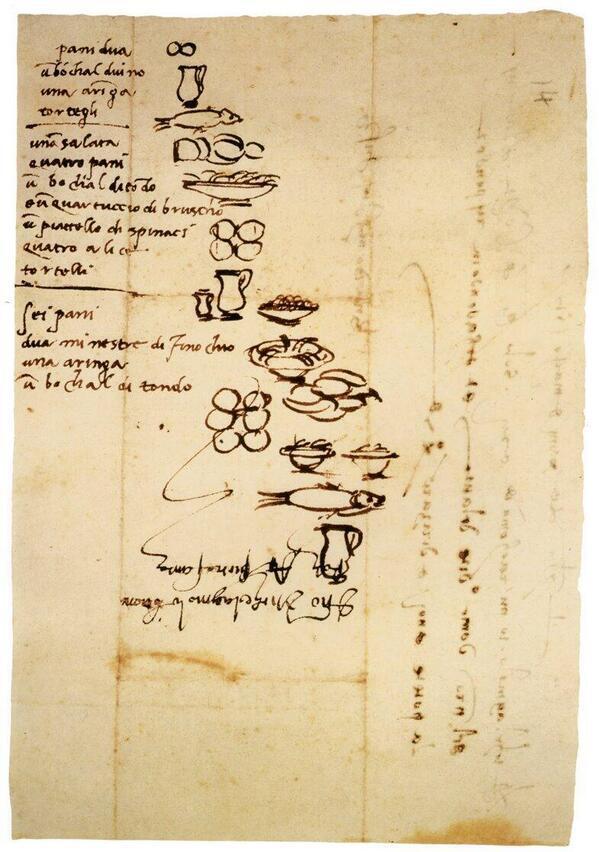
A small document preserved in Casa Buonarroti in Florence tells us about this surprisingly human side of the artist: a shopping list written in his own hand in 1518. And it’s a piece of paper you can still find right here in the city.
I’ll tell you its history and some little curiosities.
A single document
In 1518, Michelangelo was in Florence, immersed in a monumental project: the façade of San Lorenzo, the Medici Basilica. A project that absorbed him for years and was ultimately never completed.
It was precisely during those months, between powerful clients and construction sites, that he also had to think about something much more “practical”: what to put on the table. He took a letter he had received, turned it over, and on the back wrote down what he needed. Michelangelo’s shopping list read:
- there are
- wine
- herring
- buyer
- spinach
- salad
- tortelli
- fennel soup
Nothing special, they’re the same foods that ended up on Florentine tables back then. Yet it’s strange to think that he himself wrote them down, in such a hurry.
Michelangelo even drew groceries!
The most curious thing is noticeable if you look closely at the sheet. Next to each word, Michelangelo added a small sketch of what he needed: loaves of bread, fish, jugs of wine, drawn with a few quick strokes.
Many have wondered why this practice occurs, which is certainly not just an “artist’s whim”.
The most widely accepted theory is that the list was intended for a servant who couldn’t read: the drawings told him what to buy better than any words. Other interpretations are, of course, not lacking: some see something extra, an almost ironic gesture, the pleasure of illustrating even a banality.
Whatever the truth, one thing is certain. It’s striking to see him use drawing not for a masterpiece destined for posterity, but to solve a practical problem common to everyone even today.
The great absentee on the shopping list
If you look closely, this list has a blank space: meat isn’t there. There’s bread and wine, a few vegetables, and the long-lasting fish, herring and salted anchovies.
The reason lies in the calendar. It’s March, Florence is in Lent, and that year Easter would have fallen on April 4th. In the weeks leading up to it, meat wasn’t served, and people made do with what was allowed. During those days, Michelangelo ate like everyone else.
But there’s also his personality. Those who knew him described him as a man far removed from excess: he had fame and wealth, but he continued to live on very little. Faced with a menu of bread, salted fish, and fennel soup, one can easily believe him.
What from that list can you still eat in Florence?
The great thing for you as you prepare to visit Florence is that, five centuries later, that list isn’t that far removed from a Florentine lunch today! Many of those foods are still there, in markets and on menus.
Bread, for example. Tuscan bread is still made without salt, as it once was: you can find it in any bakery and it accompanies almost every dish. Even tortelli haven’t disappeared: in trattorias in Mugello and the surrounding area, they still serve them stuffed, homemade. And spinach has remained a classic, so much so that “alla fiorentina” often means with spinach: you’ll find it in varoius typical Florentin dishes even today.
Then there’s fennel, which has never gone away in Florence: you’ll find it in finocchiona, the fennel-seed-flavored salami sold in every deli downtown. And even salted herring and anchovies, the humblest fish on the list, still survive in some dishes and on slices of bread.
It’s not the same as Michelangelo’s, of course. But if you sit down in a trattoria and order bread, a plate of tortelli, and a glass of wine, you’re eating more or less the same things he wrote down on that sheet of paper in 1518. If you’re interested in hunting for these flavors, we’ve put together some tips on where to eat typical food in Florence.
Where can I see Michelangelo’s shopping list?
As mentioned,The sheet still exists and is located in Florence. It is kept in Casa Buonarroti, on Via Ghibellina, a few steps from Santa Croce: the house that the family dedicated to Michelangelo’s memory and which today is a small museum.
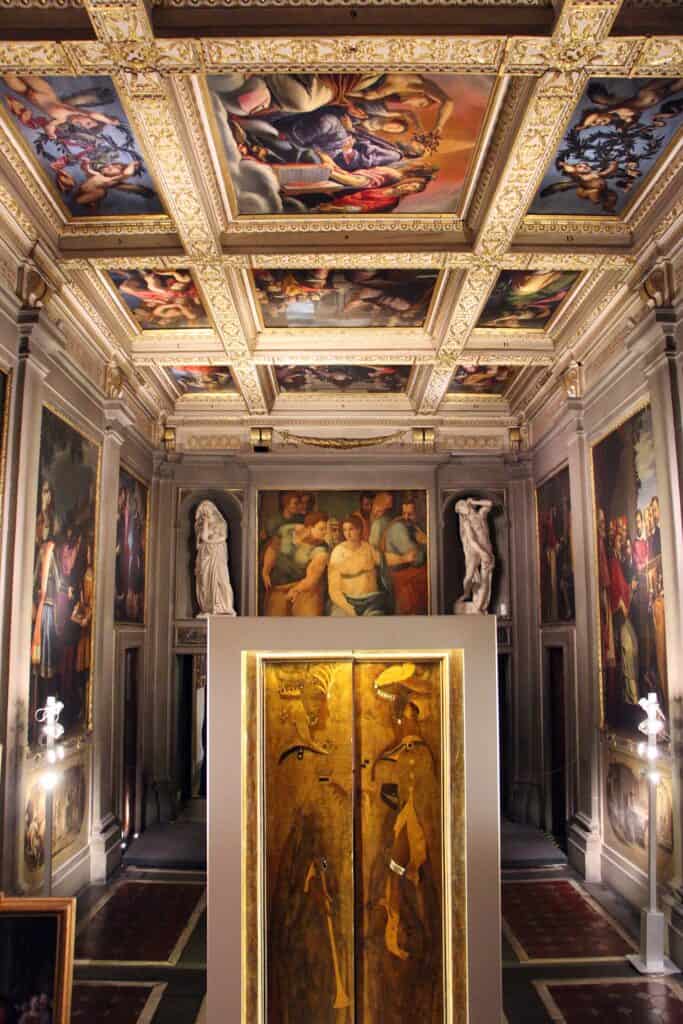
Before you go, you should know that Michelangelo’s original drawings number around two hundred, and they are very fragile. To protect them, they are displayed on rotation, a few at a time. This means the shopping list isn’t always on display; you may or may not find it there. If you’re particularly interested in seeing that particular sheet, it’s a good idea to write or call the museum before visiting and ask if it’s on display at that time.
It’s worth it, though. Casa Buonarroti is one of the quietest museums in the city center, away from the crowds of the Uffizi, and houses early works by Michelangelo that you won’t find elsewhere. For opening hours, tickets, and closing days, check out the official website of the museum, always updated.
Genius and everyday life
More than just a list of foods, this piece of paper shows us a side of Michelangelo that his works don’t reveal. Behind the man who sculpted David and painted the Sistine Chapel was someone who kept house, planned meals, and noted what was missing from the pantry.
Perhaps this is the beauty of his shopping list: it reminds us that even geniuses, before working on marble or frescoes, had to buy bread, wine, and vegetables like everyone else.
The next time you’re in Florence and stop in front of the David, think about that small sheet of paper preserved just a few steps away. It’s one of those documents that make you feel close to the man behind the artist.
And if you can’t get enough of Michelangelo, his traces in the city are everywhere: we have collected them all in Michelangelo in Florence, to build a tour of its places for you.