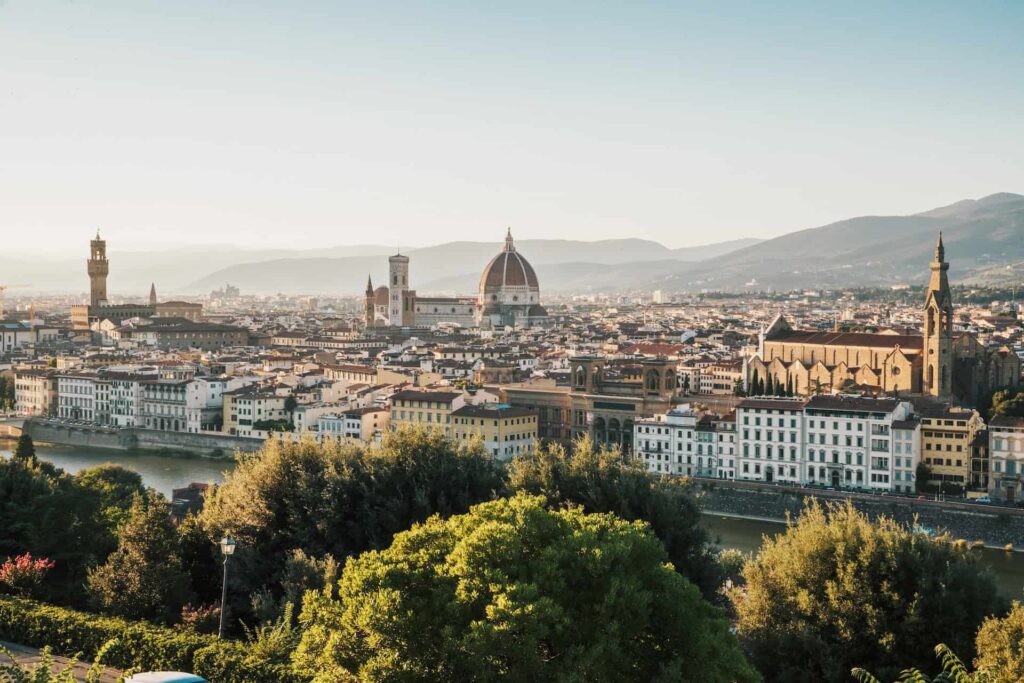


Sand on the pavement, wooden stands erected along the sides, the façade of Santa Croce closing the scene in the background. If you happen to be in Florence in the second half of June, Piazza Santa Croce isn’t the square you see in photos. For a few days, it becomes a playground.
The historic Florentine football it’s played here, as it has been for centuries. Four teams, four neighborhoods, three games in all. And a level of rivalry that Florence takes very seriously, even outside the square.
Anyone who sees it for the first time usually looks the same. It’s nothing like football, it’s even a little like rugby, and for the first few minutes, it looks more like a jumble of men throwing themselves at each other. Then you start to understand where the ball is, what the players on the wings are doing, and then you start to enjoy the game.
In this article, I’ll explain what Florentine football is, how it works, when it’s played, and how to watch it. Even in the most likely scenario, that is, when you can’t find the ticket.
What is historical Florentine football?
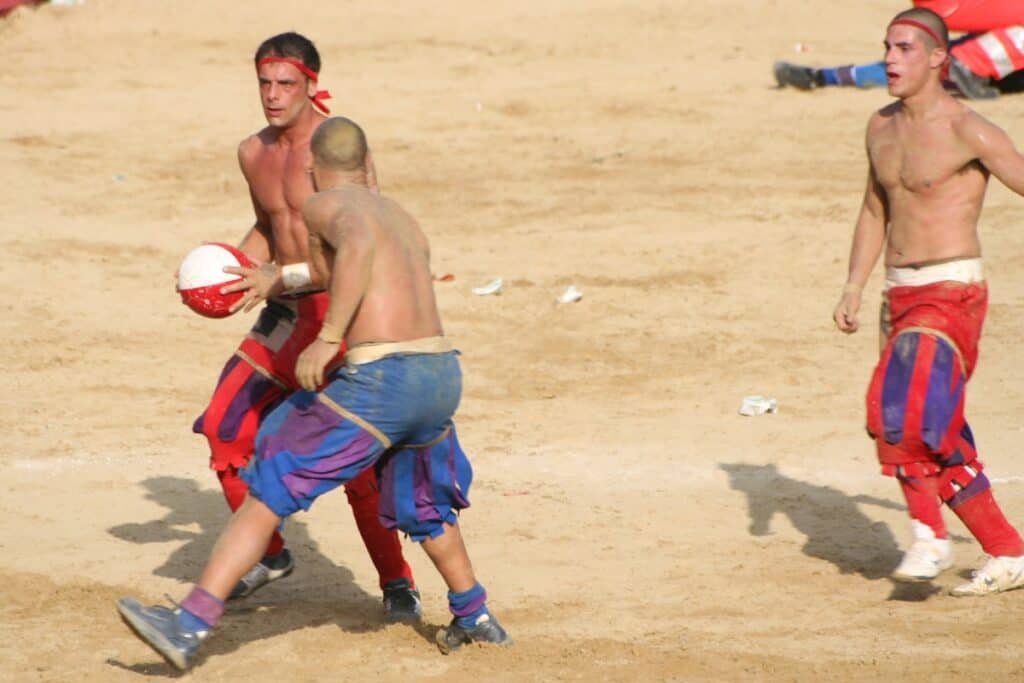
The historic Florentine football It’s a team ball game that has been played in Florence for at least five hundred years. It’s also called football in livery or football in costume, because the footballers take to the field wearing Renaissance trousers in the colours of their neighbourhood.
There are four teams, one for each historic district of the city:
- Blues of Santa Croce
- Whites of the Holy Spirit
- Reds of Santa Maria Novella
- Greens of St. John
Each team fields 27 players. The tournament is very short: two semifinals and the final, both in June, all in Piazza Santa Croce. The winner of the semifinals advances to the final on the 24th, the feast of San Giovanni.
The word “football” is confusing here. The ball can be kicked, but also picked up, carried while running, and passed as in rugby. And to stop an opponent, you tackle, push, and fight. It’s from this game, incidentally, that the Italian name for modern football comes, not the other way around.
If you’re expecting a football match in costume, well, you’ll be leftVery surprised.
Piazza Santa Croce, the playing field
Piazza Santa Croce has always been the home of historic football in the 16th century, it was one of the few Florentine squares large enough and regular enough to host such a game. Rectangular, closed on four sides, with the facade of the basilica on one side and the buildings on the other three. A sort of ready-made stadium, five centuries before the stadiums.
If you pass by in the days leading up to the games, you’ll find it undergoing a transformation. First, trucks arrive with dirt, which is spread over the pavement until it forms a compact layer of sand to cushion falls. Then, wooden stands are erected along the long sides, and the pitch is surrounded by a low fence. Nets are erected at both ends, spanning the entire length of the short side. Within a few days, the square is transformed into something unrecognizable, and remains that way for a couple of weeks.
A curious detail: on the facade of Antella Palace, the frescoed palace overlooking the square, a marble disc is set It marks the halfway line and has been there since the 17th century.
It’s worth arriving early just to see the packed square. The stands are right next to the pitch, with no social distancing like in a modern stadium, and from the front rows you can hear everything: the shots, the breath of the players, the shouts of the neighborhoods from one side to the other. The basilica remains up there the whole time, with that white and green façade that seems out of place in the match photos.
The rules of historical football
The written rules exist and are precise, but from the stands what matters is understanding a few things.
The game is tough fifty minutes and time never stops. No halftime, no injury time, no breaks for injuries. The clock starts with the starting gun and stops only at the end, fifty minutes later, with a second shot. Anyone who gets injured is removed from the field, and their team remains down to ten men until the end, with no substitutions. In the most physical matches, it can happen that a team finishes the game with four or five men down!
The goal is to get the ball over the opponent’s net, on the short side of the court. The point is called hunting and it’s the only way to score. The ball can be kicked, picked up, run, or passed in any direction.
There is, however, a rule that surprises those who discover it in the stands. If a player shoots towards the goal and misses, sending the ball out or too high, the chase is awarded half to the opponents. The score is often read at half-time: 3 to 2.5, 4.5 to 4. It serves to discourage long shots and keep the game low and close, where physical strength outweighs accuracy. Once the chase is scored, the teams switch ends and the game resumes.
The rules are less permissive regarding fights. Tackles and grappling are allowed, but only one on one. Two players may not attack the same opponent. Kicks to the back, kicks to the head, or attacks from behind on those without the ball are prohibited. Anyone committing a serious infraction is sent off, and even in that case the team is left exposed, with no replacements.
Then there are the figures that don’t play. The Master of the Field He stands at the center and intervenes when things get heated. The judges monitor the game from the sides, and the referee makes decisions from above. Drums and trumpets are played during the match, and each hunt is announced with a white flag raised on the field.
Roles on the field
The 27 players are not all the same. Understanding their positioning helps you follow the game.
There are four employers back, who stay close to their own net and act as a last line of defense. In front of them three employers ahead, the link between defense and attack. Then five stunned, distributed in midfield, with the task of breaking up the opponent’s action and freeing up space for their teammates. And finally fifteen runners, divided into groups, which are those who carry the ball and seek the hunt.
The relationship is clear when looking at the numbers: more than half the team is up front. Matches are almost always decided by the ability to open a gap between the central scrum and the net.
A tough game
Historical football is a very tough game. People get hit, fall to the ground, and leave with broken noses and cracked ribs. Medical staff are on the sidelines the entire time, and stretchers are used for almost every game. Anyone who arrives expecting a costumed reenactment with a few pushes is left feeling disoriented within the first few minutes.
The definition that is circulating on the internet, “the most violent sport in the world”, however, remains a headline-grabbing label. The game has written rules, on-field referees, suspensions, and, in recent years, stricter criteria for admitting players: those with certain criminal records are barred from the field. Teams that degenerate are fined, and more than once the tournament has been scaled back after matches that ended badly.
In short, between harshness and brawl there’s a clear difference. It’s still worth knowing what a Calcio Storico Fiorentino match entails before buying a ticket, especially if you’re bringing children. It’s a physical game where people can get seriously hurt, just a few meters from the front rows.
By the way, if you have no ideas, find out in our post dedicated to “what can you do with children in Florence“?!
The history of Florentine historical football
The game has ancient roots. Romans practiced the harpastum, a team sport with a small, stuffed ball, in which players could run, catch, and block their opponents. From there, through the centuries and local variations, the Florentine version emerged.
In 16th-century Florence, it was played wherever there was space: squares, courtyards, and fields just outside the walls. It was a pastime of noble families, played in the winter, often in the weeks between Epiphany and Lent. Imagine, the most important matches could attract the entire city!
The most folkloristic episode is that of the February 17, 1530. Florence was under siege by the imperial troops of Charles V, and the city was exhausted by hunger. The Florentines organized a match in Piazza Santa Croce for the besiegers. Musicians stood on the roof of the basilica, players kicked balls on the pitch, all in plain sight. A gesture of defiance, to show that within the walls there was still energy to waste on a game. Florence fell a few months later, but that match remained in the tradition and memory of historical football.
The first written rules
The first written rules arrive in 1580, when the count Giovanni de’ Bardi publishes The Speech on the game of Florentine football. It is the text that establishes the number of players, roles, pitch dimensions, and permitted behavior. It remains the reference for modern regulations as well.
In the seventeenth century it progressively lost ground, the matches became less frequent and in the nineteenth century it disappeared completely from city life for over a century.
The rebirth is of the 1930, for the fourth centenary of the siege. The initiative was initiated by Alessandro Pavolini, a Florentine fascist leader, during a period of intense revitalization of local traditions for propaganda purposes. From that year onward, the tournament between the neighborhoods became a regular fixture, interrupted only by the war and resumed afterward. The current format, with four teams, semifinals, and the final on June 24th, stems from that period.
The prize for the winning team retains a surprising peasant trait: in addition to the prize, The Field Master symbolically delivers a Chianina calf.
Historical football and the Feast of San Giovanni
The final will be played on June 24th, St. John the Baptist’s Day, patron saint of Florence. It’s the date around which the city’s most important day of the year revolves, and historic football is just one part of it.
The morning begins with the mass in the Baptistery and the official ceremonies. In the afternoon the Historical Procession of the Florentine Republic passes through the city center: five hundred costumed figures, drums, trumpets, flags, and armor. It starts from Santa Maria Novella and arrives in Piazza Santa Croce, where the procession enters the field before the match. It passes through the historic center, so you can catch it even without a ticket, staying in the streets along the route.
At nine o’clock in the evening the fires, the fireworks set off from Piazzale Michelangelo. It’s the other great moment of the day, the one that closes the festival and that Florentines watch from the Lungarni, the bridges, and the terraces. If you want to know where to watch them and what time to go, I’ve discussed it in detail in the article on the “Feast of San Giovanni and the fires of Florence”.
June 24th is also a holiday in Florence. Many shops and offices are closed, the city center is crowded from the morning, and traffic in the Santa Croce area is closed several hours before the match.
When to play and how to watch the matches
The tournament takes place entirely in June. The two semifinals are played in the first half of the month, usually on a weekend, while the final always falls on the 24th. Three matches in total, all in Piazza Santa Croce, all in the late afternoon.
Tickets are sold online through the official channels designated by the City of Florence. Tickets usually go on sale a few days before matches.
Seats in the temporary stands are limited to a few thousand and fill up very quickly, often within minutes. Prices vary depending on the sector: the stands in the curves are less expensive than the central stands, which also offer the best view of the pitch.
The only way to have a real chance is to keep an eye on the City’s channels starting at the end of May, knowing the exact day and time the sale opens, and being online at that time. Anyone who tries the next day will find everything sold out.
If you can’t find your ticket
It happens to most people, and it doesn’t mean you should stay out of the party.
The historical procession is free and can be seen from the street. It passes through the city center in the afternoon, with hundreds of participants, drums, and trumpets, and passes through streets where you just need to set up a little early.
The matches are broadcast live from local television and are followed in many bars and clubs downtown, especially those in the neighborhoods where the races are held. Watching them from a bar in Santo Spirito or Santa Croce, surrounded by fans, is a different experience than sitting in the stands, but far from disappointing.
And then there are the fireworks on the evening of the 24th, visible free of charge from the riversides and bridges.,
Practical advice if you go to the square
- The heat is the first thing to consider. In June, Florence easily reaches over thirty degrees Celsius, and the stands are uncovered, with no shade. Matches are played in the late afternoon, so the sun still beats down strongly on the west-facing stands. A hat, water, and sunscreen are essential.
- The entering the square takes time. The gates open well before kickoff, and security checks slow down the line considerably, especially for the final. Arriving an hour early is reasonable, especially since it allows you to see the procession enter the field, which is one of the best moments of the day.
- It’s best to pack lightly: large backpacks, glass bottles, and flagpoles won’t pass through security. There’s no left-luggage office in the square. A fully charged phone is useful; tickets are digital.
- Forget the car, because the entire Santa Croce area closes off hours earlier and the ZTL remains in effect. The center can be reached on foot from any point in the historic center, and those arriving from outside Florence are quicker to leave their car in an outdoor parking lot and take the tram or bus (for more information, see our guide on “Where to park in Florence”).
- As you leave, the square slowly empties, and the surrounding streets remain blocked for a long time. If you have a train or dinner reservations, calculate at least half an hour more compared to what the map says.
- One last thing about children. There are no age limits, but the game is as I described it: violent contact just a few meters from the front rows, loud noise, a compact crowd, and vulgarity. With the little ones, the historical parade works well; think carefully about the match.
Why is it worth seeing?
What’s most striking about Florentine Calcio Storico is that it’s not a spectacle for tourists. The players are locals, the crowd is largely Florentine, and the rivalries between Santa Croce, Santo Spirito, Santa Maria Novella, and San Giovanni are genuine and centuries-old. Training takes place all year round for three matches. The winner carries the result with him until the following June.
Even without a ticket, June 24th remains one of the best days to be in Florence. The procession passes through the center in the afternoon, the city celebrates from the morning, and in the evening the fireworks close out everything from Piazzale Michelangelo.