

The Porcellino Fountain, in the heart of the Mercato Nuovo, is one of the most beloved symbols of Florence. Between Medici history and popular tradition, the statue of the boar is linked to a small ritual of luck that promises a return to the city. A simple place, but rich in meaning.
But what should you really do in front of the Porcellino? Why is it called that if it is not actually a pig? And what is the legend that promises to bring you back to Florence?
In this article, I will guide you to discover its history, meaning, and some curiosities that often escape those who limit themselves to taking a photo and leaving.
Where to Find the Porcellino Fountain
The Porcellino Fountain is located under the Loggia del Mercato Nuovo, between Piazza della Repubblica and Ponte Vecchio. We are in the heart of the historic center, just a few minutes’ walk from Palazzo Vecchio and the Uffizi.
To easily orient yourself: if you move from Piazza della Signoria towards the Arno, you will almost certainly pass by here. The loggia opens onto a small covered square, where today you can find stalls selling leather goods and souvenirs. It is one of those places where tourism and history have coexisted for centuries, albeit in different forms.
The Mercato Nuovo was established in the 1500s as a space dedicated to the trade of fine fabrics, particularly silk and refined textiles. It was an important exchange point, frequented by merchants and nobles. Today the atmosphere has changed, but that idea of a lived-in, traversed, and animated place remains.
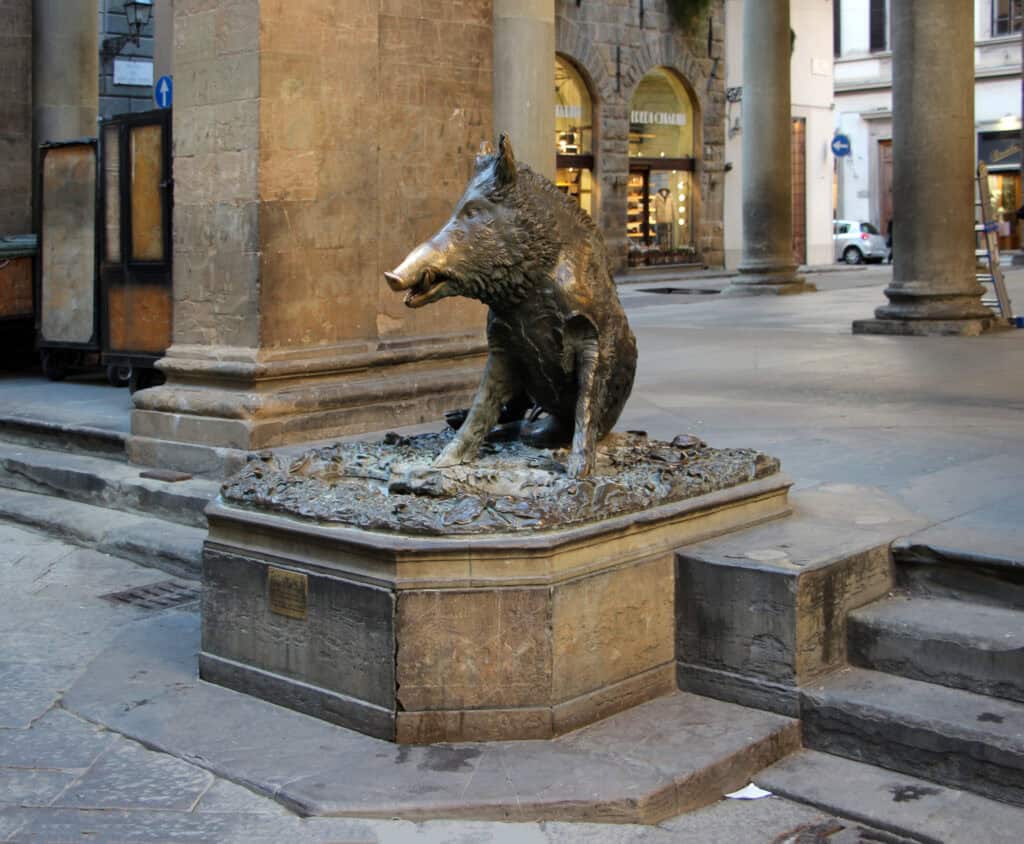
The statue of the Porcellino is located on one side of the loggia, not in the center. It is not gigantic, and perhaps that is what makes it special: you have to get close, almost search for it among the people. And when you find it, you immediately recognize it by the golden nose that shines.
From here, the most fascinating part of the story begins.
The Legend of the Porcellino: What to Do (and Why Everyone Does It)
In front of the Porcellino, the scene repeats every day, almost identical yet always different. Some approach with a playful air, some do so with conviction, and some see it as just a simple tourist game. However, everyone ends up performing the same gesture: a stroke on the snout and a coin left to slide between its jaws.
Tradition says that rubbing the nose of the Porcellino brings good luck. It is a quick gesture, but loaded with symbolic meaning: you touch the statue, make a wish, and let a coin fall from the animal’s mouth towards the grate below. If the coin manages to pass through the grid, the wish will come true and, above all, you will return to Florence.
It doesn’t matter how much you believe in superstitions. What matters is the moment itself. In a city dominated by solemn works and grand monuments, this small ritual creates a more direct, almost intimate connection with the place. It is a simple gesture that brings together people from all over the world, all united by the same hope, even if just for fun.
The shiny nose of the statue tells this story better than any explanation. It is not an effect intended by the sculptor, but the result of thousands of hands that over the years have repeated the same movement. It is concrete proof that the Porcellino is not just a statue, but a meeting point between tradition and everyday life.
Today, the collected coins are donated to charity, transforming a popular legend into a small act of solidarity.
And there is one detail that surprises many visitors: the “Porcellino” is actually not a piglet at all!
So Why Is It Called “Porcellino”? History and Meaning of the Statue
Many visitors are surprised when they discover that the Porcellino is not a piglet at all, but a wild boar. The nickname was born over time, probably to make the statue more likable and immediate, but the animal depicted is actually a wild boar.
The sculpture we see today is a bronze copy made in the Seventeenth century by Pietro Tacca, an artist active at the Medici court. Tacca was inspired by an ancient Roman statue, which in turn was derived from a Greek model. This means that behind what we perceive today as a small city curiosity lies a much longer artistic story, rooted in classical tradition.
In the Renaissance and Medici context, the interest in antiquity was very strong. Reproducing classical works meant celebrating the past while enriching the city with new symbols. The boar, in ancient culture, was linked to strength, nature, and hunting, far from the idea of “good luck charm” that we associate today with the statue.
However, over the centuries, the original meaning has transformed. The work has become part of the daily life of the city and has acquired a different, more popular value, linked to tradition and the ritual of currency. The original version of the sculpture is now preserved at the Bardini Museum, while under the Loggia del Mercato Nuovo there is a copy, chosen precisely to preserve the work from wear caused by the constant contact of visitors.
The history of the statue is therefore intertwined with both Medici art and the more vibrant and spontaneous dimension of the city. And it is precisely this combination of culture and popular tradition that makes the Porcellino so special.
The Porcellino Market: History and Curiosities
The Fountain of the Porcellino is located under the Loggia del Mercato Nuovo, an elegant covered space built in the sixteenth century to host the trade of precious fabrics. At that time, silks, fine fabrics, and valuable goods were sold here: it was a place frequented by merchants and nobles, in a Florence that thrived on exchanges and craftsmanship.
Today the atmosphere is different, but the commercial vocation has remained. The stalls mainly sell leather goods and souvenirs, and the loggia is one of the liveliest spots in the historic center. It is interesting to think that
Right here, in a space born for commerce, a ritual linked to fortune and money has become so strong.
There is also a detail that often goes unnoticed. On the floor of the loggia, there is a circular marble slab, traditionally called the “stone of scandal.” According to tradition, this is where insolvent debtors were publicly punished: a public humiliation that served as a warning for others. The contrast is curious: on one side, the ritual of tossing a coin to attract luck, on the other, the memory of those who had lost their money.
This intertwining of official history, daily life, and small superstitions is what makes the place interesting beyond the usual photograph. It is not just a quick stop between one museum and another, but a space that tells of a more concrete Florence, made of merchants, shops, traditions, and gestures that have been passed down through time.
The Fontana del Porcellino is one of those places that one risks dismissing in a few seconds: a photo, a coin, and off to the next stop. Yet, if you pause for a moment longer, you realize that beneath that loggia intertwine Medici art, popular tradition, and mercantile memory.
In the Renaissance and Medici context, the interest in antiquity was very strong. Reproducing classical works meant celebrating the past while at the same time enriching the city with new symbols. The boar, in ancient culture, was associated with strength, nature, and hunting, far from the idea of “good luck charm” that we associate today with the statue.
However, over the centuries, the original meaning has transformed. The work has become part of the daily life of the city and has acquired a different, more popular value, linked to tradition and the ritual of currency. The original version of the sculpture is now preserved at the Bardini Museum, while a copy can be found under the Loggia del Mercato Nuovo, chosen precisely to preserve the work from wear caused by the constant contact of visitors.
The history of the statue is therefore intertwined with both Medici art and the more vibrant and spontaneous dimension of the city. And it is precisely this combination of culture and popular tradition that makes the Porcellino so special.
The Mercato Del Porcellino: History and Curiosities
The Fontana del Porcellino is located under the Loggia del Mercato Nuovo, an elegant covered space built in the sixteenth century to host the trade of precious fabrics. At that time, silks, refined fabrics, and valuable goods were sold here: it was a place frequented by merchants and nobles, in a Florence that thrived on exchanges and craftsmanship.
Today the atmosphere is different, but the commercial vocation has remained. The stalls mainly sell leather goods and souvenirs, and the loggia is one of the liveliest spots in the historic center. It is interesting to think that
The gesture of rubbing the snout and dropping a coin is not just a tourist superstition. It is a way to participate, even if just for a moment, in a custom that spans centuries of history and millions of visitors.
If you pass by, allow yourself a few extra minutes. Observe the hustle and bustle of the market, watch the reflection of the bronze in the daylight, and try the little ritual yourself. Whether you believe in the legend or not, that gesture will connect you to Florence in your own unique way.
