


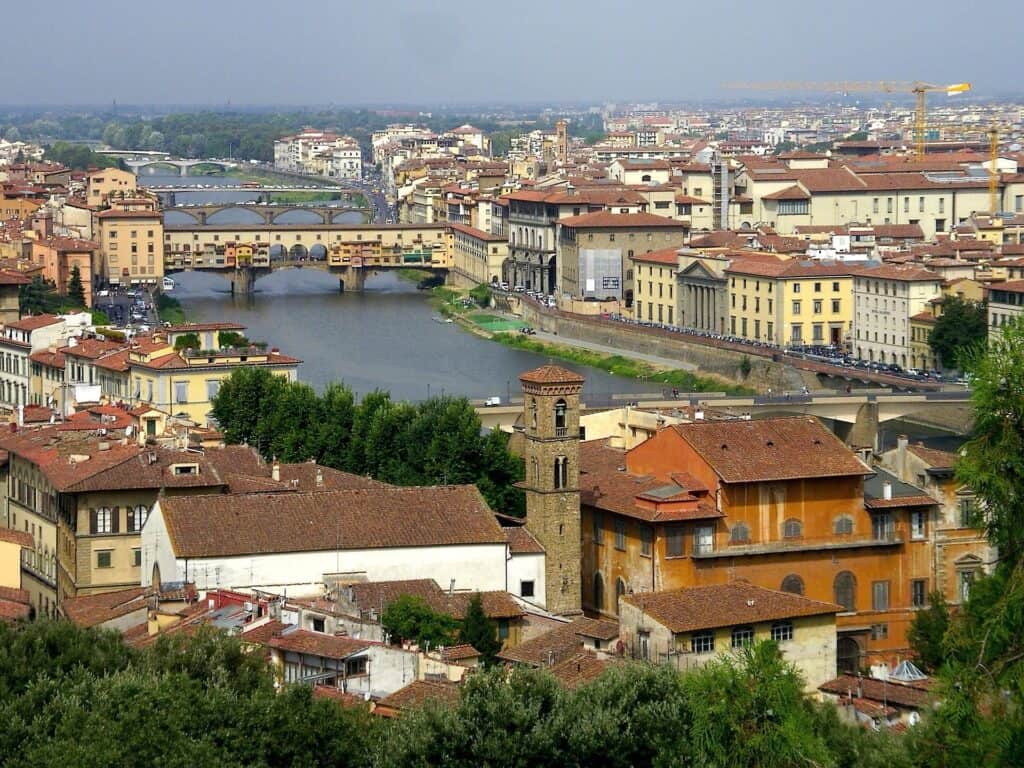
In Florence, one often moves by looking up: domes, towers, facades. Then, at a certain point, one realizes that just getting closer to the Arno can completely change the perspective.
The bridges of Florence are not just passages from one bank to the other.
They are observation points. From there, the city expands, breathes. You can see the buildings reflecting in the water, the hills in the background, the rows of roofs that seem never-ending. Each bridge offers a slightly different Florence.
There is the most famous one, which everyone recognizes at first glance. There is the one that offers the best view at sunset. There is the one you almost cross absentmindedly, not knowing that beneath your feet an important part of the city’s history has passed.
Walking along the Arno and crossing its bridges is one of the simplest ways to understand what Florence is really like. Not just monuments, but perspectives, silences, light that changes.
In this journey, we see them one by one, without haste.
How Many Bridges Are There in Florence?
If you stop for a moment along one of the banks of the Arno and start looking at them in sequence, you realize that there are quite a few. In the main urban stretch, the one that crosses the historic center, there are six bridges. And each one tells a different phase of the city.
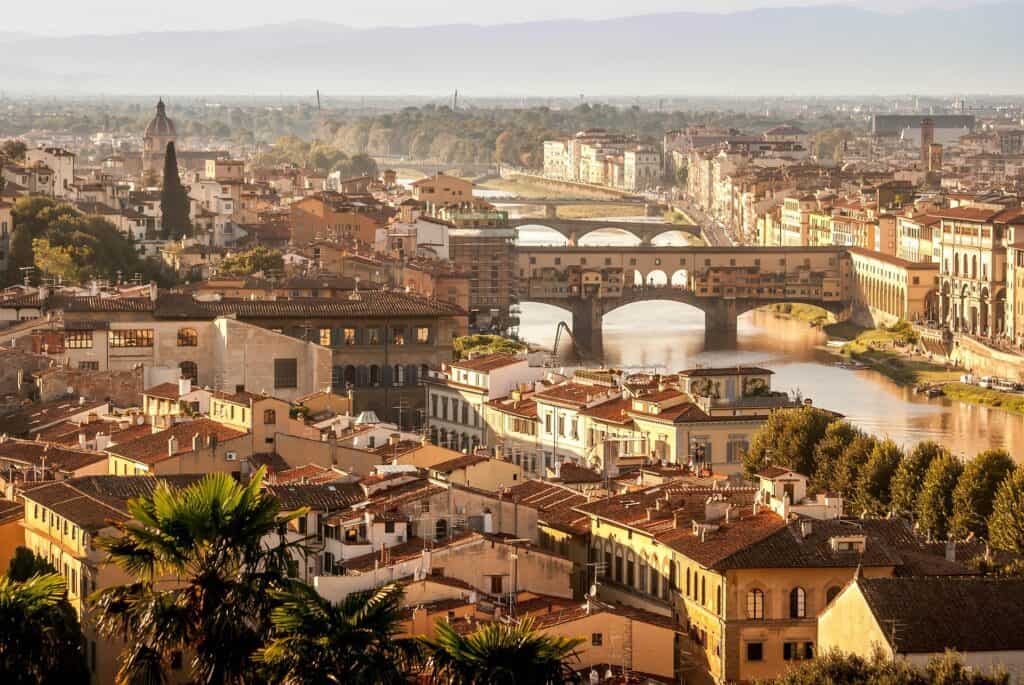
From east to west we find the Ponte alle Grazie, the closest to Santa Croce; then the famous Ponte Vecchio, with its shops suspended over the water; a little further on the refined Ponte Santa Trinita, elegant and light; then the Ponte alla Carraia, which connects the center to the more lived-in Oltrarno area; the Ponte Amerigo Vespucci, wide and open, with a very airy view; and finally the Ponte alla Vittoria, already further away from the medieval heart.
They are not just names on a map. If you cross them one after another, you feel the atmosphere change. The center is more compact, almost enclosed; going west, the city opens up, becoming less touristy and more everyday.
And then there is a historical detail that often surprises: almost all the bridges were destroyed during World War II. The only one spared was the Ponte Vecchio. The others we see today are reconstructions, some very faithful to the originals.
Knowing this changes the way you look at them. They are not just links between two banks, but signs of a city that has managed to rebuild itself.
Ponte Vecchio
It is inevitable to start with it. Although the idea of this journey is to look at all the bridges with the same attention, the Ponte Vecchio remains the reference point. Not only because it is the most photographed, but because it best represents the iconic image of Florence in the world.
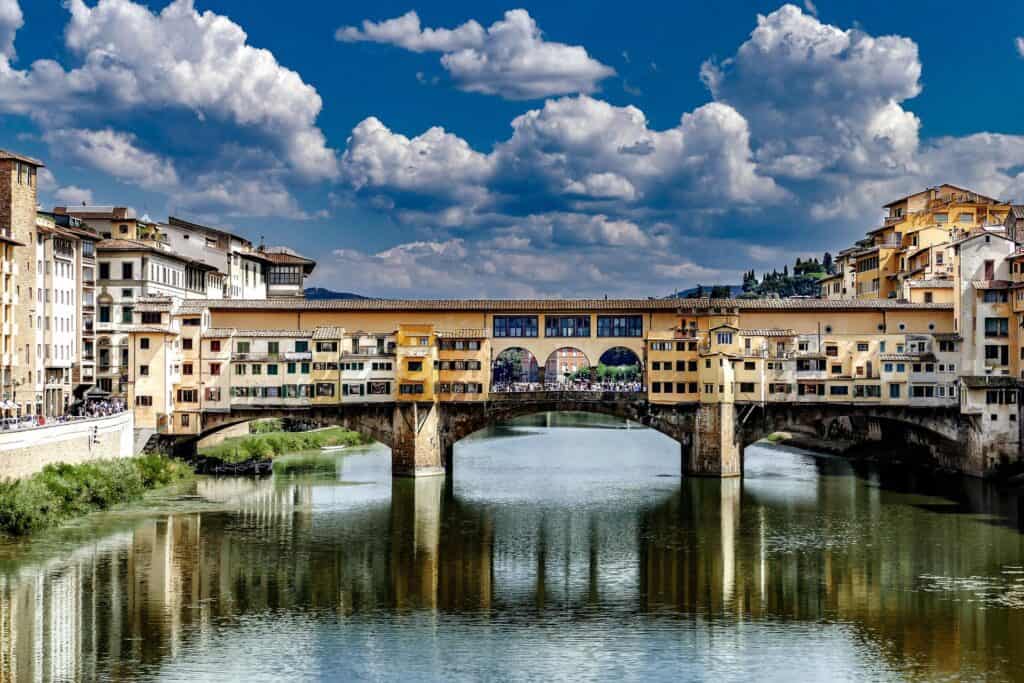
The shops suspended over the Arno, the Vasari Corridor running above the heads of passersby, the feeling of crossing something that has remained almost unchanged over the centuries. It is a bridge that does not just connect two banks: it is a small inhabited street, with its own life.
But there is an interesting aspect that is often lost when observing it only from the front: the most beautiful view of the Ponte Vecchio is not from above, but from the side. In this sense, the other bridges become essential, especially Santa Trinita.
Ponte Vecchio is the protagonist, of course. But to truly appreciate it, you also need to step back a bit.
Ponte Santa Trinita: Elegance and Perfect Perspective
If Ponte Vecchio is the most famous,Ponte Santa Trinita is probably the most elegant. Just crossing it once makes you realize it has something different: lighter lines, harmonious arches, a sense of balance that can be felt even without knowing its history.
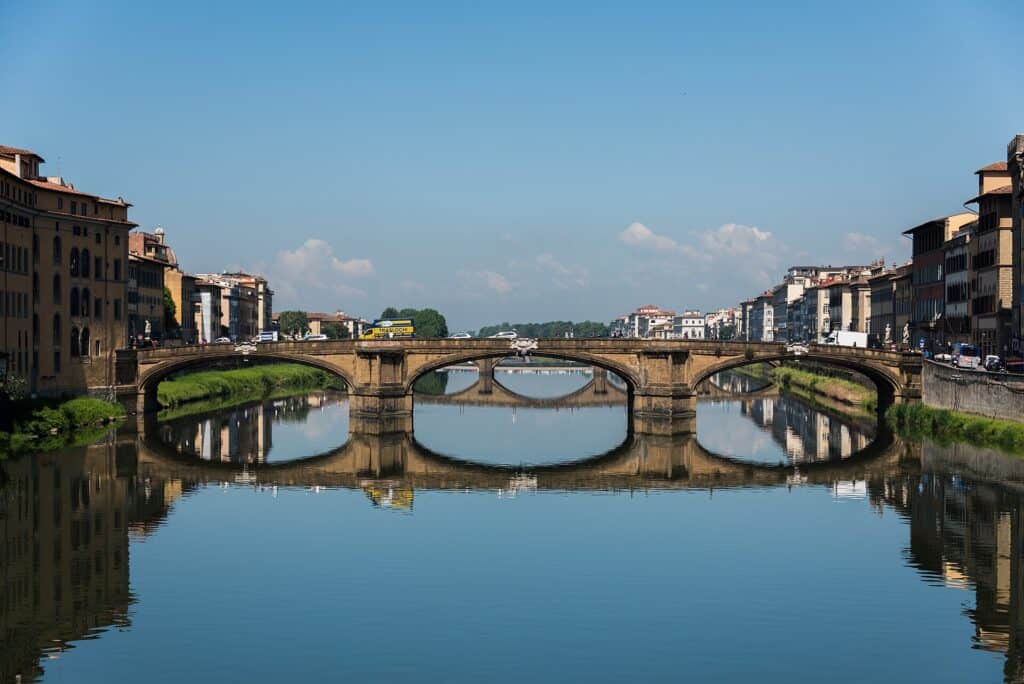
It is a Renaissance bridge, faithfully reconstructed after its destruction during World War II. The original arches were recovered from the bed of the Arno and patiently reassembled, almost like a puzzle. This is also a detail that adds depth to what you are crossing.
But there is a reason why those who live in Florence consider it one of the most beautiful spots in the city: from here you have the perfect view of the Ponte Vecchio. At sunset, with the light descending along the river and coloring the facades of the buildings, the scene is one that stays etched in your memory. It is one of those moments when the city seems to slow down, even though people continue to pass around you.
Ponte Santa Trinita is not just a passage: it is a privileged observation point. And perhaps it is precisely from here that one understands how integral the Arno is to the Florentine scenery.
The Other Bridges: Less Famous, but Part of Daily Life
After Ponte Santa Trinita, the Arno changes rhythm, and with it, the city also changes. The monumental center remains behind, and Florence becomes less of a postcard and more everyday.
The Ponte alla Carraia, for example, is one of those bridges that are often crossed without much thought. Yet it has a long history: there was a passage here in the Middle Ages, which was destroyed several times by the floods of the Arno. The current bridge is a 20th-century reconstruction, but it retains its role as an important link between the historic center and the more lived-in Oltrarno. It is the bridge of people coming and going, of shops, of less polished streets. From here, the Arno appears wider, less framed by monuments. It is a less iconic view, but perhaps more real.
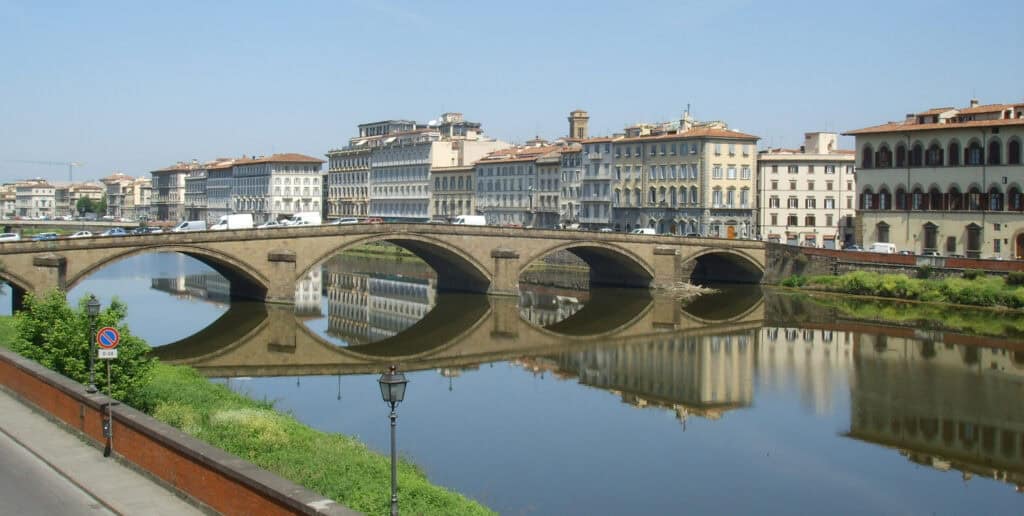
Continuing west, you arrive at the Ponte Amerigo Vespucci. It is wider, more modern in appearance, less burdened by Renaissance history. But precisely for this reason, it offers a different perspective. From here, the width of the river is better perceived, and the city seems to breathe more. It is not the bridge you choose for the postcard photo, but it is one of those that makes you understand how Florence is not just its medieval center.
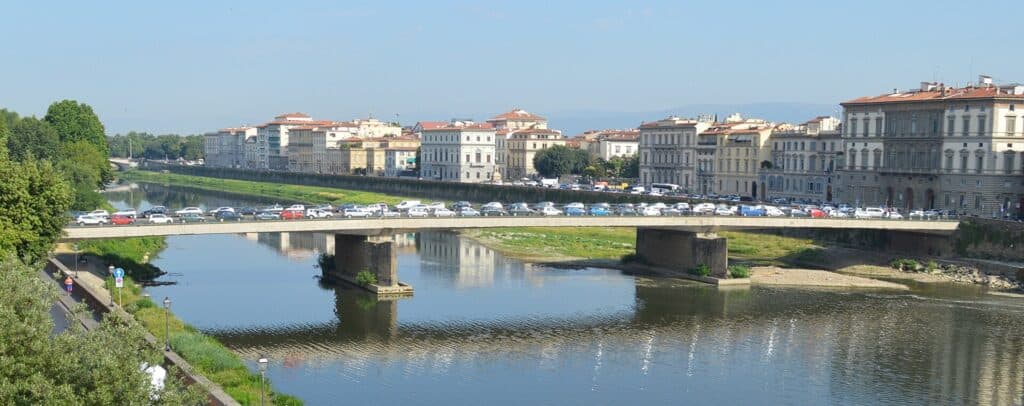
Further along, you encounter the Ponte alla Vittoria, built in the 20th century. It is the farthest from the tourist heart, and you can feel it immediately: fewer visitors, more local traffic, more silence along the banks. It is a functional bridge, of course, but crossing it means stepping out of the Florence that everyone knows and approaching the one that is lived every day.
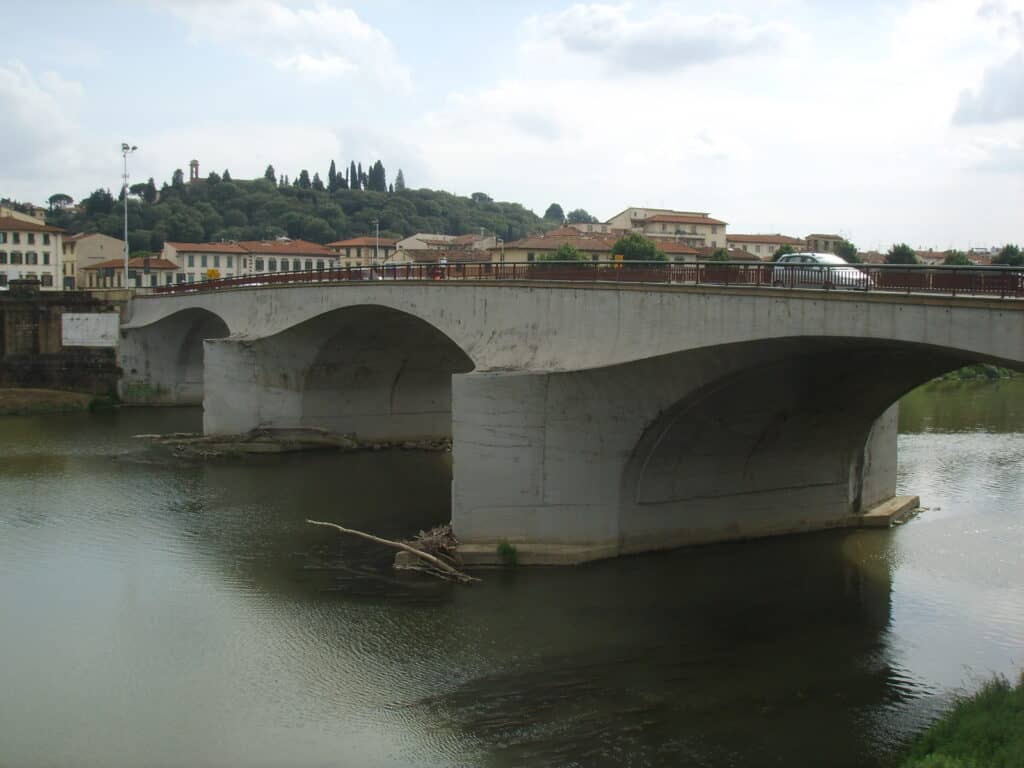
Returning eastward, however, the Ponte alle Grazie deserves a stop. Many cross it heading to Santa Croce without stopping too much, but the view it offers towards the center is surprising. From here, the profile of the Duomo stands out above the rooftops, and the perspective is more open compared to that of Ponte Vecchio. It is one of the points where the dialogue between the river and the city is best perceived.
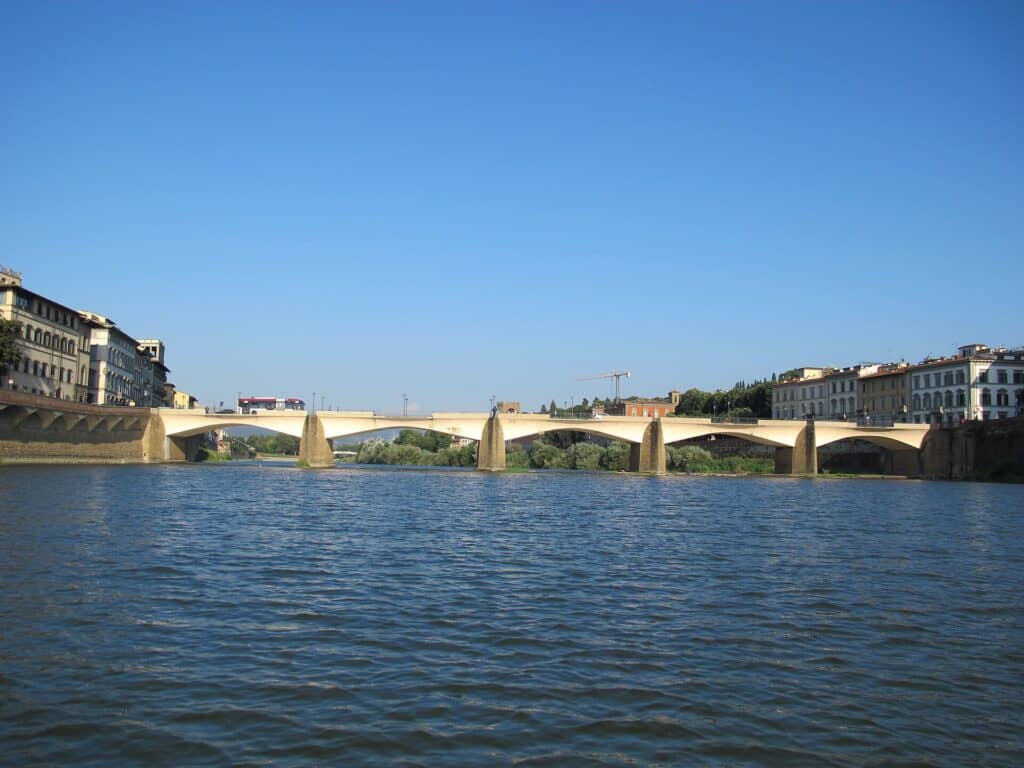
Crossing all these bridges, one after the other, is like reading Florence in sequence. Each crossing slightly changes the angle, the background noise, the light. And slowly you realize that the bridges are not just architectural elements: they are passages of atmosphere.
What Is the Most Beautiful Bridge in Florence?
It is a question that I am often asked, and the answer is never immediate. It depends on the time of day, the light, what you are looking for.
If we talk about recognizability, the Ponte Vecchio has no rivals. It is the one that everyone wants to see at least once, the one that tells the medieval and mercantile Florence in one glance. But it is not necessarily the most elegant, nor the one that offers the best view.
If I had to choose a point from which to observe Florence, I would probably say Ponte Santa Trinita, especially at sunset. From there, the Ponte Vecchio aligns perfectly, the Arno reflects the facades and the city seems almost suspended. It is one of those moments when there is no need to talk much: just stay for a few minutes to observe.
For a broader, less crowded perspective, the Ponte alle Grazie is a surprise. It offers a more open view of the historic center and allows you to better perceive the dialogue between the river and the architectures.
The truth is that there is no “most beautiful” bridge in an absolute sense. Each bridge shows a different side of the city. Crossing them all,
Perhaps on a slow walk along the Arno, it is the best way to get a personal idea.
Ready to discover the bridges of Florence in person?
Florence cannot be understood from just one point of view. And its bridges, more than connecting two banks, connect perspectives.
Crossing them one after the other means seeing Florence slowly transform:
from the medieval heart around the Ponte Vecchio to the broader and everyday dimension of the bridges to the west. It is a simple walk, but capable of telling much more than one might imagine.
The next time you find yourself along the Arno, try not to limit yourself to the most famous bridge. Stop, watch the water flow, observe the palaces reflecting. Often it is precisely from these passages that one captures the most authentic soul of the city.
