

It’s one of the first questions you ask yourself when you start planning your trip: how many nights to book, how many vacation days to set aside, how long to stay in Florence before moving on.
The short answer is that to see the main things it is enough two or three days. But that’s a short answer, because a lot depends on what you’re looking for and how you like to travel. Some people in Florence just want to soak up the atmosphere for a weekend, others head straight for the museums, and others use it as a base for touring Tuscany.
I have been working as a tourist guide in Florence. And I get asked this question almost every day. So, instead of giving you the usual “minimum three days,” I’ll try to explain what you can actually accomplish with one day, two, three, or more time. So, in the end, you can figure out how many days you need.
Can you see Florence in 2 or 3 days?
The short answer is yes. To see the heart of Florence, two or three days are enough. Two will cover the essentials; three will do it without rushing. This is the right amount of time for most people.
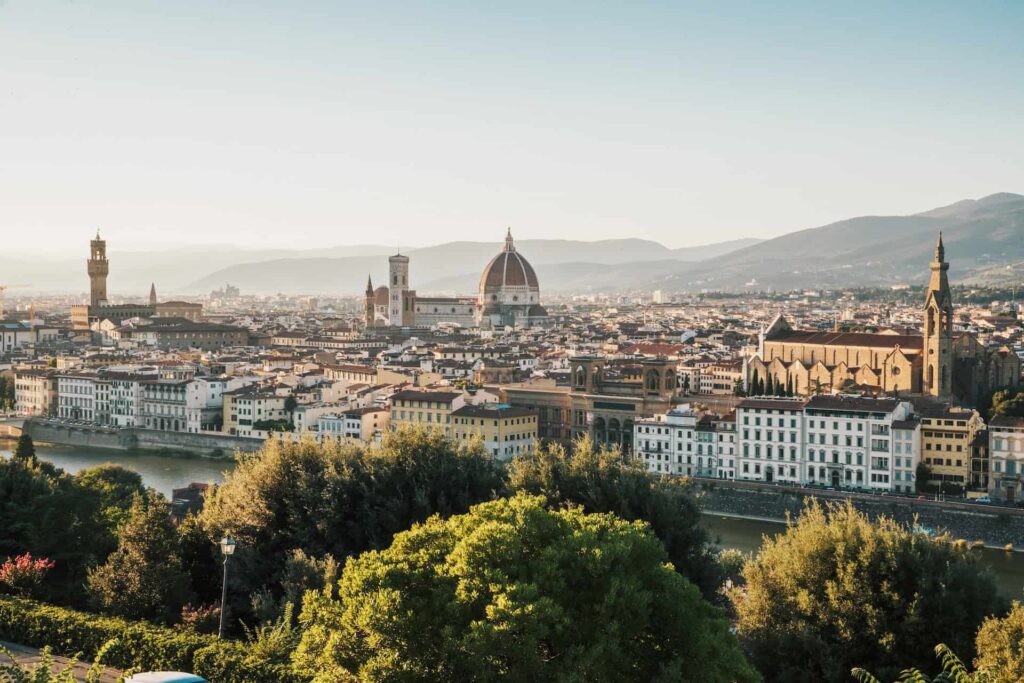
This is because the Florence’s historic center is small overall. From the Duomo to Ponte Vecchio, it’s about a ten-minute walk. Much of what you came to see is within the same radius. The Uffizi Gallery, Piazza della Signoria, the Mercato Nuovo, the Accademia area: it’s all there, within walking distance. You don’t waste time on buses or subways, which is a huge advantage compared to larger, more spread-out cities.
What bothers you, if anything, is not the distances but two less obvious things.
The first one is the code: in front of the Uffizi or the Accademia, during busy periods, you can waste up to an hour before entering.
The second is the tiredness. Florentine museums are dense, concentrated, and packed with things to see. It seems like you can squeeze three into one day, but after the second one your mind is already full and you only half-enjoy the third, if you’re lucky.
For this reason, the number of days doesn’t depend so much on how big Florence is and how long do you want (or can) dedicate to it.Those who try to see everything quickly return home tired and with the feeling of having seen only half of Florence.
What can you see in a single day?
A day in Florence isn’t enough, but it doesn’t mean it’s useless. If you’re passing through, perhaps on your way elsewhere in Tuscany, or if you just want a taste of the city, you’ll still bring something important home.
It’s clear that we have to be realistic. You can’t expect to seeall Florence in just one day. However, you can plan a full day to see the city’s excellent highlights.
In one day, you can see the Duomo from the outside, with its façade and dome imposing themselves as soon as you enter the square. You can even climb Giotto’s Bell Tower for the view, and then walk down to Piazza della Signoria. From there, you’re just steps from the Uffizi Gallery and, just beyond, the Ponte Vecchio. This is the most classic route, and if you keep a good pace, it’s doable in one day.
Obviously you have to choose, of course you can’t do everything. If you go to the Uffizi you spend at least a couple of hours there and you can take those hours off for something else. For this reason, with only one day, my advice is to focus on a single large museum and leave the rest of the time to the city: the squares, the bridges, a stop at the New Market where there is the Porcellino fountain, the Lungarno towards sunset.
What inevitably gets lost is the Oltrarno, the other bank of the Arno, with its shops and less central museums, like the Bargello or Palazzo Pitti. And above all, the time to stop is lost: in a day you walk, look, take photos, but it’s hard to actually sit at a table or wander down a street without thinking.
to the next stage.
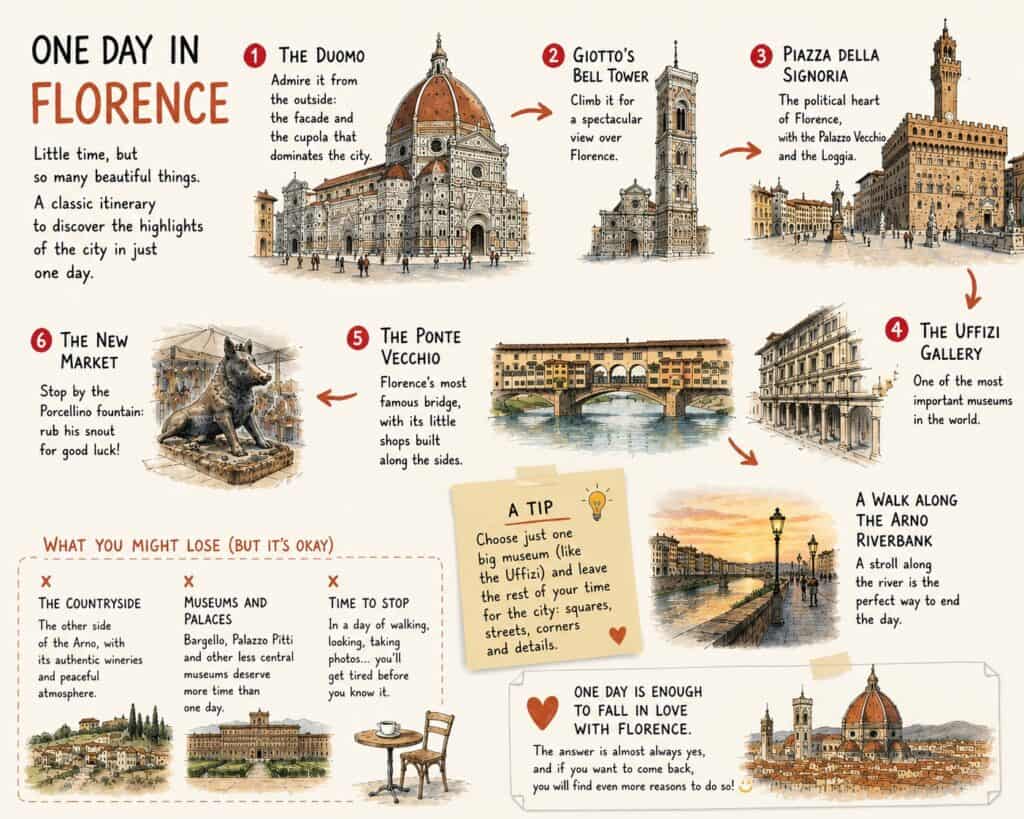
In short, a day is a great way to see if you like Florence. The answer is almost always yes, and it makes you want to come back later. 🙂
Two days: the minimum to avoid rushing.
In two days you can start breathing. It’s the classic weekend format, the minimum that allows you to see the essential without feeling like you’re chasing the clock too much.
With two days at your disposal, you can orient yourself like this.
The Duomo, the Uffizi Gallery, Piazza della Signoria, and Ponte Vecchio are all taken care of on the first day, with the peace of mind of entering a large museum without having to cut it in half. The second day is free for what you would have had to sacrifice in just one day.
A stage that is worth the second day is the Accademia Gallery, where there is the David. The visit is quicker than the Uffizi, but it’s worth expecting a queue or booking your ticket, as it’s one of the busiest museums in the city.
The other thing not to be missed is the Oltrarno, the bank of the Arno River on the other side of the Ponte Vecchio. Just cross the bridge and you enter a quieter Florence, filled with artisan workshops, squares like Santo Spirito, and a less touristy atmosphere. It’s the part of the city that those who stay only one day almost never see, but that on the second day is just fine!
If you have time left towards evening, go up to Piazzale Michelangelo, which you can reach on foot or by bus. From up there, you can see Florence in its entirety, with the Duomo’s dome rising above the rooftops.
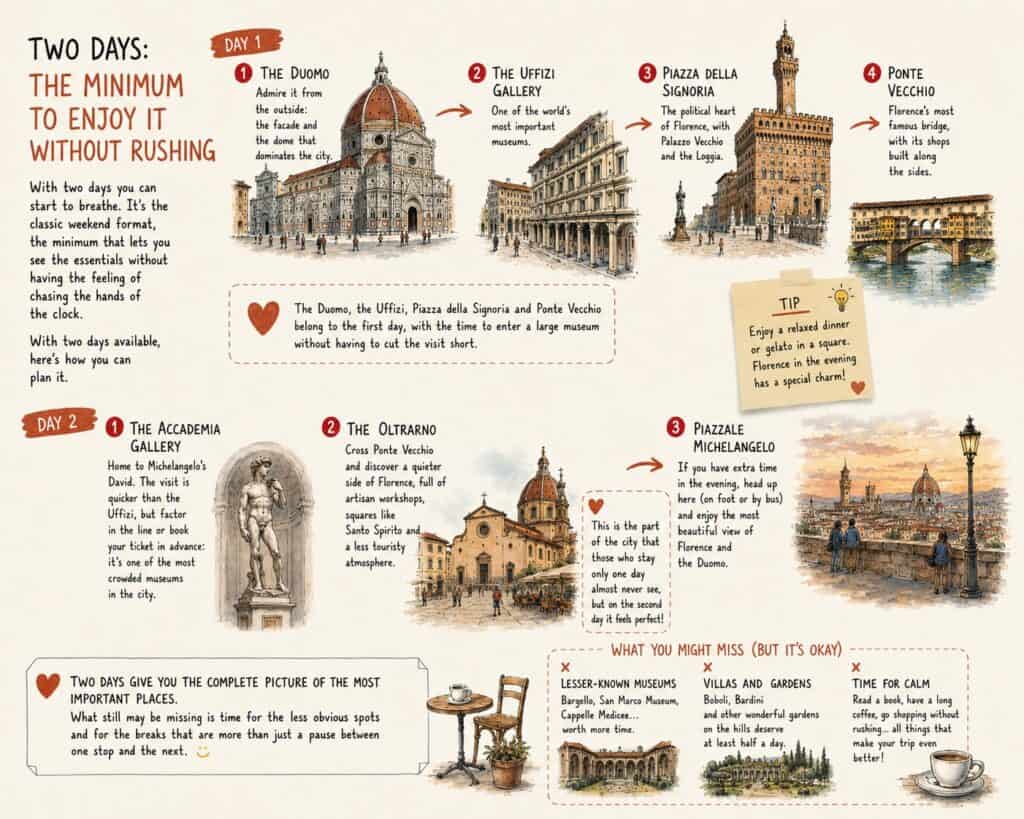
Two days give you a complete picture of the most important things. What’s still missing is time for the less obvious places and for breaks that aren’t just a stop between stops.
Three days: the balance point
When it comes to visiting Florence, three is pretty close to the perfect number.
It’s the time that allows you to see the important things, to add some less obvious ones and, above all, to not experience the visit as a list to check off.
The third day makes the difference. With the first two, you’ve already covered the city center, a couple of large museums, and the Oltrarno. The third day gives you a head start: you can return to a place you liked, pop into a museum you’d missed, or simply slow down and enjoy Florence.
This is where the places that those in a hurry always skip come into play. The Bargello Museum, for example: full of Renaissance sculptures and much less crowded than the Uffizi, it’s one of those places where you can still stand in front of a work of art without the crowds behind you.
Not far away are the Medici Chapels, near the Church of San Lorenzo, where you can see up close the bond between the Family that created Florence and the artists who worked there.
And if you enjoyed the Oltrarno, the Brancacci Chapel is worth the trip alone: the frescoes inside have influenced generations of painters, yet it is a secluded place, nothing like the crowds of the more famous museums.
None of these are “first-time visitors to Florence” stops. They’re exactly the kind of places that make a visit more personal, less like everyone else’s.
And then there’s the part you really can’t afford with a day or two: downtime, the good kind. A leisurely morning at the market, a long lunch, a wandering stroll along the Arno. Florence can be enjoyed like this, too, not just in its museums.
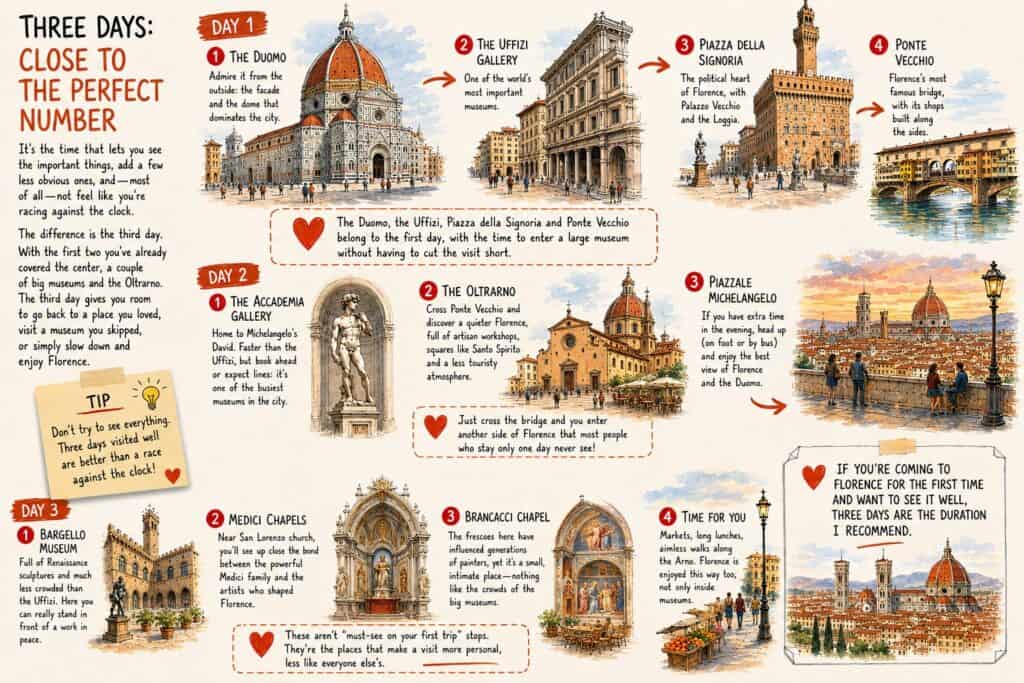
For this reason, if you’re coming to Florence for the first time and want to visit it thoroughly, three days is the length of time I recommend.
Four days or more: when does it make sense to stay longer?
Beyond three days, things change. If you decide to stay longer, it’s usually for one of two reasons: either you want to delve deeper into the museums, or you want to use Florence as a base to visit Tuscany.
If you want to delve deeper into museums
This is for those who love Really Art. Florence has nearly a hundred museums, and the three or four most famous are just the tip of the iceberg.
With a week, you can take the time to visit places like the San Marco Museum, the Pitti Palace with its apartments and galleries, and the Opera del Duomo. These are places you simply can’t visit in three days, as each one requires hours and concentration.
If you want to use Florence as a base for Tuscany
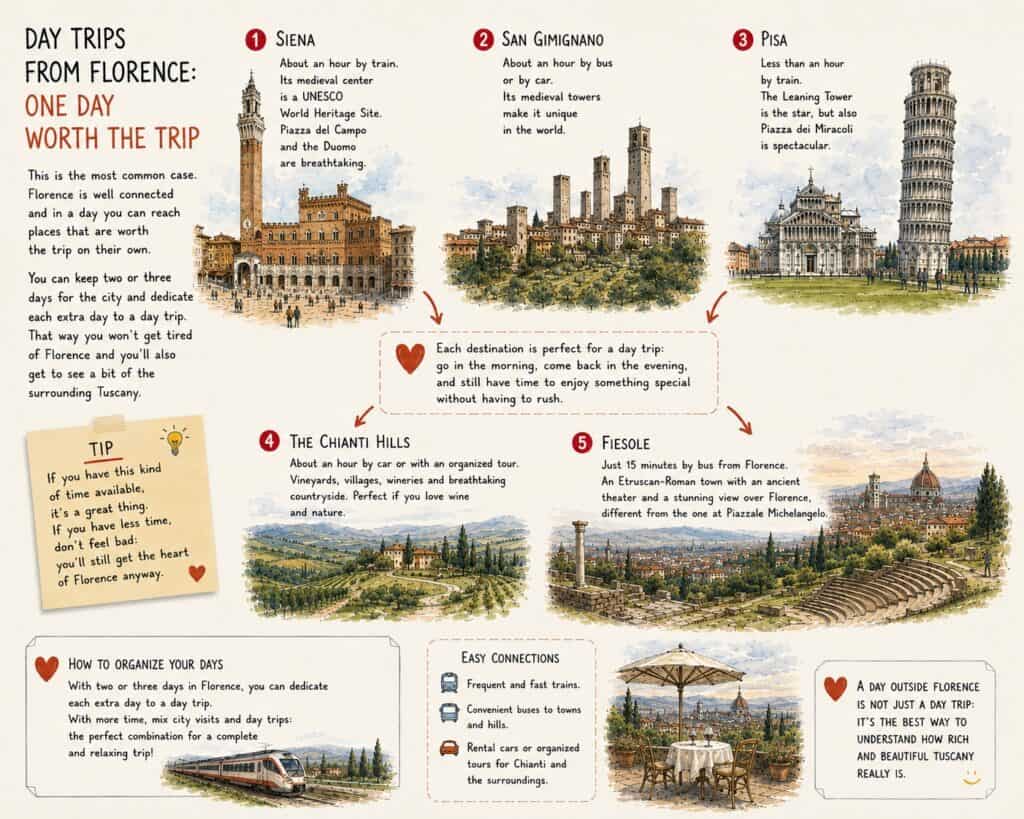
This is the most common case. Florence is well-connected, and within a day you can reach places that are worth the trip in themselves. Siena and San Gimignano, with their medieval towns. Pisa, less than an hour away by train. The Chianti hills, if you like wine and scenery. Or even just Fiesole, which is a quarter of an hour away by bus and offers a view of Florence from above that’s different from the one from Piazzale Michelangelo.
You can spend two or three days exploring the city and dedicate each extra day to an excursion outside. This way, you won’t tire of Florence and you can also see a bit of the surrounding Tuscany.